
What Tires for Off-Road Use on a Toyota RAV4? A Guide
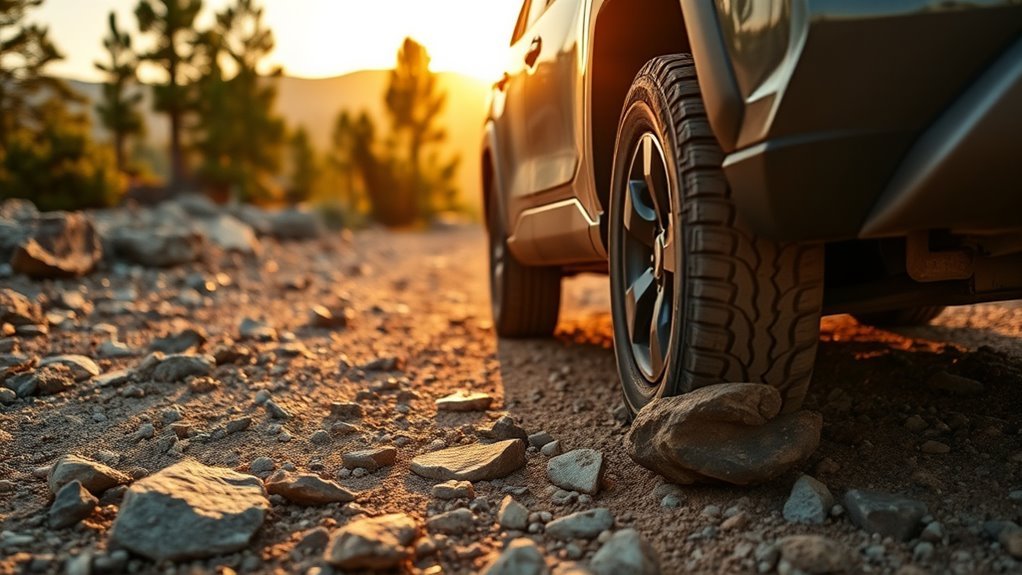
For light off-road driving in a Toyota RAV4, the safest upgrade is not the biggest tire you can squeeze under the fenders. It is a properly sized crossover-focused all-terrain tire that matches your exact year, trim, wheel size, load rating, and speed rating. Good choices include the Falken Wildpeak A/T Trail, BFGoodrich Trail-Terrain T/A, and Yokohama Geolandar A/T G015, but fitment must be verified against your door-jamb tire placard before buying.
Quick Answer
The best all-terrain tire for a Toyota RAV4 is a CUV/SUV all-terrain in your factory size, such as Falken Wildpeak A/T Trail, BFGoodrich Trail-Terrain T/A, or Yokohama Geolandar A/T G015. Pick by terrain, then confirm tire size, load index, speed rating, and wheel-well clearance before installation.
Key Takeaways
- Do not assume one universal RAV4 tire size. Check the driver-door placard, current sidewall, owner’s manual, and wheel size before ordering.
- Choose a crossover all-terrain, not a heavy mud-terrain, if your RAV4 still sees daily commuting and highway miles.
- Expect more road noise, extra tire weight, and a possible fuel-economy drop compared with highway all-season tires.
- Rotate every 5,000–7,500 miles, check pressure monthly, and inspect for cuts or rubbing after trail use.
At a Glance
| Time Required | 30–60 minutes to choose the right tire; 1–2 hours for professional mounting, balancing, TPMS check, and alignment inspection. |
| Difficulty | Moderate. Tire selection is DIY-friendly, but installation, balancing, and alignment should be handled by a tire professional. |
| Tools Needed | Door-jamb tire placard, current tire sidewall, tire-pressure gauge, tread-depth gauge, and a tire shop that can check clearance at full steering lock. |
| Cost | Moderate. Total cost varies by tire size, tire model, mounting, balancing, TPMS service, alignment needs, and local labor rates. |
Quick Recommendation: Best All-Terrain Tires for RAV4 and Why
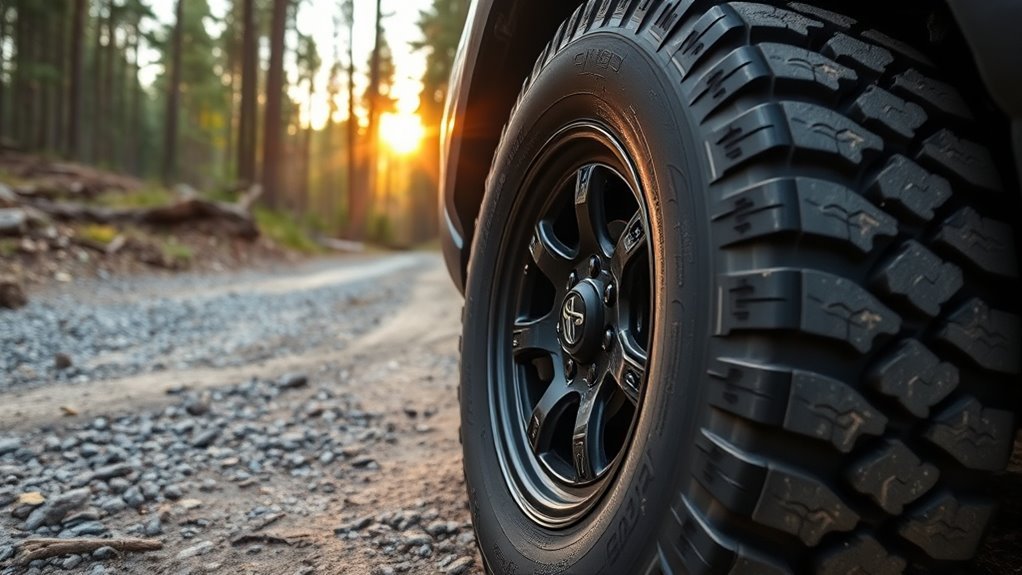
Three strong all-terrain choices for a Toyota RAV4 are the Falken Wildpeak A/T Trail, BFGoodrich Trail-Terrain T/A, and Yokohama Geolandar A/T G015. They are better matched to a RAV4 than heavy truck mud-terrains because they focus on gravel-road grip, light trail traction, snow-rated options, highway comfort, and daily drivability.
The Falken Wildpeak A/T Trail is the best first look for many RAV4 owners who want a more aggressive tread without turning the SUV into a loud trail toy. Falken lists it with a 65,000-mile limited tread life warranty and 3PMSF severe snow service rating. The BFGoodrich Trail-Terrain T/A is a balanced pick for owners who want a quiet ride with more loose-surface traction than a standard highway tire. The Yokohama Geolandar A/T G015 is another proven all-terrain option with all-weather traction, highway manners, and up to a 60,000-mile limited treadwear warranty on P-metric and Euro-metric sizes.
A good RAV4 all-terrain tire should improve grip on dirt, gravel, snow, and rutted access roads without making the vehicle feel unstable, noisy, or oversized on pavement.
| Tire Model | Best For | Main Tradeoff |
|---|---|---|
| Falken Wildpeak A/T Trail | Daily driving plus gravel, light trails, rain, and snow-rated traction | Slightly firmer, heavier feel than a highway all-season |
| BFGoodrich Trail-Terrain T/A | Comfort-focused drivers who still want dirt-road and loose-surface grip | Not a deep-mud tire |
| Yokohama Geolandar A/T G015 | All-weather use, mild off-road driving, and long highway trips | Less aggressive than dedicated mud-terrain designs |
[Products Worth Considering]
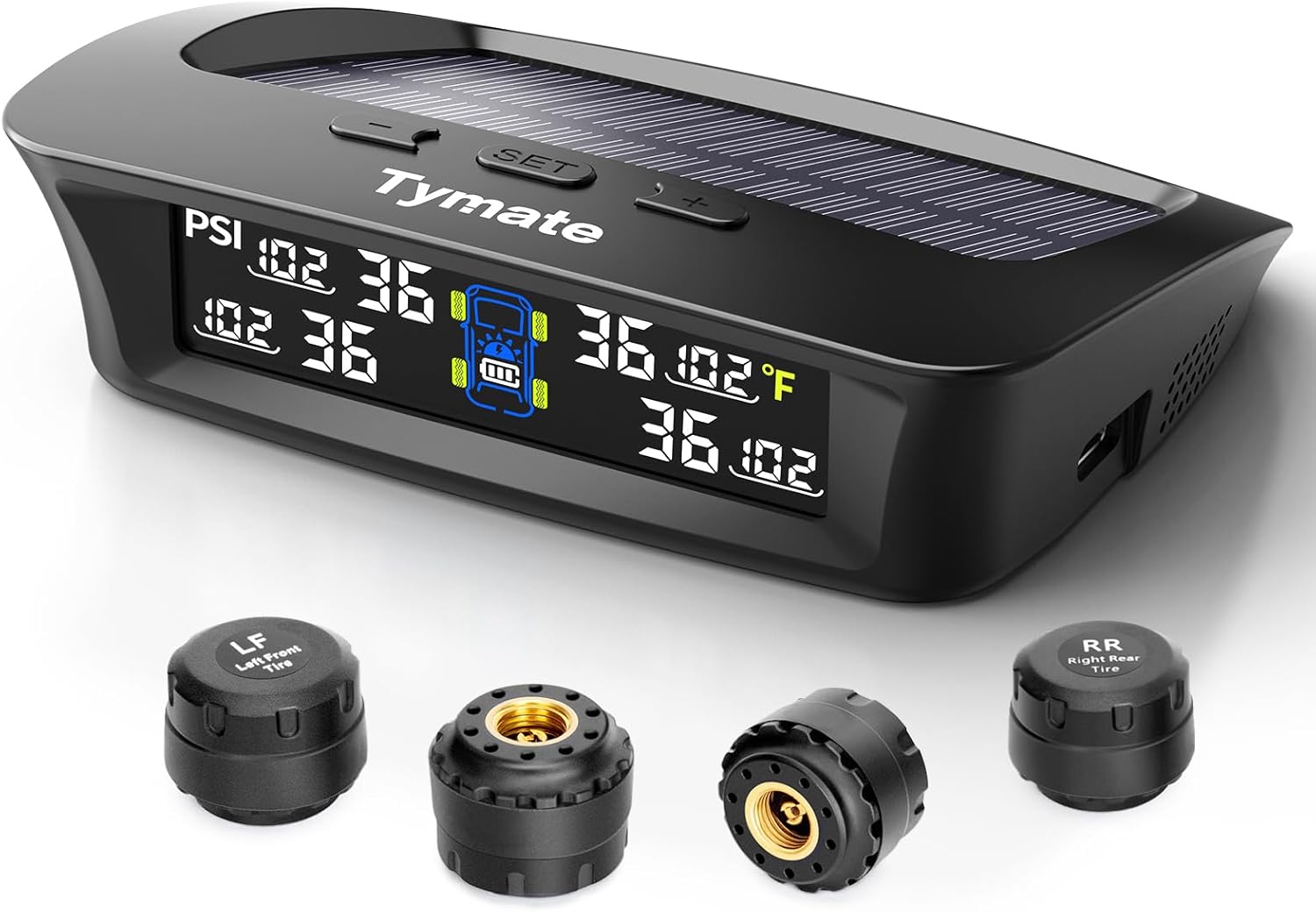
The Tymate TM3 RV TPMS delivers real-time tire pressure monitoring from 0 to 144 PSI with accurate readings and dependable wireless communication. It includes four external sensors with pre-pairing, six alarm modes for rapid leak, pressure extremes, temperature, and signal loss, plus an easy-reference setup for alert thresholds. Solar and USB-C charging help keep the display powered, while the color LCD and adaptive backlight improve visibility for safer driving and towing.

EVOULTES heavy duty tire inflator with an integrated gauge delivers accurate pressure readings from 10–120 PSI, helping you inflate, deflate, and check tires in one tool. The 16.5-inch extended dual-head air chuck with swivel base reaches hard-to-access dual wheel valves on trucks and RVs. A brass trigger core and side-mounted air release valve make operation smooth, with standard 1/4" NPT threading and quick-connect compatibility for easy setup.

The JACO FlowPro Tire Inflator measures, inflates, and airs down tires up to 100 PSI with battery-free operation and ±2% accuracy after calibration. It features a glowing pressure dial for night visibility, a heavy-duty steel build with a hybrid hose, and a precision push-to-inflate thumb trigger. The patented Lightning Air Chuck locks on for a secure seal, and the kit includes quick-connect hardware for easy inline use with your air compressor.
Match Tires to Off-Road Use: Trail, Mud, Gravel, Snow, and Overland
Start with where your RAV4 actually goes. A tire that feels great on a forest road may feel heavy and noisy on a daily commute. A tire that looks tough in a parking lot may still be the wrong choice if it overloads the RAV4’s suspension, rubs the liner, or drops fuel economy too much.
- Gravel roads and fire roads: Choose a mild all-terrain with good chip resistance, stable tread blocks, and comfortable highway manners. This is the best match for most RAV4 owners.
- Light trails, roots, and ruts: Pick a CUV/SUV all-terrain with stronger shoulders and a more open tread pattern. Keep the size close to factory unless a professional confirms clearance.
- Snowy roads: Look for the 3PMSF symbol if you want better packed-snow traction than a basic all-season. A 3PMSF all-terrain is helpful, but a dedicated winter tire is still better for severe ice and deep winter conditions.
- Mud: Avoid deep mud in a RAV4. A crossover all-terrain can handle muddy access roads, but it is not a mud-bogging tire. A true mud-terrain adds noise, rolling resistance, weight, and wet-pavement tradeoffs.
- Overlanding and camping: Prioritize puncture resistance, predictable highway behavior, and easy replacement availability in your actual tire size.
Warning: Do not install oversized tires because they “look right” online. A tire that rubs at full steering lock, compresses into the fender liner, or fails to meet the required load and speed rating can create steering, braking, warranty, and safety problems.
Fit & Sizes for RAV4: Wheel Clearance, Tire Size, OEM vs Aftermarket
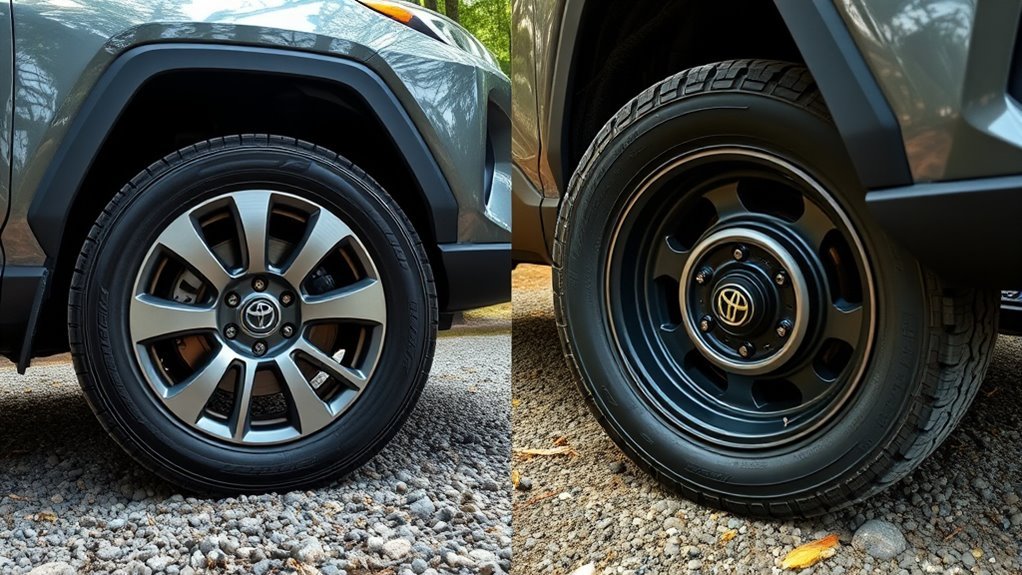
The most important RAV4 tire rule is simple: match the tire to your exact vehicle, not to a generic RAV4 size list. Recent RAV4 trims can use different factory wheel and tire sizes, and newer model years can change again. Before buying, compare three things: the tire placard on the driver-side door jamb, the size printed on your current tire sidewall, and the size of the wheel you plan to keep.
The tire placard and owner’s manual are also where you confirm cold inflation pressure. FuelEconomy.gov notes that the correct vehicle pressure is usually found on the driver-side door sticker or in the owner’s manual, and that proper inflation helps fuel economy, safety, and tire life. Use that vehicle pressure as your starting point, not the maximum pressure printed on the tire sidewall.
Safe Fitment Checklist Before Buying
- Confirm the exact tire size: Read the door placard and your current sidewall. Do not assume 255/65R17 is OEM for your RAV4.
- Match or exceed load index: The replacement tire must safely carry the vehicle’s rated load.
- Use an appropriate speed rating: Do not downgrade speed rating without professional approval.
- Check wheel width: The tire must be approved for the rim width on your RAV4 wheels.
- Verify clearance: Ask the installer to check inner fender, strut, suspension, brake-line, and mud-flap clearance at full steering lock.
- Recheck after driving: Inspect for shiny rub marks, plastic liner contact, vibration, or pulling after the first 25–50 miles.
Note: If your RAV4 has AWD or hybrid components, stay conservative with tire diameter changes. Large differences in rolling diameter can affect speedometer readings, traction-control behavior, and drivability.
Top All-Terrain Picks by Use Case: Fuel Economy, Traction, Wear
All-terrain tires trade some highway efficiency for more bite on loose surfaces. That tradeoff can be worth it if you regularly drive gravel, dirt roads, snowy access roads, campsites, or mild trails. It is less useful if your RAV4 spends nearly all its time on clean pavement.
| Your Priority | Best Direction | Why It Fits a RAV4 |
|---|---|---|
| Best daily-driver balance | Falken Wildpeak A/T Trail or Yokohama Geolandar A/T G015 | Good mix of highway comfort, snow-rated options, and light-trail durability |
| Quietest mild all-terrain feel | BFGoodrich Trail-Terrain T/A | Designed for on-road comfort with more trail confidence than a standard touring tire |
| Snowy dirt roads | Choose a 3PMSF-rated all-terrain in your correct size | Better packed-snow confidence than a basic all-season, while staying usable year-round |
| Maximum mud appearance | Usually avoid for a RAV4 | Mud-terrains are louder, heavier, less efficient, and often overkill for a crossover |
Load Rating, Speed Rating, and 3PMSF: Details That Matter
Tread pattern gets the attention, but the small numbers on the sidewall matter just as much. The load index tells you how much weight the tire can carry. The speed rating tells you the tire’s certified speed capability. A replacement tire should meet or exceed the original equipment requirements unless a tire professional confirms a safe alternative.
The 3PMSF marking is useful if you drive in winter weather. Falken, BFGoodrich, and Yokohama all offer all-terrain products with severe snow service ratings in selected sizes or models. That does not make every all-terrain tire a winter tire, and it does not guarantee strong ice performance. If your RAV4 regularly sees ice, mountain passes, or deep winter storms, a dedicated winter tire may still be the safer seasonal choice.
Pro Tip: If two all-terrain tires fit your RAV4, choose the lighter one when your use is mostly commuting, rain, gravel, and snow. Lower tire weight usually feels better in braking, acceleration, steering response, and fuel economy.
[Products Worth Considering]

This portable cordless tire inflator delivers fast, efficient inflation for cars, motorcycles, bikes, and sports balls with a digital pressure gauge. Use the one-click PSI preset with auto shut-off for accurate, hands-free topping to your target pressure up to 150 PSI. It’s compact and rechargeable with a built-in emergency LED light plus valve adapters and accessories for quick, ready-to-go use.
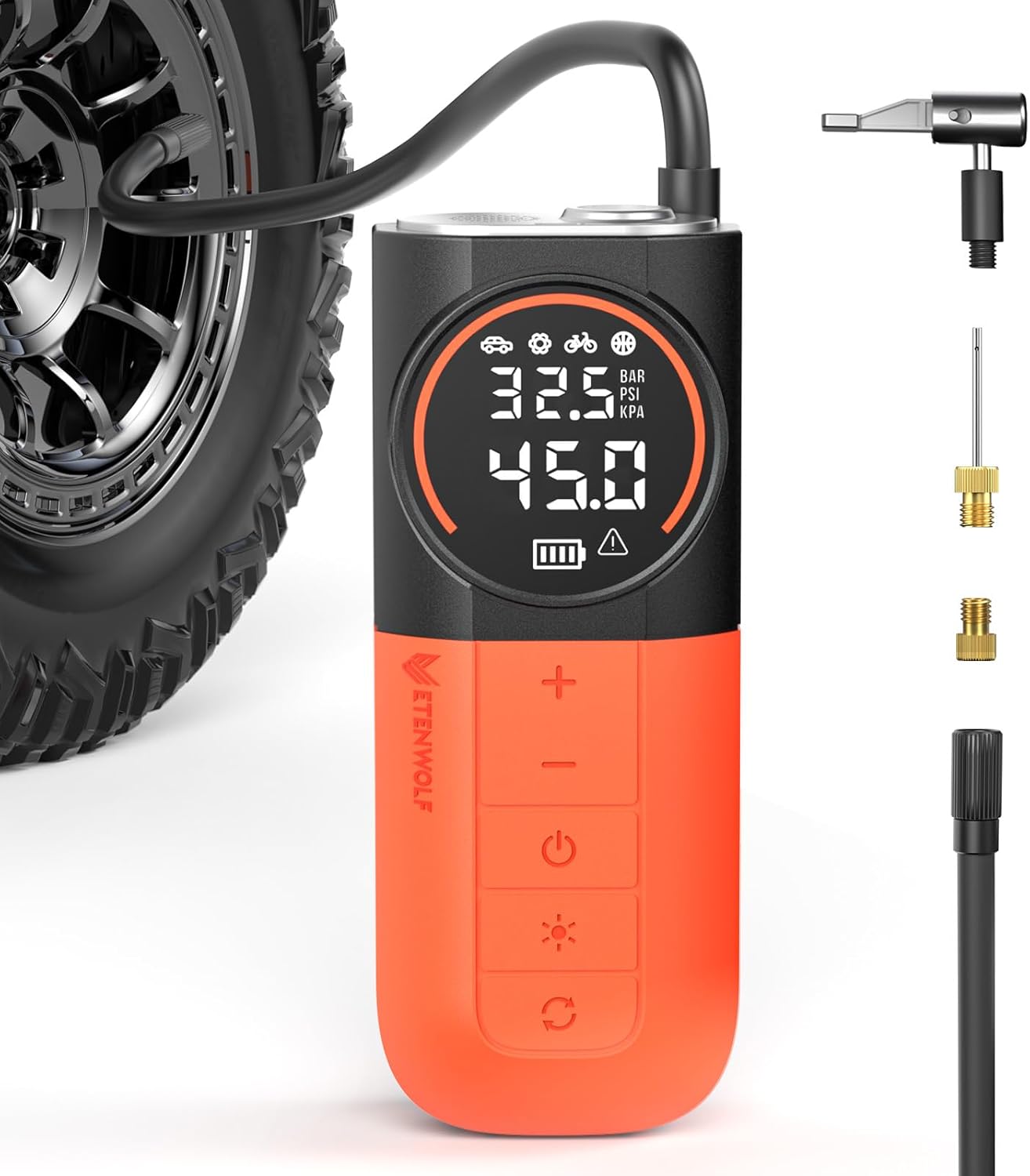
The ETENWOLF S1 cordless tire inflator delivers ultra-fast inflation with up to 160 PSI and a 20 L/min airflow for quicker tire top-offs. Its 5200mAh battery and cooling system support inflating many tires and sports balls on a single charge, while the digital pressure gauge and multi-unit display help you reach the right pressure accurately. With preset modes, pressure memory, an auto-stop feature, and an LED flashlight, it’s built for easy roadside and everyday use.
Installation & Maintenance for RAV4 All-Terrain Tires
Have the tires mounted and balanced by a shop that will also check TPMS function, lug-nut torque, clearance, and alignment. Toyota scheduled maintenance guidance recommends rotating tires every 5,000 to 7,500 miles, with the best interval depending on driving habits and road surfaces. If you drive rough gravel, washboard roads, or trails often, stay closer to the 5,000-mile end.
Pressure matters too. FuelEconomy.gov says properly inflated tires can improve gas mileage by 0.6% on average and up to 3% in some cases, while underinflation can reduce mileage by about 0.2% for every 1 psi drop in the average pressure of all tires. Check pressure when the tires are cold, then use the RAV4 placard pressure as the baseline unless your tire professional recommends a specific adjustment for a non-factory size.
Longevity Checklist
- Rotate: Every 5,000–7,500 miles, or sooner if you see uneven wear.
- Pressure check: Monthly and before long trips or trail weekends.
- Alignment check: After installation, suspension work, curb hits, pothole impacts, or any pull to one side.
- Tread check: Inspect across the full tread width, not just the outside shoulder.
- Sidewall check: Look for cuts, bulges, exposed cords, punctures, or impact bubbles after off-road use.
- Balance check: Rebalance if vibration appears at highway speed.
Troubleshooting RAV4 All-Terrain Tire Problems
If the RAV4 feels worse after the tire upgrade, do not ignore it. Most problems come from size, balance, pressure, alignment, or clearance.
| Symptom | Likely Cause | Fix |
|---|---|---|
| Rubbing when turning | Tire too wide/tall, mud flap contact, or liner contact | Have the shop check full-lock clearance and suspension compression; downsize if needed. |
| Highway vibration | Balance issue, tire uniformity issue, or bent wheel | Road-force balance and inspect wheels. |
| Pulling to one side | Alignment, uneven pressure, or tire conicity | Set cold pressure, rotate side-to-side if allowed, and align. |
| Louder road hum | More aggressive tread blocks | Confirm pressure and alignment; choose a milder AT next time if highway comfort matters most. |
Frequently Asked Questions
Is the Toyota RAV4 good for off-roading?
The RAV4 is good for light to moderate off-road use, such as gravel roads, snow-covered access roads, forest roads, campsites, and mild trails. Toyota’s RAV4 lineup offers crossover capability and available AWD-focused features, but it is not built for deep mud, rock crawling, or heavy recovery situations.
Can you modify a RAV4 for off-road driving?
Yes, but keep the build realistic. The most useful RAV4 upgrades are properly sized all-terrain tires, skid plates, mild suspension lift from a reputable kit, recovery boards, better lighting, and a full-size spare strategy. Avoid extreme tire sizes or drivetrain claims that do not match how the RAV4 is engineered.
What is the difference between on-road tires and off-road all-terrain tires?
On-road tires usually prioritize low noise, smooth ride, wet braking, and fuel economy. All-terrain tires use stronger tread blocks, more void area, and tougher construction for dirt, gravel, light mud, and rough surfaces. The tradeoff is usually more noise, more weight, and slightly lower efficiency.
Can I put 255/65R17 tires on a Toyota RAV4?
Do not assume 255/65R17 is a safe RAV4 fit. It is not a universal factory size and may be too tall or wide for many RAV4 trims without rubbing or other side effects. Use your door placard and current sidewall as the starting point, then have a tire professional confirm clearance, load rating, speed rating, and wheel compatibility.
Will all-terrain tires hurt RAV4 fuel economy?
They can. All-terrain tires often weigh more and have higher rolling resistance than highway tires. The exact change depends on size, tread pattern, tire weight, pressure, driving speed, and alignment. Keeping tires properly inflated helps reduce the fuel-economy penalty.
Do I need 3PMSF all-terrain tires for a RAV4?
Choose 3PMSF-rated all-terrain tires if you drive in snow, mountain weather, or cold mixed conditions and want one tire set for year-round use. For frequent ice, deep snow, or severe winter commuting, dedicated winter tires are still the stronger choice.
Conclusion
The best Toyota RAV4 all-terrain tire is the one that fits correctly first and performs aggressively second. Choose a crossover-focused all-terrain in the correct factory-compatible size, confirm load and speed ratings, and avoid oversized or heavy mud-terrain tires unless a qualified installer verifies every clearance and safety detail. With the right tire, regular rotation, proper pressure, and alignment checks, your RAV4 can gain useful off-road confidence without giving up the daily comfort that makes it practical.
Sources
- Toyota Crossovers & Compact SUVs — RAV4 capability and ground-clearance context.
- Toyota Scheduled Maintenance Guide — tire rotation interval guidance.
- Falken Wildpeak A/T Trail — tire features, 3PMSF rating, and limited tread life warranty.
- BFGoodrich Trail-Terrain T/A — tire features, comfort positioning, and limited warranty.
- Yokohama Geolandar A/T G015 — 3PMSF rating, on/off-road traction features, and treadwear warranty.
- FuelEconomy.gov Gas Mileage Tips — tire pressure and fuel-economy impact.

Related Articles

Toyota RAV4 TPMS Reset: Easy Steps That Work
Unlock the secrets to resetting your Toyota RAV4's TPMS effortlessly—discover the essential steps to ensure your tires are always safe.
Read More
Toyota RAV4 Tire Rotation: DIY Steps & Pattern
Take control of your Toyota RAV4's tire maintenance with our simple DIY rotation guide—discover the best steps for optimal performance and longevity!
Read More
Mix Tire Brands on a Toyota RAV4? Expert Guide
Keeping your RAV4 safe? Learn when mixing tire brands risks traction, ABS/TCS and AWD damage — and what exact matches you must insist on.
Read More