
7 Tire Care Tips Every Honda Accord Owner Should Follow

Good tire care helps your Honda Accord brake, steer, ride, and use fuel the way it should. You do not need special tools for the basics, but you do need a steady routine: check cold tire pressure monthly, inspect tread and sidewalls, rotate tires on schedule, and get vibration or pulling checked before it turns into uneven wear.
Quick Answer
For Honda Accord tire care, check cold tire pressure at least once a month, use the PSI on the driver-side door placard, inspect tread and sidewalls, rotate tires about every 5,000 to 8,000 miles if recommended, and schedule balancing or alignment when you feel vibration, pulling, or see uneven wear.
Key Takeaways
- Use the Honda tire placard or owner’s manual for the correct cold PSI, not the maximum PSI printed on the tire sidewall.
- Check tire pressure and tread depth monthly, including the spare tire if your Accord has one.
- Rotate tires around every 5,000 to 8,000 miles when your tire size and Honda guidance allow it.
- Get balancing checked for vibration and alignment checked for pulling, off-center steering, pothole impacts, or uneven wear.
- Replace tires at 2/32 inch tread depth, or sooner if you see bulges, exposed cords, cracks, repeated pressure loss, or poor wet-road grip.
At a Glance
| Time Required | 5 to 10 minutes for a pressure and tread check; 30 to 60 minutes for professional rotation, balancing, or alignment service. |
| Difficulty | Easy for inspections and pressure checks; professional service recommended for balancing, alignment, tire repair, and mounting. |
| Tools Needed | Tire pressure gauge, air compressor, penny or tread-depth gauge, flashlight, gloves, and your Honda tire placard or owner’s manual. |
| Cost | Pressure and tread checks are usually free after you own a gauge; shop costs vary for rotation, balancing, alignment, repair, or replacement. |
Understanding the Importance of Tire Care for Your Honda Accord
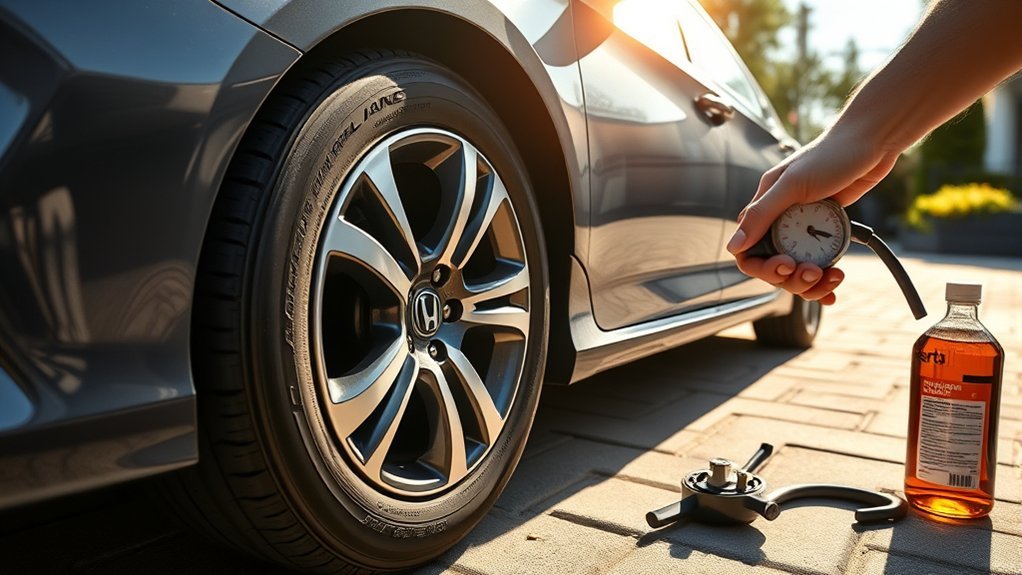
Your tires are the only parts of your Accord that touch the road. When they are underinflated, worn, damaged, or out of alignment, braking distance, steering response, ride comfort, and fuel economy can all suffer. The National Highway Traffic Safety Administration says poor tire maintenance, including low air pressure and missed rotations, can lead to flats, blowouts, or tread separation.
Tire care is also a money issue. FuelEconomy.gov says keeping tires inflated to the proper pressure can improve gas mileage by 0.6% on average, and underinflated tires can lower gas mileage by about 0.2% for every 1 psi drop in the average pressure of all tires. That makes a simple pressure check one of the easiest ways to protect both your Accord and your budget.
NHTSA reported 511 traffic fatalities in tire-related crashes in 2024, which is a reminder that tire maintenance is a real safety issue, not just a comfort item.
[Products Worth Considering]

EVOULTES heavy duty tire inflator with an integrated gauge delivers accurate pressure readings from 10–120 PSI, helping you inflate, deflate, and check tires in one tool. The 16.5-inch extended dual-head air chuck with swivel base reaches hard-to-access dual wheel valves on trucks and RVs. A brass trigger core and side-mounted air release valve make operation smooth, with standard 1/4" NPT threading and quick-connect compatibility for easy setup.

The JACO FlowPro Tire Inflator measures, inflates, and airs down tires up to 100 PSI with battery-free operation and ±2% accuracy after calibration. It features a glowing pressure dial for night visibility, a heavy-duty steel build with a hybrid hose, and a precision push-to-inflate thumb trigger. The patented Lightning Air Chuck locks on for a secure seal, and the kit includes quick-connect hardware for easy inline use with your air compressor.

This portable cordless tire inflator delivers up to 160 PSI with fast 17 L/min airflow to help you quickly top up tires and get back on the road. It features dual power mode, running on a 21V rechargeable battery or a 12V DC adapter for convenient roadside use. An automatic shut-off with digital pressure gauge helps prevent overinflation, and a built-in LED light improves visibility in low-light conditions.
Monthly Honda Accord Tire Care Checklist
Use this quick routine once a month, before long road trips, and after a hard pothole hit. It works for daily drivers, commuters, family cars, and older Accords that may not show tire problems on the dashboard right away.
- Check cold tire pressure: Measure pressure before driving or after the car has sat for at least three hours.
- Use the door placard: Find the correct PSI on the driver-side door jamb or in your owner’s manual.
- Inspect tread: Use a tread-depth gauge or the penny test to look for low tread.
- Scan the sidewalls: Look for cuts, cracks, bulges, bubbles, exposed cords, or objects stuck in the tire.
- Watch wear patterns: Feathering, cupping, one-edge wear, or center wear can point to pressure, balance, suspension, or alignment problems.
- Check valve caps: Replace missing caps to help keep dirt and moisture away from the valve stem.
- Look at the spare or kit: If your Accord has a spare tire, check its pressure and age. If it has a tire repair kit, check the sealant expiration date.
Warning: Do not keep driving on a tire with a sidewall bulge, exposed cord, deep cut, repeated pressure loss, or a TPMS warning that returns after inflation. Have the tire inspected by a qualified tire professional.
Maintain Proper Tire Inflation for Your Honda Accord
Correct tire inflation starts with the number Honda lists for your specific car, tire size, and load. On most Accords, you can find it on the Tire and Loading Information Label on the driver-side door jamb. You can also confirm it in your owner’s manual. Do not use the maximum PSI printed on the tire sidewall as your daily inflation target because that number is the tire’s maximum rating, not Honda’s recommended cold pressure.
Current Honda Accord trims can use different tire sizes. For example, Honda’s 2026 Accord specifications list 225/50R17 94V all-season tires on some trims and 235/40R19 96V all-season tires on others. Use that as a reminder to check your own placard instead of assuming every Accord uses the same tire pressure or tire size.
How to Check Tire Pressure Correctly
- Park and let the tires cool: For the best reading, check pressure before driving or after the car has been parked for at least three hours.
- Find the recommended PSI: Use the driver-side door placard or owner’s manual.
- Remove the valve cap: Keep it in your hand or pocket so it does not roll away.
- Press the gauge straight onto the valve stem: If you hear air leaking, reseat the gauge and try again.
- Add or release air: Match the cold PSI listed for your Accord. Some models may specify different front and rear pressures.
- Recheck the reading: Confirm the pressure after adding air.
- Replace the valve cap: This helps protect the valve from dirt and moisture.
Pro Tip: Keep a simple tire pressure gauge in your glove box. TPMS warnings are helpful, but NHTSA says TPMS is not a substitute for regular monthly checks with an accurate gauge.
Why Cold Pressure Matters
Tire pressure rises as tires warm up from driving. That can make a recently driven tire read higher than it really is when cold. If you must add air while the tires are warm, use the placard pressure as a temporary target, then recheck and fine-tune the pressure when the tires are cold.
Seasonal temperature changes also affect pressure. A tire that was correct in warm weather may be low on a cold morning. If the TPMS light comes on and then turns off after driving, still check the tire pressure because the cold pressure may be close to the warning threshold.
Regularly Rotate Your Tires to Prevent Uneven Wear
Regular tire rotation helps spread wear across the tire set. This matters on many Honda Accord models because front tires often work harder during steering, braking, and front-wheel-drive acceleration. NHTSA recommends checking your owner’s manual for the correct rotation pattern and says that, when rotation is recommended by the vehicle manufacturer, tires are often rotated every 5,000 to 8,000 miles or sooner if uneven wear appears.
For many Accord owners, a simple way to stay on track is to rotate tires at oil-change service or when the Honda Maintenance Minder calls for tire rotation. If your Accord has different front and rear tire sizes, directional tires, or unusual wear, ask a tire professional for the right pattern before rotating.
| Rotation trigger | What to do |
| 5,000 to 8,000 miles, if recommended | Rotate using the Honda-approved pattern for your tire setup. |
| Uneven tread wear | Inspect pressure, alignment, balance, and suspension before only rotating the tires. |
| New tire installation | Ask the shop to balance the new tires and confirm rotation guidance. |
Schedule Professional Tire Balancing for Smooth Rides
Tire balancing is different from alignment. Balancing corrects uneven weight around the wheel and tire assembly. Alignment adjusts wheel angles so the tires meet the road correctly. Your Accord may need one, the other, or both, depending on the symptoms.
Have new tires balanced when they are installed. Also schedule a balance check if you feel vibration through the steering wheel, seat, or floor, especially at highway speeds. Ignoring vibration can make the ride worse and may contribute to uneven tire wear.
Benefits of Tire Balancing
Balanced tires help your wheels rotate smoothly. That can improve ride comfort, reduce vibration, help the tread wear more evenly, and protect suspension parts from extra shake. It also makes it easier to notice other problems, such as a bent wheel, damaged tire, worn suspension part, or alignment issue.
Signs You Need Balancing
- Steering wheel vibration that gets worse at certain speeds.
- Seat or floor vibration at highway speeds.
- Patchy or cupped tire wear.
- Vibration after installing new tires.
- Vibration after a pothole impact or wheel repair.
Professional Balancing Services Offered
A tire shop can remove each wheel, mount it on a balancing machine, measure the imbalance, and add small weights to correct it. If vibration remains after balancing, ask the shop to inspect the tire for internal damage, check for a bent wheel, and look at the suspension and alignment.
Check Your Wheel Alignment for Better Handling

Wheel alignment affects how your Accord tracks down the road and how evenly the tires wear. A good alignment keeps the tires pointed at the correct angles for your suspension design. When alignment is off, the car may pull, the steering wheel may sit crooked, or one edge of a tire may wear faster than the rest.
You do not need to align the car every few months if it drives straight and the tires wear evenly. You should get alignment checked after a hard pothole hit, curb strike, suspension repair, new tire installation with old uneven wear, or any time the car pulls on a straight, level road.
Note: If your Accord pulls only on crowned roads but drives straight on a flat road, it may be following the road slope. If it pulls on flat pavement, get the tires, pressure, brakes, and alignment inspected.
Monitor Tire Tread Depth for Optimal Traction
Tread gives your Accord grip, especially on wet or icy roads. NHTSA says tires are not safe and should be replaced when tread is worn to 2/32 inch. You can check this with a tread-depth gauge or the penny test.
For the penny test, place a penny into the tread groove with Lincoln’s head upside down and facing you. If you can see the top of Lincoln’s head, the tire is worn to the point where it should be replaced. Check several grooves across each tire because one side may wear faster than the other.
Do not look at tread depth alone. Replace or professionally inspect a tire if you see sidewall bulges, deep cuts, cracking, exposed cords, vibration that does not go away, or repeated pressure loss. Also check tire age. NHTSA says some vehicle and tire manufacturers recommend replacing tires that are six to 10 years old regardless of treadwear. You can find the tire’s age by reading the DOT Tire Identification Number on the sidewall; the last four digits show the week and year the tire was made.
[Products Worth Considering]

This tire repair kit provides fast emergency puncture repair without removing the tire from the rim, helping you get back on the road quickly. Its screw plug system is designed for punctures in both tread and sidewall and includes a complete patch plug tool set with essential accessories. A portable storage bag makes it easy to carry for cars, trucks, SUVs, motorcycles, and heavy-duty applications.

This compact capsule-style tire repair kit helps you quickly fix punctures and plug flats with minimal effort. The rugged stainless steel shell protects the contents for reliable roadside use, while the simple plug assembly makes repairs fast and tool-free. Suitable for motorcycles, cars, ATVs, UTVs, and even mountain bikes.
Understand Your Accord TPMS Light
Your Honda Accord’s tire pressure monitoring system can warn you when one or more tires are significantly underinflated. Treat the warning as a prompt to stop safely, inspect the tires, and check pressure with a gauge. A tire can be low without looking flat.
- Steady TPMS light: Check all tires as soon as it is safe, then inflate to the placard pressure.
- Light on cold mornings: Pressure may be near the warning threshold. Check the tires when cold instead of ignoring the light.
- Flashing light followed by a steady light: This can indicate a TPMS malfunction. Have the system inspected.
- Light returns after inflation: Look for a leak, nail, bad valve stem, damaged wheel, or sensor issue.
Know How to Care for Your Tires in Different Seasons
Seasonal care helps your Accord stay predictable as temperature and road conditions change. Cold weather can lower tire pressure, while summer heat and long highway drives can stress underinflated or overloaded tires. Build seasonal checks into your routine instead of waiting for a warning light.
Winter Tire Care
Check pressure more often during cold snaps because pressure can drop as temperatures fall. If you live where snow, ice, or freezing rain are common, consider winter tires that fit your Accord and driving conditions. Winter tires should be installed as a set of four, not only on the front axle, so the car remains balanced during braking and cornering.
Summer Tire Care
Before summer road trips, check pressure, tread, tire age, and sidewall condition. Heat, high speeds, heavy loads, and low pressure are a bad mix. Do not overload the car beyond the Tire and Loading Information Label, and inspect tires after hitting debris or potholes.
Seasonal Tire Storage
If you switch between all-season and winter tires, store the off-season set in a cool, dry place away from direct sunlight, petroleum products, and electric motors. Clean and dry the tires first. If the tires are mounted on wheels, they can be stacked flat. If they are not mounted, store them upright and rotate their position occasionally.
When to Replace Your Honda Accord Tires
Replace your tires when tread reaches 2/32 inch, but do not wait for that limit if the car feels unsafe in rain or the tires show damage. You should also replace a tire when a professional says a puncture is too close to the sidewall, the sidewall is damaged, the tire has internal damage, or the tire is too old for safe use.
When buying replacement tires, match the size, load rating, and speed rating recommended for your Accord. Honda’s current Accord specs show that tire size can vary by trim, so confirm your exact size on the tire placard, your current tire sidewall, or your owner’s manual before ordering.
Frequently Asked Questions
How often should I check my Honda Accord tire pressure?
Check your Accord’s tire pressure at least once a month, before long trips, and during major temperature changes. Measure pressure when the tires are cold and use the PSI listed on the driver-side door placard or in the owner’s manual.
What tools do I need for tire inspections?
Use a tire pressure gauge, a tread-depth gauge or penny, a flashlight, and an air compressor. For professional work such as mounting, balancing, alignment, puncture repair, or TPMS diagnosis, use a qualified tire shop.
When should I replace my tires?
Replace tires when tread reaches 2/32 inch, when wear bars are level with the tread, or when the penny test shows the top of Lincoln’s head. Replace them sooner if you see bulges, cracks, exposed cords, sidewall damage, repeated pressure loss, or poor wet-road grip.
Can I mix different tire brands on my Accord?
It is safest to use four matching tires with the same size, load rating, speed rating, tread type, and similar wear. Mixing brands or tread patterns can affect handling, braking, and traction. If you must replace only two tires, ask a tire professional where they should be installed for your setup.
How do I know if my tires are balanced?
Balanced tires usually ride smoothly without speed-related vibration. If your steering wheel, seat, or floor shakes, especially at highway speeds, schedule a balance check. If balancing does not fix it, ask the shop to inspect the tire, wheel, suspension, and alignment.
Why does my Accord TPMS light come on when it gets cold?
Cold weather can lower tire pressure enough to trigger the TPMS warning. Check all tires with a gauge when they are cold, inflate them to the door-placard PSI, and recheck later. If the light flashes or keeps returning, have the system and tires inspected.
How often should I rotate Honda Accord tires?
Many tire rotations fall around every 5,000 to 8,000 miles when the manufacturer recommends rotation, but your Accord’s owner’s manual and Maintenance Minder should guide the final schedule. Rotate sooner if uneven wear appears and your tire setup allows rotation.
Conclusion
Honda Accord tire care is simple when you follow a steady routine. Check cold pressure monthly, inspect tread and sidewalls, rotate tires when recommended, and get balancing or alignment checked when the car vibrates, pulls, or wears tires unevenly. These small checks help your Accord ride smoothly, use fuel more efficiently, and stay safer in daily driving.
Sources
- NHTSA TireWise: Tire Safety Ratings and Awareness — backs tire pressure, tread depth, TPMS, rotation, balance, alignment, tire aging, and tire-related crash safety data.
- FuelEconomy.gov: Keeping Your Vehicle in Shape — backs fuel-economy impact from proper tire inflation.
- Honda 2026 Accord Sedan Features & Specs — backs current Accord wheel and tire-size examples by trim.

Related Articles
How Tall Is a 305 70 R17 Tire? Exact Height, Width & Dimensions
Curious how tall a 305 70 R17 tire really is—and whether it fits your truck?
Read More
Can-Am Defender Tire Size Guide: Stock Specs & Upgrade Options
Just how big can you go on a Can-Am Defender before mods become necessary?
Read More
How Tall Is a 275 65 20 Tire? Exact Height, Width & Dimensions
Check the exact height, width, and hidden fitment effects of a 275/65R20 tire before you buy or upgrade.
Read More