What Is Tire Section Width? Measurement Guide Explained
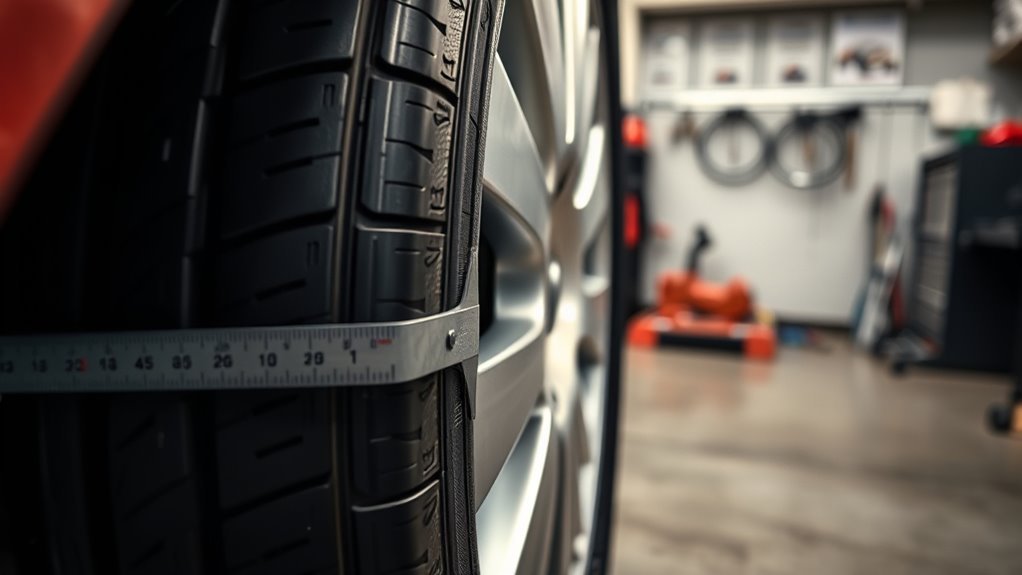
Tire section width is the tread-to-tread measurement in millimeters shown on the sidewall (e.g., 225 in P225/70R16) and it determines contact patch, load distribution, and fitment. You’ll measure it across the tread at standard inflation and the manufacturer-specified rim width; rim changes and pressure alter the measured value. Section width ties to aspect ratio and overall diameter, affecting handling, braking, and rolling resistance. Keep OEM limits in mind—more details follow.
Who Searches “Tire Section Width” : And How This Guide Helps
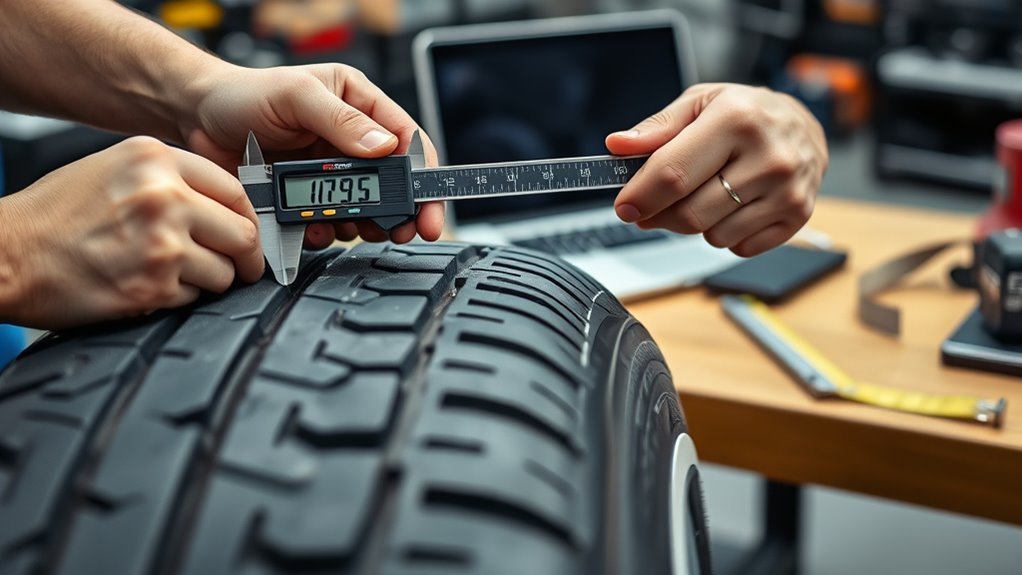
Who wants to know a tire’s section width, and why should you care? You’re likely a vehicle owner, automotive enthusiast, or tire professional verifying dimensions that affect tire compatibility and performance factors. You’ll use the millimeter section width to confirm fitment against wheel width and vehicle clearance limits, avoiding rubbing or improper seating. You’ll evaluate trade-offs: wider sections increase lateral grip and cornering stability but can raise rolling resistance; narrower sections can lower fuel consumption. The section width is integral to sizing notation and informs load, handling, and ride comfort expectations. This guide helps you interpret that number, compare options, and select tires that meet manufacturer requirements and your targeted performance outcomes without guesswork.
What Tire Section Width Means And Where To Find It On The Sidewall
Locate the tire size on the sidewall—usually immediately after the tire type letter (e.g., “P225/70R16”)—to find the section width. The section width is the first numeric value in that code and gives the millimeter measurement from one sidewall to the other. Remember the measured width on the rim can change with different rim widths and inflation pressures, so the sidewall code is the nominal specification.
Sidewall Location Explained
Tire section width is the three-digit number on the sidewall (for example, the “225” in P225/70R16) and tells you the width in millimeters measured from one sidewall to the other at a standard inflation and a specified rim width. You’ll find that number stamped prominently within the sidewall design; it’s positioned with other codes so technicians can read vehicle-fit information quickly. Note the printed width doesn’t account for sidewall flexibility or rim-induced changes.
- visual: raised numerals near the bead area
- touch: textured lettering contrasting the rubber
- context: adjacent load and speed ratings
- orientation: readable when tire mounted on vehicle
- inspection: compare numbers across tires for fit
Use the sidewall code to select tires that match your vehicle specifications.
Width Measurement Method
Section width tells you the exact cross‑sectional distance — in millimeters — from one outer sidewall to the opposite outer sidewall at the tire’s widest point. To perform a width measurement yourself, mount the tire on the intended rim, inflate to the specified pressure, and measure across the tread from outer sidewall edge to outer sidewall edge at the midsection. Note the printed section width on the sidewall (first number in the tire size) to confirm the nominal value. Understand that rim width and inflation alter actual width; measure under service conditions for accuracy. Use the measured and nominal widths to assess tire compatibility with wheel wells, fenders, and suspension clearances. Compare values to manufacturer limits before final installation.
Reading The Tire Code
Think of the sidewall code as the tire’s specification label: you’ll find the section width as the first number (in millimeters) after the type designation (for example, the “225” in P225/70R16). You read that code to get key tire specifications for selection and service. The sidewall lists size, aspect ratio, construction, and rim diameter; the section width tells you expected tread-to-tread measurement under standard conditions.
- Visualize the code stamped on the sidewall.
- Picture “225” as the millimeter span between sidewalls.
- Imagine how rim width and inflation shift that span.
- Consider wider widths improving grip but raising rolling resistance.
- Recall rim compatibility limits and manufacturer’s spec ranges.
Use the stamped code when choosing replacements or verifying rim compatibility.
Measuring Tire Section Width: Rims, Inflation, And Mm-To-Inches
When you measure section width, use the specified rim width and the standard 35 psi inflation to get a repeatable result. Changing rim width shifts section width—about a 0.5 in rim change alters the tire width by roughly 0.2 in—while temperature and inflation deviations also affect measured dimensions. To compare or document results, convert millimeters to inches by multiplying mm × 0.03937.
Measuring Rim Width Effects
A rim’s width directly changes a tire’s measured section width, so if you swap a rim that’s 0.5 inches wider or narrower you can expect about a 0.2‑inch change in the tire’s section width as measured between the outer sidewall edges. You should account for rim width impact when selecting tires, because that measured width affects tire performance and fit. Section width is specified in millimeters and converted to inches (mm × 0.03937) for comparison; measurements assume standard inflation (≈35 psi).
- narrow rim compresses sidewalls, visually slimmer tire
- wider rim stretches bead, increasing measured width
- small width shifts alter contact patch and handling
- conversion example: 225 mm ≈ 8.86 in
- maintain specified rim range for intended performance
Inflation And Temperature Impact
Although rim width sets the baseline, tire inflation and temperature greatly change measured section width, so you should measure at the specified inflation and stable temperature to get repeatable results. You’ll use a standard 35 psi baseline; inflation effects alter sidewall bulge and contact patch, changing measured mm width and converted inches (mm × 0.03937). Temperature variations heat the tire, raising pressure and slightly increasing section width; cold lowers both. Measure after temperature stabilizes to ambient.
| Variable | Effect |
|---|---|
| Inflation (under) | Wider profile, larger contact patch |
| Inflation (over) | Narrower profile, reduced contact patch |
| Temperature rise | Increases pressure and section width |
| Measurement tip | Record psi and ambient °C for repeatability |
How Section Width Links To Aspect Ratio, Sidewall Height, And Diameter
One clear link you’ll use constantly is that section width (mm) multiplied by aspect ratio (%) gives the sidewall height, which you then double and add to rim diameter to get overall tire diameter. You’ll apply this to assess tire performance and handling dynamics: section width affects contact patch; aspect ratio defines sidewall height; diameter alters effective gearing and speedometer reading. Calculate precisely to match vehicle specs.
- 225 mm width × 60% = 135 mm sidewall
- Sidewall × 2 = 270 mm total sidewall contribution
- Rim 17 in (431.8 mm) + 270 mm ≈ 701.8 mm overall diameter
- Lower aspect ratio → shorter sidewall → stiffer response
- Wider section width → larger contact patch, more stability
Use these relations to choose diameter-compatible tires that preserve performance.
How Tire Section Width Affects Handling, Braking, And Rolling Resistance
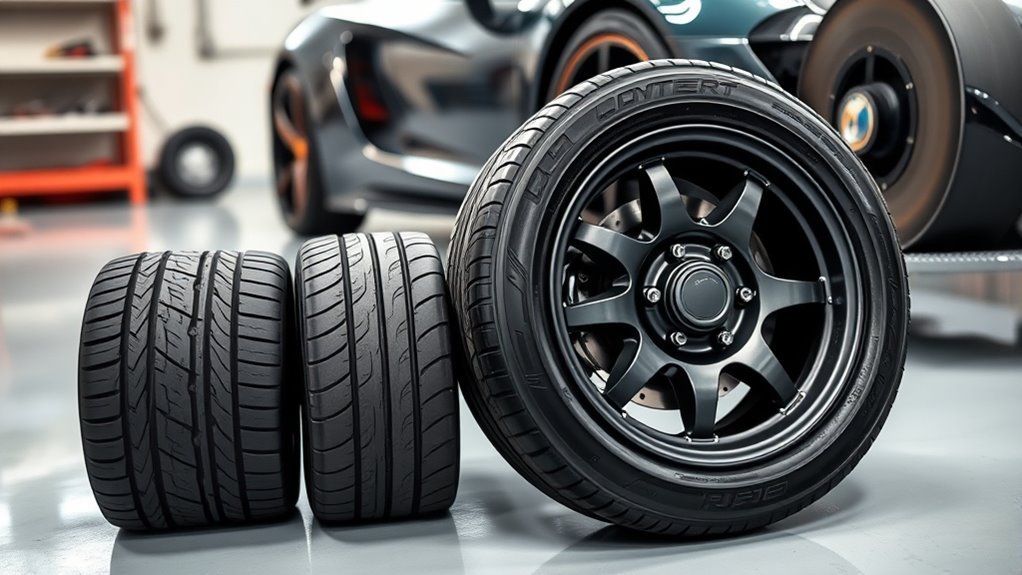
When you increase section width, the tire’s contact patch grows and directly changes lateral grip, braking force distribution, and rolling resistance; wider tires generally give better cornering traction and shorter stopping distances but raise rolling resistance and road noise, so you must balance width against fuel economy and comfort. You’ll notice tire performance shifts: wider section widths enlarge the contact area, improving traction dynamics during acceleration and lateral maneuvers and enhancing high-speed stability. Braking force spreads over a larger surface, reducing stopping distances under ideal conditions. Conversely, increased rolling resistance from wider tread compounds energy losses, lowering fuel efficiency. Wider tires can also transmit more road noise and vibration, affecting ride quality. Evaluate trade-offs quantitatively for optimized vehicle setup.
Choosing The Right Section Width For Your Vehicle And Driving Style
If you want predictable handling and appropriate comfort for your driving needs, choose a section width that balances traction, rolling resistance, and ride quality while staying within your vehicle maker’s specs. You should match section width to your typical driving conditions and intended tire performance: wider for stability and grip, narrower for comfort and lower resistance. Always verify manufacturer compatibility.
Choose a tire width that balances grip, rolling resistance, and ride comfort while respecting manufacturer specs.
- Wide, low-aspect tire on smooth pavement: maximum lateral grip, firmer ride
- Narrow, high-aspect tire on rough roads: improved shock absorption, reduced road noise
- Moderate width for mixed urban/highway use: balanced handling and comfort
- Wider section for spirited driving conditions: increased traction during cornering and acceleration
- Consult vehicle specs first to avoid compromised safety or dynamics
How Changing Section Width Affects Fitment, Speedometer, And Electronics
After choosing a section width that fits your driving needs, you should check how a different width affects fitment, speedometer readings, and vehicle electronics. Changing section width alters overall diameter and can produce inaccurate speedometer readings, so plan speedometer adjustments or recalibration. Fitment considerations include increased contact patch from wider tires, potential interference with wheel wells, and the need to match rim width to the new section width to preserve handling. Electronic systems—ABS, traction control, stability control—are tuned to original tire dimensions; altering width without recalibration can trigger faults or degrade control. Consult manufacturer guidelines for load ratings and safety compliance. Evaluate performance implications versus required suspension or wheel modifications before finalizing a change.
How To Measure Your Tires At Home And Compare Widths (With Conversions)

Start by inflating the tire to the manufacturer’s recommended pressure and park the vehicle on level ground so you can get a repeatable measurement. You’ll measure section width head-on with a tape measure across the widest points of both sidewalls. Maintain consistent technique for measurement accuracy; record rim width and inflation. Convert millimeters to inches by multiplying by 0.03937 (225 mm × 0.03937 ≈ 8.86 in). Compare measured values to manufacturer specs to assess tire performance implications.
- tape measure across sidewalls
- vehicle on flat, level surface
- tire at correct pressure
- note rim width and specs
- convert mm → inches (×0.03937)
This method yields practical, repeatable results and highlights small variations caused by rim width or inflation.
Common Mistakes And Quick Rules When Changing Tire Section Width
When changing tire section width, understand that even small deviations from your vehicle’s recommended specs can alter handling, clearance, and load capacity; you must prioritize precise matching. Common mistakes include ignoring tire compatibility with vehicle specs and rim width, assuming wider is always better, and failing to verify overall diameter and load rating. Wider section widths can enhance traction and cornering but introduce performance trade-offs: increased rolling resistance, noise, and potential rubbing. Quick rules: consult manufacturer guidelines or a tire professional before any change; match tire section width to rim inner width per sizing charts; keep overall diameter within ±3% of stock; confirm load rating meets or exceeds OEM; test for clearance under full suspension travel and steering lock. Verify compatibility before purchase.
Frequently Asked Questions
How Is Tire Section Width Measured?
You measure tire section width across the widest sidewall points on a specified rim at standard inflation, using precise tire measurements tools; you’ll note width significance for fitment, handling and performance, and account for rim-width effects.
What Is 37X12 5r20 Mean?
37×12.5R20 means you’ve got a 37-inch overall diameter, 12.5-inch section width, radial construction for a 20-inch rim; these tire specifications optimize off road performance, traction, clearance, and heavy-duty stability.
Conclusion
You now know what section width is, where to read it on the sidewall, and how to measure it accurately on a rim at correct inflation; you know how it ties to aspect ratio and diameter, how it alters handling, braking, and rolling resistance, and how fitment, speedo accuracy, and vehicle electronics can change when you shift widths. Use measured conversions, follow mounting and clearance rules, and match width to driving needs for safe, predictable performance.
Related Articles

How to Read Motorcycle Tire Size: Complete Breakdown
Often misunderstood, this guide decodes motorcycle tire sizes like 180/55ZR17—learn what each number and letter means to ensure safe, perfect fitment.
Read More
How to Read Bicycle Tire Size: Inches, Metric & ISO
Get the essential trick to decoding ETRTO/ISO codes so you’ll always pick rim-compatible tyres—discover what to check next.
Read More
How to Read Tire Size Numbers: Decode the Sidewall
Step-by-step guide to decode tire sidewalls—sizes, load, speed, DOT and winter symbols—so you’ll know what fits and when to replace.
Read More