What Is Tire Load Range? Letters B Through F Explained
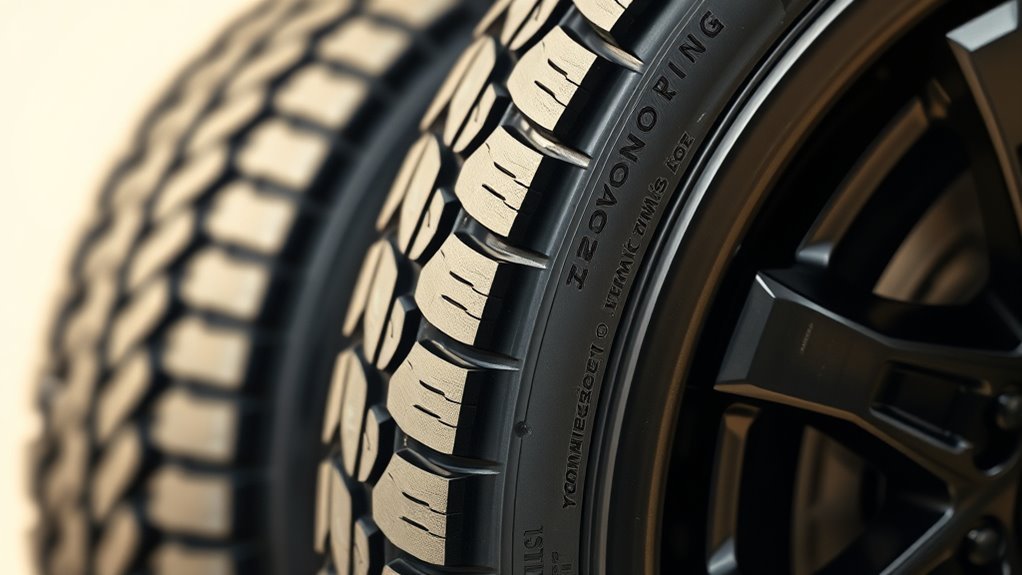
Tire load range (letters B–F) tells you a tire’s construction strength, ply-equivalent, maximum inflation and safe carrying capacity so you can match tires to payload and towing needs. Higher letters mean thicker construction, higher allowable PSI and greater weight per tire, but they need correct inflation and may affect ride comfort. Use B or C for light to moderate loads, D for frequent heavy use, and E/F for extreme towing; keep vehicle specs in mind — more details follow if you want them.
What Is Tire Load Range (Letters B–F) and Why It Matters

Think of tire load range as the tire’s rated carrying capacity: it’s a letter code (B through F) on the sidewall that tells you how much weight the tire can support at a specific inflation pressure. You’ll read B–F to match ply-equivalents—B equals roughly 4-ply, F about 10-ply—so higher letters mean greater strength and durability. Correct selection ties directly to tire safety and load management: higher load ranges require increased inflation accuracy to achieve rated capacity and preserve driving performance. You’ll check sidewall markings against vehicle compatibility and manufacturer specs, especially when towing or carrying heavy payloads to protect towing capacity and prevent blowouts. Regular tire maintenance and adjustments for varying road conditions help maintain rated load support and overall system reliability.
Which Tire Load Range Should You Buy? Quick Rules
When you’re choosing tires, match the load range to how you’ll use the vehicle: pick C for standard light-truck hauling, D for heavier loads and regular towing, and E for heavy-duty trucks or trailers. Always follow the vehicle manufacturer’s load recommendations on the door placard or owner manual; deviating downward risks blowouts and loss of control. For tire safety, prioritize a load range that meets or exceeds specified capacity without overloading the axle. Maintain correct pressures per inflation guidelines—higher load ranges require higher recommended inflation to achieve rated capacity. Incorporate tire maintenance into your routine: inspect sidewalls, monitor tread wear, and verify pressure before trips. If in doubt, consult a tire professional to confirm compatibility and safe operation.
How Load Range Differs From Load Index : And Why Both Matter
Although both terms relate to how much weight your tires can handle, load range and load index tell you different things: load range describes tire strength and construction (ply-equivalent) while load index is a numeric code for maximum weight at proper inflation pressure. You must use both to preserve tire safety, vehicle performance, towing capacity, tire durability, and correct weight distribution.
- Load range indicates durability and how the tire handles sustained structural stress.
- Load index gives the exact per-tire weight limit you’ll reference for loading charts.
- Match or exceed manufacturer load index and load range to avoid overload and failure.
- Proper inflation pressure is required for the load index to be valid; underinflation reduces capacity and lifespan.
Use both values together when specifying tires for heavy loads.
What Load‑Range Letters Mean (Ply Equivalent & Max PSI)
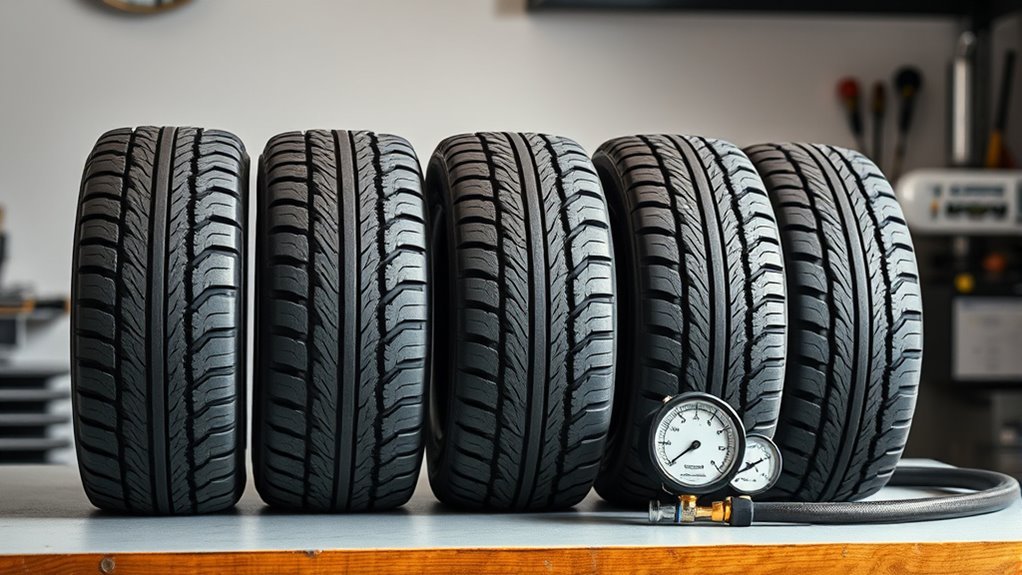
Now you’ll learn what each load‑range letter actually signifies for capacity and inflation. Letters B through F map to ply‑equivalent ratings (B=2, C=6, D=8, E=10, F=12) and correspond to progressively higher maximum inflation pressures. Choosing the correct letter guarantees your tires can handle the required load and recommended PSI for safe operation.
Load Range Letter Meaning
Think of load-range letters as a quick reference that tells you a tire’s construction strength and the maximum inflation pressure it’s rated for; manufacturers assign B through F to indicate increasing ply-equivalent strength (B=4, C=6, D=8, E=10, F=12) and corresponding max PSI (for example, C≈50 PSI, E≈80 PSI). You’ll use the letter to match tire construction benefits to your vehicle’s demands. It directly informs maximum load capacity and has clear safety implications if mismatched. Consider inflation considerations when selecting load range: rated PSI must be met to achieve rated load.
- B = entry-level strength, lower load and PSI
- C = moderate load, ~50 PSI capability
- D = heavy-duty, higher PSI
- E/F = maximum load capacity, highest PSI ratings
Ply Rating Equivalents
You’ve seen how load-range letters give a quick sense of a tire’s construction and maximum inflation; now look at what those letters actually represent in ply-equivalent and PSI numbers. You’ll find B = 4-ply, C = 6-ply (light trucks), D = typically up to 65 PSI, and F = 12-ply with higher PSI capacity. Knowing ply rating benefits helps you match tires to vehicle manufacturer specifications and avoid load range misconceptions that lead to unsafe choices. Assess tire durability factors and heavy load suitability together with inflation pressure importance — underinflation or wrong ply-equivalent reduces truck performance impact and shortens service life. Use manufacturer charts to meet tire safety standards and choose tires suited to ideal driving conditions and towing demands.
Max Inflation Pressure
Start by checking the load-range letter stamped on the tire sidewall—those letters map directly to a ply-equivalent and a maximum inflation pressure that determine how much weight the tire can safely carry. You’ll use that letter to follow inflation guidelines and maintain pressure safety tailored to load demands. B through F letters correspond to increasing ply-equivalents and higher max PSI limits, so choose the range that matches your vehicle and payload.
- B: lower capacity, max ~35 psi, light loads
- C: ~6-ply equivalent, moderate duty, mid-range max PSI
- E: ~10-ply equivalent, heavy duty, higher max PSI
- F: highest capacity, max ~95 psi, for severe loads
Always adhere to manufacturer specs; overinflating beyond the letter’s max risks tire failure.
How to Read Load Range on a Tire Sidewall
When you inspect a tire sidewall, locate the load range letter—typically adjacent to the tire size—and read it as the manufacturer’s code for the tire’s maximum load capacity at a specified inflation pressure. You’ll use tire sidewall markings for precise load range identification: the single-letter code (B, C, D, E, F) directly indicates rated capacity class. Note the letter’s position near size and other specification data, avoid confusing it with ply rating text, and verify corresponding inflation pressure in the manufacturer chart. For practical checks, record the letter, confirm it meets your vehicle’s required load index, and compare to towing or payload needs. Choose the next higher load range only when vehicle specs or frequent heavy loading demand increased capacity.
Typical Tire Load Ranges for Light Trucks (B, C, D, E, F) and Use Cases
You’ll see load range letters B through F denote increasing capacity and typical inflation pressures, so match the letter to your vehicle’s load and towing needs. For example, B is around 1,100 lb per tire at lower PSI for light use, C about 1,400 lb for occasional towing, D about 1,750 lb for frequent hauling, and E roughly 2,300 lb for heavy-duty or commercial work. Use the lowest load range that meets your rated axle load and towing specs, and upsize only when you routinely exceed those limits.
Load Range Letter Meanings
Although load range letters look simple, they convey specific maximum-load and pressure specs you need to match to your vehicle’s duty cycle. You’ll use load range terminology to interpret capacity and apply tire selection tips when choosing tires for payload, towing, or durability needs. Know the practical meanings:
- B: ~1,100 lbs capacity at 32 psi — light-duty passenger/compact truck use.
- C: ~1,400 lbs at 35 psi — moderate loads for vans and light trucks.
- D: ~1,750 lbs at 40 psi — heavier light trucks and towing-ready setups.
- E/F: E ≈2,200 lbs at 80 psi; F ≈2,750 lbs at 95 psi — heavy-duty trucks, trailers, high-tow applications.
Match the letter to your expected load and operating conditions; don’t under-spec or you risk reduced control and premature wear.
Typical PSI And Capacity
Because load range letters tie a tire’s ply-equivalent construction to a specific inflation pressure and maximum load, you should match the letter (B, C, D, E, F) to the vehicle’s payload and towing demands rather than guessing by tread or size. Load range B typically requires around 32 psi and supports roughly 1,110 pounds per tire; it’s for minimal light-duty use. C is a 6‑ply equivalent for light towing and hauling, with moderate tire pressure and increased weight capacity over B. D is an 8‑ply equivalent for regular cargo, needing higher inflation to sustain heavier loads. E operates near 80 psi and handles about 3,640 pounds per tire. F, a 10‑ply equivalent, gives the highest weight capacity and durability for heavy towing and off‑road stresses.
Best Uses And Recommendations
When selecting tires for a light truck, match the load range to your typical payload and towing profile so you get the needed capacity without unnecessary stiffness or excessive inflation demands. Use load considerations and vehicle compatibility to pick B (1,100 lb/32 PSI) for minimal cargo, C (1,400 lb/35 PSI) for moderate hauling, D (1,750 lb/40 PSI) for frequent heavier loads, E (2,200 lb/80 PSI) or F (2,900 lb/95 PSI) for heavy or extreme-duty use. Follow best practices: choose the lowest effective load range for ride comfort and tire durability while meeting safety factors.
- Assess driving conditions and towing needs before upgrading.
- Verify vehicle compatibility with manufacturer specs.
- Monitor pressure and wear as maintenance tips.
- Expect performance expectations to shift with higher ranges.
Pick the Right Load Range for Towing, Hauling, or Off‑Road Gear
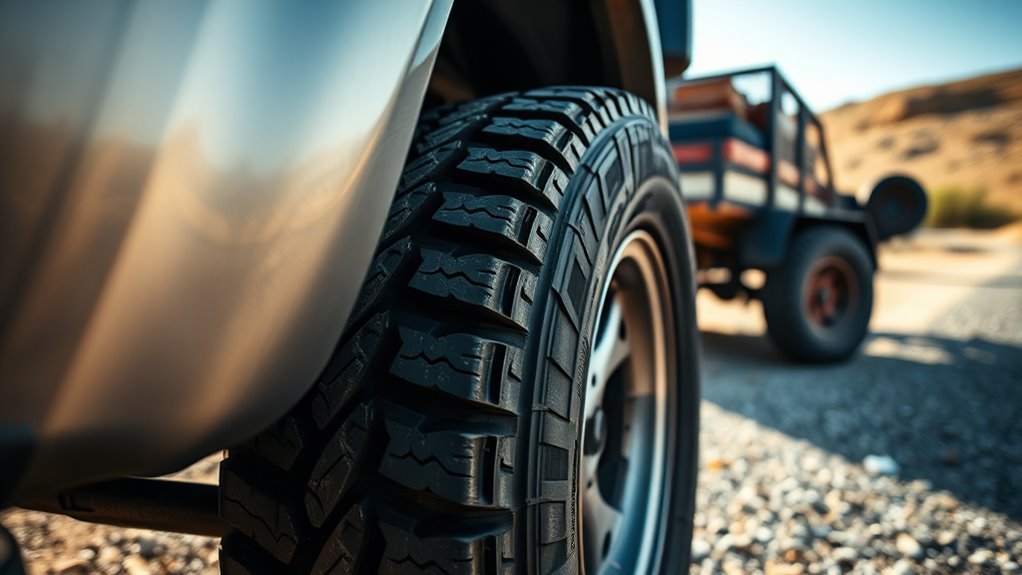
Wondering which load range you need for towing, hauling, or off‑road gear? You’ll choose based on tire safety and load capacity: for regular towing and heavy hauling, select E or F load ranges because they provide higher ply ratings and greater tire durability under stress. Confirm vehicle compatibility by checking manufacturer specs, then match tire load limits to the combined vehicle, cargo, and trailer weight. Prioritize towing stability and proper weight distribution—overloading one axle increases failure risk. For off road performance, pick a load range that exceeds anticipated static and dynamic loads to resist punctures and heat buildup. Follow inflation guidelines tied to the chosen load range; correct pressures maximize load capacity, handling, and long‑term durability.
How Load Range Impacts Ride, Handling, and Inflation Needs
If you fit a higher load‑range tire (C through F) to match heavier loads, you’ll notice firmer sidewalls that change both ride feel and handling characteristics. You’ll get increased load capacity and improved handling stability, but the tradeoff is a firmer ride quality that demands attention to inflation pressure. Match the tire’s rated max psi to your vehicle and load; higher load ranges allow higher inflation pressure (e.g., up to ~95 psi for F) which reduces deflection under load.
- Firmer sidewalls resist deformation, improving handling stability during cornering.
- Higher allowed inflation pressure preserves load capacity and reduces heat build‑up.
- Expect a harsher ride quality on light loads if you overinflate.
- Inspect pressures regularly; incorrect inflation undermines safety and tire life.
Top Load‑Range Mistakes and a Quick Matching Checklist
After noting how higher load ranges stiffen sidewalls and demand careful inflation, you should watch for common selection errors that directly affect safety and tire longevity. Top mistakes include choosing a lower load range than the vehicle requires, assuming a higher letter always improves performance, and ignoring the vehicle’s load index and manufacturer placard. Also avoid mismatching tires across an axle or mixing ply-equivalent ratings without recalculating capacity.
Quick checklist: 1) Verify vehicle placard/owner’s manual recommended load range and load index. 2) Match load range (B–F) to expected towing/hauling loads. 3) Guarantee axle pairs use identical load ranges. 4) Confirm ply-equivalent ratings (e.g., C ≈ 6-ply) meet capacity. 5) Adjust inflation to rated load. Follow this to reduce blowout risk.
Frequently Asked Questions
Is Load Range B or C Better?
Load range C is better if you carry heavier loads or tow, since its load range differences improve tire performance; choose B for lighter, everyday driving to save weight and cost, but don’t exceed your vehicle’s requirements.
What Load Range Tire Is F?
Like a fortress, Load Range F is a heavy-duty tire spec: you’ll use it when tire specifications call for roughly a 10-ply equivalent and about 3,750 lb load capacity at high inflation, ideal for trucks and trailers.
How Much Weight Can a Load Range B Tire Carry?
A Load Range B tire can carry about 1,400 pounds when properly inflated; you’ll optimize tire performance and safety by maintaining correct pressure and ensuring even weight distribution to avoid overload, premature wear, or blowouts.
Is Load Range F 10 Ply?
Like a fortified bridge, yes—you’re right: Load Range F is a 10‑ply rating, and it increases tire durability and load capacity. You’ll get stiffer sidewalls and higher inflation limits for heavier towing and hauling.
Conclusion
Choose the correct tire load range like you’d pick the right tool: match capacity to the job to avoid trouble. If you tow, haul, or carry heavy gear, pick higher letters (D–F) and follow max PSI, ply‑equivalents, and your vehicle’s load index. Don’t overinflate for comfort or underinflate for safety. Check sidewall markings, consult specs, and keep inflation precise—the right load range keeps performance predictable and failures far less likely.
Related Articles
How to Read Motorcycle Tire Size: Complete Breakdown
Often misunderstood, this guide decodes motorcycle tire sizes like 180/55ZR17—learn what each number and letter means to ensure safe, perfect fitment.
Read More
How to Read Bicycle Tire Size: Inches, Metric & ISO
Get the essential trick to decoding ETRTO/ISO codes so you’ll always pick rim-compatible tyres—discover what to check next.
Read More
How to Read Tire Size Numbers: Decode the Sidewall
Step-by-step guide to decode tire sidewalls—sizes, load, speed, DOT and winter symbols—so you’ll know what fits and when to replace.
Read More