
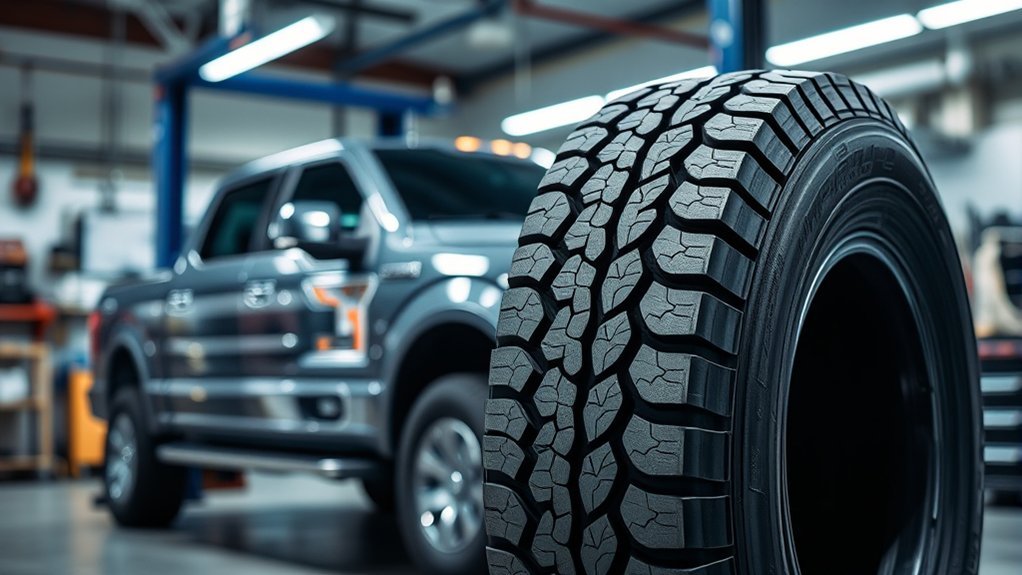
A light truck tire, usually marked with “LT” in its size, is designed for vehicles and jobs that require greater load support at specified inflation pressures. LT tires are commonly used on pickups, vans, work vehicles, and some SUVs, especially for towing, hauling, commercial service, or rough roads. They are not automatically the best choice for every truck, so the vehicle placard, load rating, wheel limits, and driving conditions must guide the decision.
Quick Answer
An LT tire is a light-truck tire built to carry higher loads at specified inflation pressures than a comparable passenger tire. It can suit towing, hauling, commercial, and rough-road use, but it does not increase a vehicle’s payload or tow rating. Always match the door placard, load index, speed rating, and wheel limits.
Key Takeaways
- LT tires are intended for light-truck and multipurpose-vehicle applications that need suitable load and inflation capability.
- Load range C, D, E, or F is not a fixed pound rating. Check the exact tire’s load index, maximum load, pressure, and size.
- A higher tire rating does not increase the vehicle’s GVWR, GAWR, payload, hitch limit, or tow rating.
- Not every pickup or SUV needs LT tires. Many are designed to use P-metric or metric passenger tires.
- Use the vehicle placard or owner’s manual for normal cold inflation pressure, not the maximum pressure molded on the tire.
- ST trailer tires and LT vehicle tires serve different applications and should not be interchanged.
What Is an LT Tire?
An LT tire is a tire that its manufacturer designates primarily for use on lightweight trucks or multipurpose passenger vehicles. This definition appears in the federal light-vehicle tire standard in 49 CFR 571.139.
Compared with a similar passenger tire, an LT tire is normally engineered to operate at higher inflation pressures and support demanding loads. Depending on the model, it may also use a heavier casing, more robust sidewall construction, or features intended for commercial and off-road service. Those features vary, however, so the LT marking alone does not guarantee a particular tread depth, puncture resistance, or off-road ability.
LT tires often feel firmer and may weigh more than passenger tires. That can affect ride comfort, steering response, road noise, braking feel, and fuel use. These tradeoffs can be worthwhile when the vehicle regularly carries cargo, pulls a trailer, travels on damaged roads, or works away from pavement.
A tire with a higher load rating may provide more tire capacity, but it does not raise the vehicle manufacturer’s GVWR, GAWR, payload, hitch, or towing limits.
LT Tires vs. Passenger Tires
LT and passenger tires serve different needs, but neither type is automatically better. The correct choice is the type, size, load rating, speed rating, and pressure approved for the vehicle.
| Feature | LT Tire | Passenger or P-Metric Tire |
|---|---|---|
| Typical use | Towing, hauling, commercial work, rough roads, and some off-road driving | Daily driving, lighter loads, commuting, and comfort-focused use |
| Load markings | Often includes an LT designation, load range, and single/dual load indexes | Usually uses a passenger load index and may be Standard Load or Extra Load |
| Inflation capability | Commonly designed for higher pressure, depending on the exact size and load range | Commonly operates at lower pressure, as specified by the vehicle manufacturer |
| Ride | Often firmer, especially when the vehicle is lightly loaded | Often smoother and quieter on paved roads |
| Weight and efficiency | May be heavier and create more rolling resistance | Often lighter and optimized for everyday efficiency |
| Best selection rule | Follow the vehicle placard, owner’s manual, and approved replacement guidance rather than choosing by vehicle appearance alone. | |
Warning: An ST marking means Special Trailer. An ST trailer tire is not an LT tire and should not be installed on a pickup, SUV, van, or other powered vehicle. The Forerunner QH500, for example, is a trailer tire rather than an LT-vehicle tire.
When LT Tires Make Sense
LT tires make the most sense when the vehicle manufacturer specifies them or when an approved replacement is needed for sustained towing, hauling, commercial use, or rough-road travel. The exact tire must still provide the correct size, load capacity, pressure capability, speed rating, and wheel compatibility.
Heavy Loads and Towing
LT tires can provide useful load and heat-management capability for vehicles that regularly carry heavy cargo or tow. They may also feel more stable under load because their construction is designed for demanding service. That does not mean every towing vehicle needs an LT conversion.
If the vehicle came with passenger tires, first check the Tire and Loading Information label, owner’s manual, payload rating, axle ratings, and towing guide. An approved P-metric tire can remain suitable when the vehicle, trailer, passengers, cargo, tongue weight, tire load, and inflation pressure all stay within their limits.
- Confirm vehicle limits: Never exceed GVWR, either GAWR, payload, hitch, or tow ratings.
- Check the exact tire capacity: Use its load index, maximum load, and approved pressure data.
- Account for tongue weight: Trailer tongue or pin weight becomes part of the tow vehicle’s load.
- Check loaded axle weights: A scale measurement is more reliable than estimating cargo weight.
Off-Road and Tough Terrain
An LT tire can be useful on rocky, rutted, or debris-covered routes because many LT models use construction intended for tougher service. Tread design remains a separate choice. Highway, all-terrain, mud-terrain, and winter tires can all be sold in different load categories.
| LT Feature | Possible Benefit | What to Verify |
|---|---|---|
| Open or aggressive tread | Traction and debris clearing on loose surfaces | Wet-road braking, noise, and actual terrain rating |
| Robust sidewall design | Greater resistance to some cuts and impacts | Manufacturer construction details for the exact size |
| Higher inflation capability | Supports specified loads when correctly inflated | Vehicle, wheel, valve, and tire pressure limits |
Many all-terrain and mud-terrain lines include both passenger and LT sizes. Read the complete sidewall marking for the exact size rather than assuming that an aggressive tread is automatically an LT tire.
Better Fit for Trucks
LT tires are often a better fit when a truck, van, or SUV leaves the factory with LT tires or regularly performs work that calls for an approved LT fitment. A vehicle’s classification alone does not settle the question. Many light-duty pickups and SUVs are factory-equipped with passenger tires because their intended use favors comfort, handling, and efficiency.
- Start with the placard: Match the original tire size and required cold pressure.
- Meet or exceed the approved rating: Do not use a lower load index, pressure capability, or speed rating than allowed.
- Confirm wheel compatibility: The wheel must support the required load and inflation pressure.
- Check clearance and electronics: A size change can affect body clearance, gearing, the speedometer, ABS, stability control, and four-wheel-drive systems.
When LT Tires May Not Be the Best Choice
An LT tire may be unnecessary when the vehicle spends most of its time lightly loaded on paved roads and the manufacturer specifies a passenger tire. Installing a heavier or stiffer tire solely for appearance can reduce ride comfort and may change steering, braking, noise, and fuel consumption.
A higher load range is also not automatically safer. A tire that is poorly matched to the vehicle or operated at the wrong pressure can perform worse than the correctly specified original tire. Choose additional capacity only when the fitment is approved and the duty requires it.
Note: The right tire is not the one with the highest load-range letter. It is the tire that meets the vehicle manufacturer’s size, capacity, pressure, speed, handling, and wheel requirements for the intended use.
How to Read LT Tire Sizes
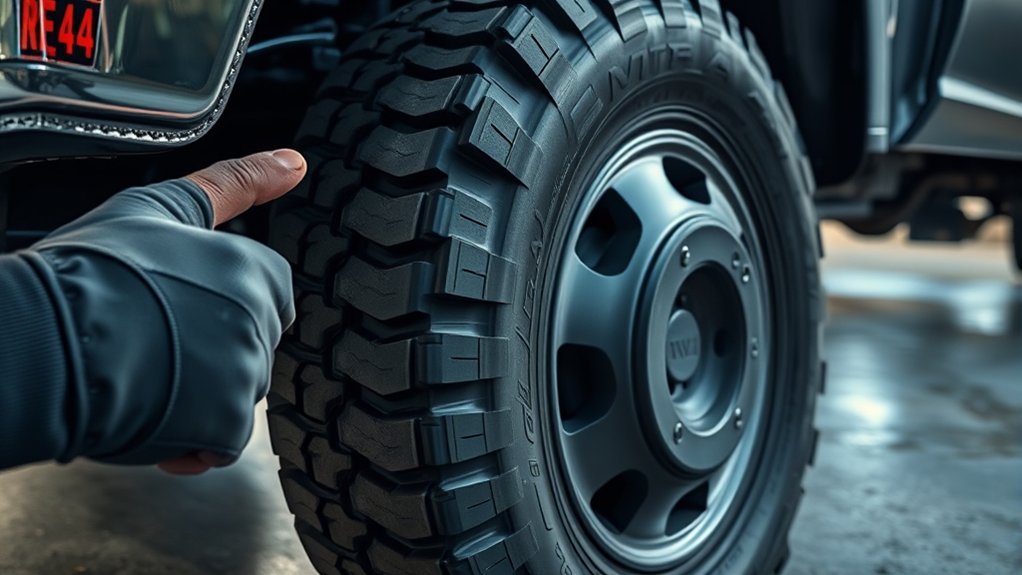
A complete LT sidewall marking may look like LT265/75R16 123/120S Load Range E. Each part describes a different characteristic:
- LT: The tire is designated for light-truck service.
- 265: Nominal section width in millimeters.
- 75: Sidewall height is approximately 75% of the section width.
- R: Radial construction.
- 16: The tire fits a 16-inch-diameter wheel.
- 123/120: Load indexes for single-wheel and dual-wheel service.
- S: Speed rating.
- Load Range E: The tire’s load-and-inflation category.
LT Size Breakdown
In LT265/75R16, the size portion describes geometry and construction rather than the exact load capacity. Two tires with the same nominal size may carry different load indexes, speed ratings, load ranges, tread patterns, and maximum loads.
High-flotation LT sizes use a different format, such as 35×12.50R17LT. In that example, 35 is the approximate overall diameter in inches, 12.50 is the nominal section width, R means radial, 17 is the wheel diameter, and LT identifies the light-truck application.
Load Range Meaning
Load range identifies a tire’s load and inflation limits. It does not state one universal pound capacity for every tire carrying that letter. The exact capacity comes from the complete size, load index, maximum-load marking, inflation pressure, and whether the tire is used in single or dual service.
The USTMA passenger and light-truck tire guide illustrates this with an LT tire carrying separate single and dual load indexes and maximum-load markings.
P-Metric vs. LT
A P-metric tire may be marked P265/70R17, while an LT-metric tire may read LT265/70R17. Similar-looking dimensions do not make the tires interchangeable. They use different load and inflation systems and may require different operating pressures.
When a P-metric tire is applied to a light-truck application, U.S. industry replacement guidance uses an adjusted capacity calculated by dividing the passenger-vehicle capacity by 1.10. This calculation is not permission to perform an unapproved tire conversion. The vehicle manufacturer, tire manufacturer, or a qualified tire professional should confirm the fitment.
Load Range vs. Load Index and Ply Rating
These three terms are related but do not mean the same thing:
| Term | What It Means | How to Use It |
|---|---|---|
| Load range | A category identifying load and inflation limits | Consider it with the exact size, load index, pressure, and manufacturer data |
| Load index | A numerical code corresponding to maximum supported weight under specified conditions | Meet or exceed the vehicle manufacturer’s approved requirement |
| Ply rating | A historical strength-equivalence term | Do not treat it as the physical number of cord layers in a modern tire |
| Speed rating | The tire’s tested speed capability under specified load and operating conditions | Match the vehicle manufacturer’s requirement and obey legal and safe speeds |
The following values are common references for many LT-metric tires, but the exact sidewall markings and manufacturer data always control:
| Load Range | Historical Ply Rating | Common Maximum Cold Pressure |
|---|---|---|
| C | 6-ply rating | Often 50 psi |
| D | 8-ply rating | Often 65 psi |
| E | 10-ply rating | Often 80 psi |
| F | 12-ply rating | Often 95 psi |
Bridgestone’s tire terminology guide explains that load range replaced the former ply-rating term. A tire called “10-ply rated” may have fewer than ten physical plies because modern materials can provide the required strength with a different construction.
Choose the Right Load Range
Selecting an LT tire requires more than choosing C, D, E, or F from a general table. Follow this order:
- Read the vehicle placard: Record the original tire size and front and rear cold inflation pressures.
- Check the owner’s manual: Look for tire-replacement restrictions, towing instructions, and approved alternate sizes.
- Match the service description: Confirm load index, speed rating, load range, and single or dual application.
- Verify the wheel: Make sure the rim width, diameter, load rating, and pressure rating support the tire.
- Check actual loads: For frequent towing or hauling, weigh the loaded vehicle by axle and stay below every vehicle, axle, tire, wheel, and hitch limit.
- Confirm clearance: Inspect suspension, brakes, fenders, steering travel, and dual-tire spacing when changing size.
- Get approval for a conversion: Consult the vehicle manufacturer, tire manufacturer, or a qualified tire professional before switching between passenger and LT systems.
Warning: Never inflate an LT tire to its sidewall maximum simply because that pressure is available. Use the vehicle manufacturer’s approved cold pressure or an approved replacement pressure based on the tire and vehicle application. Never exceed the tire or wheel’s maximum pressure.
Pro Tip: When comparing tires online, open the specification page for the exact size. One product line may contain P-metric, XL, C-type commercial, and LT-metric versions with different ratings.
[Products Worth Considering]

ETENWOLF’s tire pressure gauge helps you quickly and accurately check tire PSI across cars, trucks, motorcycles, bikes, and more. It’s manually calibrated to ANSI B40.1 Grade A for reliable readings, includes a large glow dial for easy nighttime viewing, and features a 360-degree swivel chuck for use at any valve angle. The gauge also works consistently in extreme hot or cold weather.

Accurately measure tire tread depth with a calibrated gauge marked from 0 to 1 inch in 1/32 inch increments. The color-coded bar helps you quickly identify tread condition ranges, supporting safe driving for trucks, motorcycles, automobiles, and passenger vehicles.

This 12-inch LUMITECO dual head tire pressure gauge features an integrated straight-on chuck and a 30° reverse chuck to reach hard-to-access dual wheel valves. Its 10–150 PSI / 1–10 BAR range with a clear, two-sided scale helps you quickly check tire pressure for safer, smoother driving. Heavy-duty construction and a simple no-battery design make it a reliable tool for trucks, cars, RVs, and motorcycles.
Pick the Best LT Tread Type
After confirming fitment and capacity, choose a tread type that matches where the vehicle spends most of its time.
| Tread Type | Best For | Main Tradeoff |
|---|---|---|
| Highway or touring | Paved-road driving, work commutes, towing, and long highway trips | Less traction in deep mud or highly uneven terrain |
| All-terrain | Mixed pavement, gravel, dirt, and moderate trails | Usually more noise and rolling resistance than a highway tread |
| Mud-terrain | Deep mud, loose soil, rocks, and demanding recreational trails | More road noise, faster or less even wear, and weaker paved-road refinement |
| Winter | Regular snow, ice, and sustained cold temperatures | Seasonal use and faster warm-weather wear |
| Commercial or ribbed highway | Delivery vans, fleet work, and high-mileage paved-road service | Limited off-road capability compared with open-shoulder treads |
The M+S marking is based on tread-design criteria and does not require a standardized winter-traction test. The Three-Peak Mountain Snowflake, or 3PMSF, shows that the tire met a standardized snow-traction requirement. It does not guarantee the same ice performance as a dedicated winter tire, so match the tire to the full range of expected conditions. The markings are explained in Michelin’s sidewall guide.
[Products Worth Considering]

The ETENWOLF T600 digital tire pressure gauge delivers precise, manually calibrated readings to ANSI B40.7 Grade 2A standards with ±0.5% PSI accuracy. Its 360° rotating nozzle and display hold make it easy to check pressures from any angle, while a bleed button helps dial tires to the perfect level. With a 0–250 PSI range and support for PSI, BAR, and KPA, it’s a convenient tool for maintaining tire performance across many vehicles and seasons.

The SAFELIFE dial tire tread depth gauge measures tread depth in 1/32 inch increments with clear, easy-to-read 2-inch dial face. Color zones using a traffic light system help you quickly judge whether tread is low, marginal, or ample for safer driving. Built with a durable zinc cast body and a metal detect probe for precise, comfortable use across cars, motorcycles, trucks, and buses.

Check tire pressure with the Milton S-925 pencil gauge built for trucks, RVs, and bicycles. It features a single-head chuck with a built-in deflator valve, and it displays readings in both PSI and kPa for convenient use. The gauge is designed for accurate, repeatable pressure checks within its working range.
Top LT Tire Picks for Your Needs
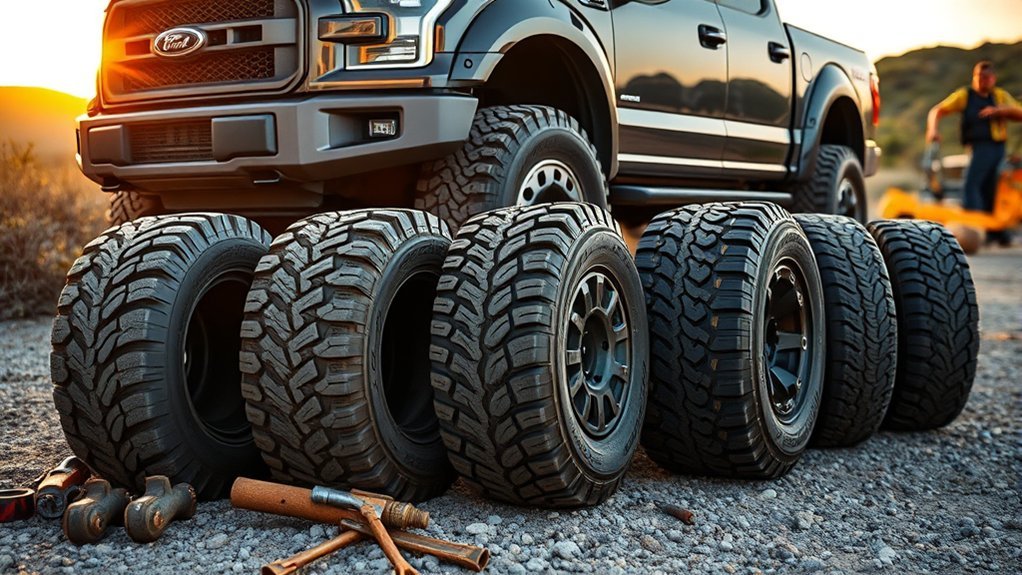
No tire is the best choice for every truck. The correct pick depends on the exact size, duty cycle, climate, load, wheel, and driving surface. The following models illustrate different categories rather than universal rankings:
- Highway and all-weather example: The Hercules Terra Trac Cross-V AW is offered for crossover, SUV, and light-truck applications. Some sizes are passenger-metric and others are LT-metric, so verify the exact specification.
- All-terrain example: The Terra Trac AT X-Venture targets all-terrain use and carries the 3PMSF marking. Confirm that the chosen size meets the vehicle’s load and pressure requirements.
- Mud-terrain example: The TIS TT1 by Hercules uses an aggressive mud-terrain pattern for recreational off-road use. Its tread design may be louder and less refined on pavement.
- Commercial example: The Terra Trac CH4 is aimed at cargo-van and work-vehicle use, where durability and even highway wear matter more than aggressive trail traction.
A passenger all-season tire such as a Fullway 215/60R16 should not be treated as an LT replacement merely because the rim diameter or general category appears suitable. Likewise, an ST trailer tire such as the Forerunner QH500 belongs on an approved trailer application, not on the tow vehicle.
Before buying any model, compare:
- Exact size and vehicle approval
- Load index and load range
- Speed rating
- Maximum single or dual load
- Required cold inflation pressure
- Wheel load and pressure rating
- 3PMSF or other seasonal markings
- Highway noise and wet braking
- Warranty terms for the exact size and application
[Products Worth Considering]
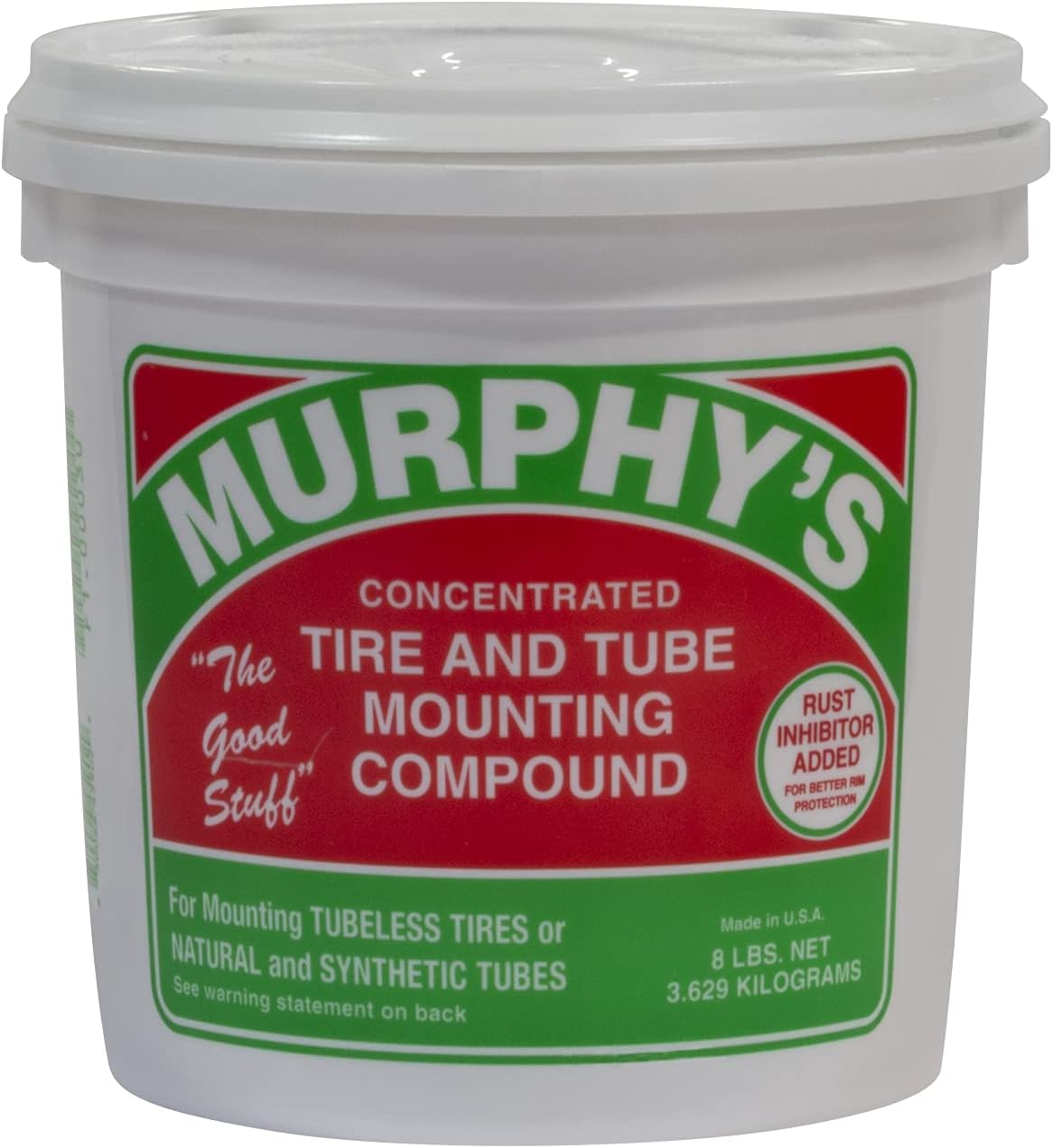
A concentrated tire and tube mounting compound designed to help simplify mounting rubber tires and tubes on passenger, semi truck, construction, and OTR applications. Its ultra-thick formula packs beads effectively and includes rust inhibitors to help protect against corrosion during use.
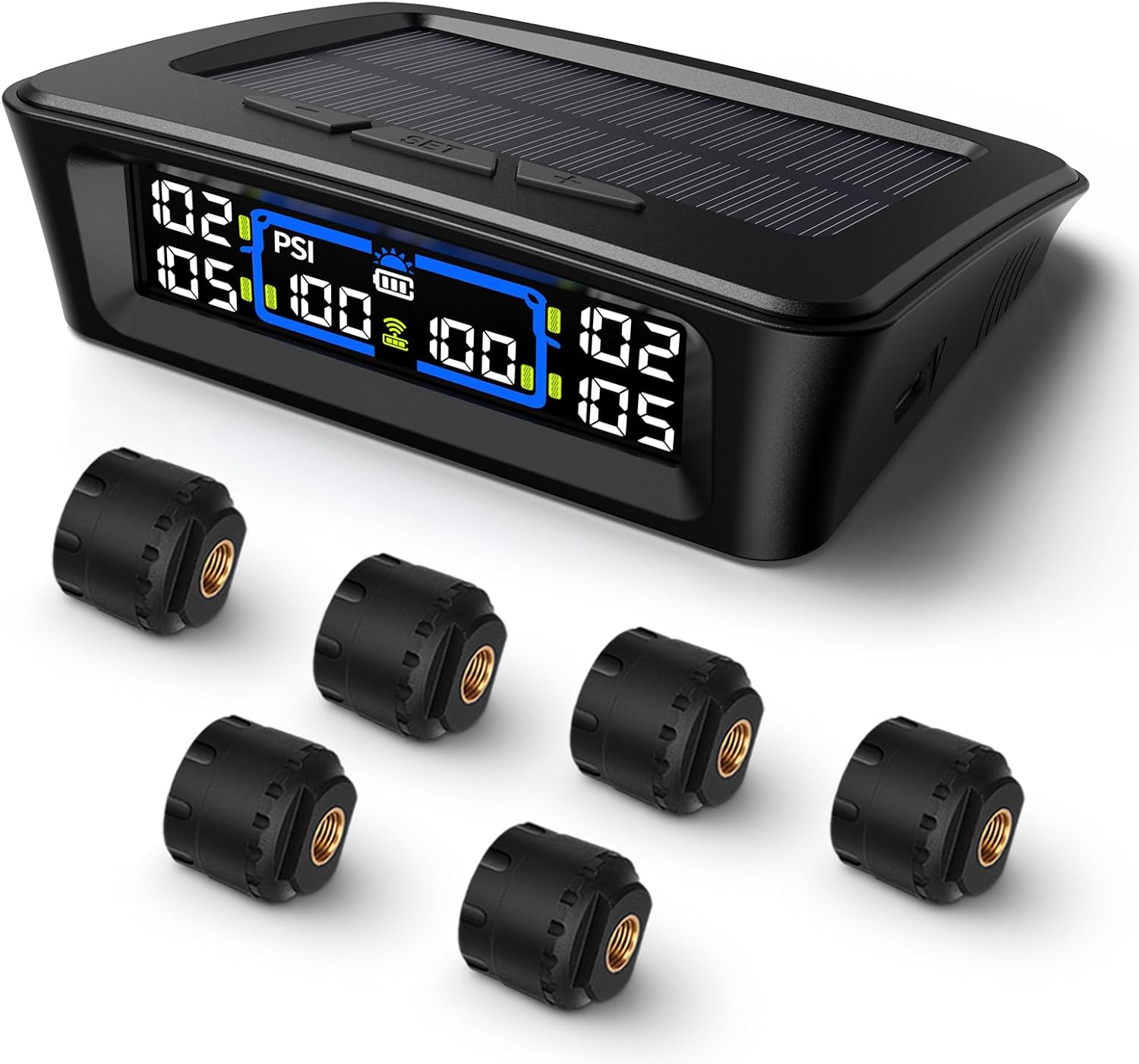
The Tymate TM12 RV TPMS delivers real-time tire pressure and temperature monitoring with a stable 433Hz display for safer long-distance driving. It supports simultaneous monitoring across vehicle and trailer zones, includes six alarm modes for pressure, temperature, leakage, battery, and signal loss, and features easy DIY installation with auto calibration. Power is supplied via USB-C charging or solar recharging, with a wide 0–144 PSI range and up to 50 ft signal coverage for RVs and towable trailers.

The 22800 wheel stud installer makes replacing wheel studs quick and secure, saving time and effort during tire service. It uses a ratchet or impact wrench to pull new studs firmly into place, helping when existing studs are too long. Compatible with most automotive wheels and light-duty truck wheel studs, it’s designed for easy, tool-assisted installation.
LT Tire Pressure and Maintenance
Correct inflation is essential because air pressure allows the tire to support its load. The maximum pressure molded on the sidewall shows a tire limit associated with its specifications; it is not a universal operating-pressure recommendation.
The National Highway Traffic Safety Administration recommends checking all tires, including the spare, at least once a month when cold. “Cold” generally means the vehicle has been parked for at least three hours. Also check pressure before towing, carrying a heavy load, or starting a long trip.
- Use an accurate gauge rather than judging pressure by appearance.
- Follow different front and rear pressures when the placard specifies them.
- Do not bleed pressure from a hot tire to reach the cold setting.
- Inspect for cuts, bulges, exposed material, cracking, punctures, and irregular wear.
- Do not rely on TPMS as a substitute for monthly pressure checks.
- Recheck pressure after major temperature or altitude changes.
Warning: If you lower pressure for slow off-road driving, reinflate the tires to the approved road pressure before returning to highway speed. Driving fast on an aired-down tire can generate excessive heat and damage the tire.
Frequently Asked Questions
What is the difference between a light truck tire and a regular tire?
An LT tire is designed for light-truck applications and commonly provides higher load and inflation capability than a comparable passenger tire. A passenger tire often favors lighter weight, comfort, quietness, and efficiency. Compare the exact size, load index, speed rating, pressure, and vehicle approval rather than relying on the category name alone.
What is considered a light truck for tires?
For tire standards, LT identifies a tire that its manufacturer intends primarily for lightweight trucks or multipurpose passenger vehicles. It does not mean that every pickup, van, or SUV must use LT tires. The vehicle placard and owner’s manual determine the approved tire specification.
Is an F-150 considered a light truck?
Yes. The Ford F-150 is a light-duty pickup, but that does not mean every F-150 requires LT tires. Tire type can vary by model year, trim, wheel package, and intended use. Follow the placard on the specific truck rather than using the vehicle name alone.
Are light truck tires 10-ply?
Not all LT tires are 10-ply rated. Load Range E is historically called a 10-ply rating, while C, D, and F correspond to other historical strength ratings. A modern tire described as 10-ply rated does not necessarily contain ten physical plies.
Can I put LT tires on an SUV that came with passenger tires?
Possibly, but only after confirming an approved size, load rating, speed rating, operating pressure, rim width, wheel pressure capacity, clearance, and handling compatibility. An LT conversion may require a different pressure and can produce a firmer ride. Consult the vehicle or tire manufacturer before changing systems.
Do LT tires increase towing capacity?
No. An LT tire may provide additional tire capacity for an approved application, but it does not raise the vehicle’s tow rating, payload, GVWR, GAWR, hitch rating, axle rating, or wheel rating. The lowest applicable limit still controls.
What pressure should I use in LT tires?
Use the cold pressure listed on the vehicle placard or an approved replacement pressure supplied by the vehicle or tire manufacturer. Do not automatically use the tire’s sidewall maximum. When towing or carrying heavy loads, follow the manufacturer’s load and inflation guidance without exceeding tire or wheel limits.
Are LT tires automatically better in snow?
No. LT describes the tire’s intended application, not its winter traction. Check the tread compound and winter markings. A 3PMSF-marked tire has passed a standardized snow-traction test, while an M+S marking alone does not require that test. Dedicated winter tires may still provide better snow and ice performance.
Conclusion
A light truck tire can be the right choice when a vehicle needs approved capacity for towing, hauling, commercial work, or rough-road use. The LT marking alone is not enough to make a safe selection. Read the full size, load index, speed rating, load range, maximum load, and single or dual markings. Then confirm the vehicle placard, owner’s manual, wheel limits, and actual axle loads. The correct tire supports the job without exceeding the limits of the vehicle around it.
Sources
- Electronic Code of Federal Regulations — 49 CFR 571.139 — official LT-tire and load-rating definitions.
- National Highway Traffic Safety Administration TireWise — vehicle placards, cold pressure, tire maintenance, tread, and TPMS guidance.
- U.S. Tire Manufacturers Association Care and Service Guide — sidewall markings, load range, replacement fitment, inflation, and P-metric adjustment guidance.
- Michelin Load Rating and Speed Rating Guide — load-index selection and the limits of higher-rated replacement tires.
- Michelin Tire Markings Guide — maximum-pressure markings, 3PMSF, M+S, and sidewall identification.
- Bridgestone Tire Terminology — load-range and historical ply-rating definitions.

