
Hyundai Sonata Recommended Tire Pressure (PSI) by Year & Trim
You should inflate your Hyundai Sonata tires to the manufacturer-specified PSI for your exact year and trim—most 2019–2022 Sonatas use 32 PSI front and rear, while older models commonly range 30–32 PSI depending on trim. Check the driver’s door jamb, fuel‑door sticker, or owner’s manual (or decode your VIN) for the precise value, and adjust for load or temperature per guidelines; continue for steps on checking, adjusting, and diagnosing tire issues.
Hyundai Sonata Tire Pressure: Quick Reference by Year & Trim
When you check tire pressure on a Hyundai Sonata, use the manufacturer’s recommended values to guarantee handling, fuel efficiency, and tire life; for 2019–2022 Sonatas that value is 32 PSI front and rear, while earlier models like the 2010 typically specify 30–32 PSI depending on trim. You’ll use that baseline to assess each model year quickly: 2019–2022 = 32 PSI all corners; earlier years commonly sit between 30–32 PSI based on trim. You’ll want to confirm if your trim skews low or high, but these figures give you immediate guidance to act. For a liberated driver who values control, keep tire pressure within recommended ranges to preserve predictable handling and optimum economy. Apply seasonal adjustments as temperature drops or rises: expect roughly 1 PSI change per 10°F, and adjust to restore the manufacturer’s stated pressure when tires are cold. That disciplined approach keeps you safe, efficient, and independent on the road.
Find Your Sonata’s Exact PSI (Sticker, Manual, VIN)
Looking for the exact PSI for your Sonata? Start with the owner’s manual: it lists the manufacturer’s recommended tire pressure for your model year and trim, and gives maintenance context. Next, inspect the driver’s side door jamb sticker — it states front and rear PSI values and is the quickest on-vehicle reference. Check inside the fuel door as well; some Sonatas include the same sticker there for convenience while fueling.
If you want a confirmatory source, decode your VIN online to retrieve factory specifications, including tire pressure recommendations tied to your build. Typical Sonata settings fall between 30 and 34 PSI, but don’t assume — verify against the manual or sticker for your specific trim and load conditions. Keep a calibrated gauge handy, set pressures when tires are cold, and adjust only to the documented PSI. Accurate tire pressure preserves handling, fuel efficiency, and your autonomy on the road.
How Tire Size & Load Affect the Recommended PSI
Tire size affects the contact patch and sidewall flex, so if you fit larger or wider tires you’ll often need a slightly higher PSI to maintain handling and even wear. Load capacity changes the pressure needed to support weight safely, so heavier loads or higher load-rated tires typically call for increased inflation. Check the door jamb sticker or owner’s manual for the exact PSI for your Sonata’s tire size and expected load.
Tire Size Impact
Anyone changing wheel size on a Sonata should recognize that tire diameter and width alter the vehicle’s load distribution and required inflation pressure; larger tires generally need higher PSI to support increased load ratings and maintain handling. When you perform a tire size comparison, note that different diameters and section widths change contact patch and sidewall flex, so you’ll adjust recommended PSI to preserve ride, wear, and fuel economy. Consult the owner’s manual or a tire professional before altering pressures. You’ll also establish an inflation frequency for checks—weekly when experimenting with new sizes, then monthly once settled. Under-inflation on oversized tires risks heat buildup and blowouts; over-inflation on smaller choices causes uneven wear and degraded handling.
Load Capacity Influence
If you change wheel size, you’ll also alter how load capacity and recommended PSI interact: larger-diameter or wider tires typically need higher inflation to carry their increased rated loads without excessive sidewall flex. You should check tire load ratings and vehicle placard values because load distribution shifts with different tire sizes. Proper tire inflation balances contact patch, handling, and tread wear; under-inflation from overloading raises rupture risk and lowers fuel economy. Brands vary in construction, so match PSI to actual tire load capacity, not just size. For liberation on the road, take control of your setup and refuse complacency about pressures.
- Feel empowered by precise maintenance.
- Fear of failure turns into confidence.
- Safety becomes personal freedom.
- Control equals mobility liberation.
- Accurate inflation protects your independence.
Adjust PSI for Load & Weather (How Many PSI to Add or Subtract)
Because temperature and load change how your tires perform, you should adjust PSI to match conditions: Use load adjustments and weather considerations to keep your Sonata safe and efficient. For every 10°F swing, change tire pressure by 1–2 PSI to retain handling and wear characteristics. If you haul heavier loads, add 3–5 PSI to compensate for increased deflection and reduce excessive wear. In snow or ice, reduce PSI by 1–2 PSI to increase the contact patch and improve traction. Always confirm targets with your owner’s manual or the driver‑door placard and monitor pressure regularly; small deviations affect fuel economy and safety.
| Condition | PSI change |
|---|---|
| +10°F temp | +1–2 PSI |
| −10°F temp | −1–2 PSI |
| Heavy load | +3–5 PSI |
| Snow/ice | −1–2 PSI |
How to Check and Set Tire Pressure: Step‑by‑Step Routine & Tools
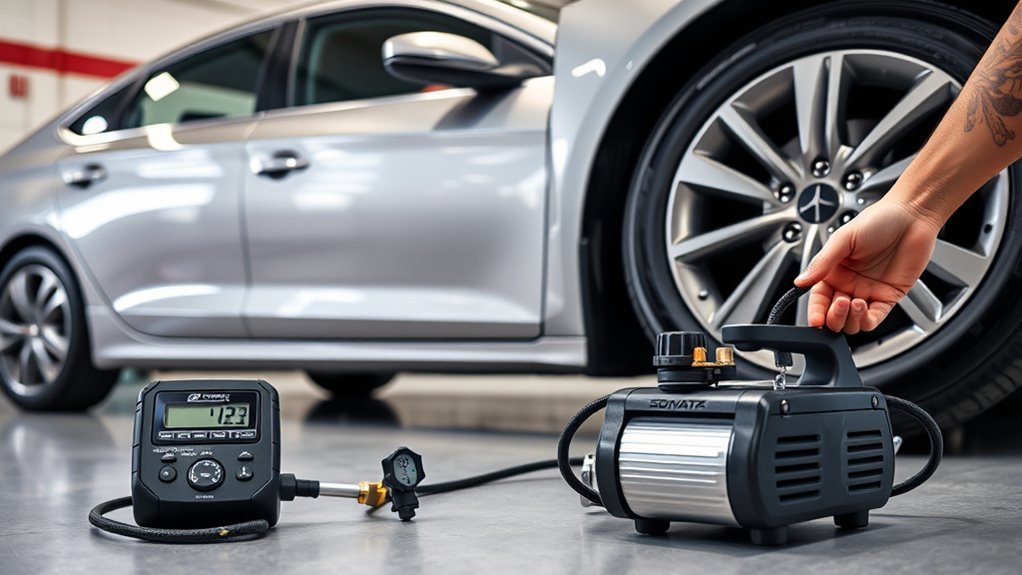
Having adjusted PSI for temperature and load, you’ll want a simple routine and the right tools to check and set pressure accurately. You’ll use a reliable tire pressure gauge and an air compressor. With cold tires, press the gauge onto the valve stem until you hear a hiss — that seal gives a true reading. Compare the reading to the manufacturer’s recommended PSI on the driver’s door jamb or owner’s manual. If pressure’s low, add air in short bursts, rechecking frequently to avoid over-inflation. Make a habit: check monthly and before long trips, and inspect tires for damage while you’re at it. These maintenance tips free you from uncertainty and keep control in your hands.
- Feel confident when you hear the seal click
- Take pride in precise readings
- Experience the calm of prepared journeys
- Reject neglect with a monthly check
- Embrace control through clear maintenance tips
Tire Wear, Safety Signs, and When to See a Technician
Inspect your tires regularly for uneven wear, bulges, cracks, or tread loss—signs that demand prompt attention and often a technician’s assessment. You’ll spot outer-edge or center wear from improper pressure; address it fast with tire maintenance and a pressure check. Tread below 2/32″ is critical—replace tires and consult a pro. Bulges, cuts, or punctures are safety indicators; don’t drive on compromised rubber. Vibrations or pulling suggest alignment or internal tire issues; schedule a specialist inspection. A sudden pressure drop can cause overheating and blowouts; stop and have a technician evaluate the tire and valve.
| Symptom | Likely Cause | Action |
|---|---|---|
| Outer-edge wear | Underinflation | Inflate to spec; inspect |
| Center wear | Overinflation | Adjust PSI; monitor |
| Bulge/crack | Structural failure | Replace immediately |
| Vibration/pull | Misalignment/tire damage | Alignment/inspection |
| Sudden pressure drop | Puncture/leak | Repair or replace |
Use these safety indicators to preserve freedom on the road.
Frequently Asked Questions
What Psi Should My Hyundai Sonata Tires Be At?
Set your Sonata tires to 32 PSI front and rear for typical models; you’ll follow tire maintenance tips and maintain ideal tire pressure to improve fuel economy, handling, and tire life while liberating yourself from avoidable breakdowns.
Is 34 Psi Too Much?
Not necessarily—think of 34 PSI as a firm handshake: it usually won’t harm tire wear and supports pressure safety, but you should check your vehicle’s placard and adjust for load, temperature, or personal comfort.
Conclusion
Keep your Sonata’s tire pressure within the recommended range to avoid “mechanical mood swings” that compromise handling, fuel economy, and tire life. Check the doorjamb sticker, owner’s manual, or VIN data, and adjust for load or temperature using a quality gauge or compressor. Inspect tires regularly for uneven wear or bulges, and get professional help if issues persist. Small, routine checks prevent bigger problems and keep your car behaving predictably and safely.

Related Articles
Hyundai Sonata Tire Sidewall Damage: Can It Be Repaired?
Hyundai Sonata tire sidewall damage poses serious risks—discover why replacement is often the safest choice for your vehicle's integrity and your safety.
Read More
Hyundai Sonata Tire Rubber Compound Explained: Why It Matters
Performance and safety in your Hyundai Sonata hinge on tire rubber compounds—discover how these blends impact your driving experience and what you need to know.
Read More
Is It Safe to Drive With a Nail in a Hyundai Sonata Tire?
Safety concerns arise when driving with a nail in your Hyundai Sonata tire; discover what steps you should take to ensure your well-being on the road.
Read More