
How to Check Tire Tread Depth on Your Hyundai Sonata at Home
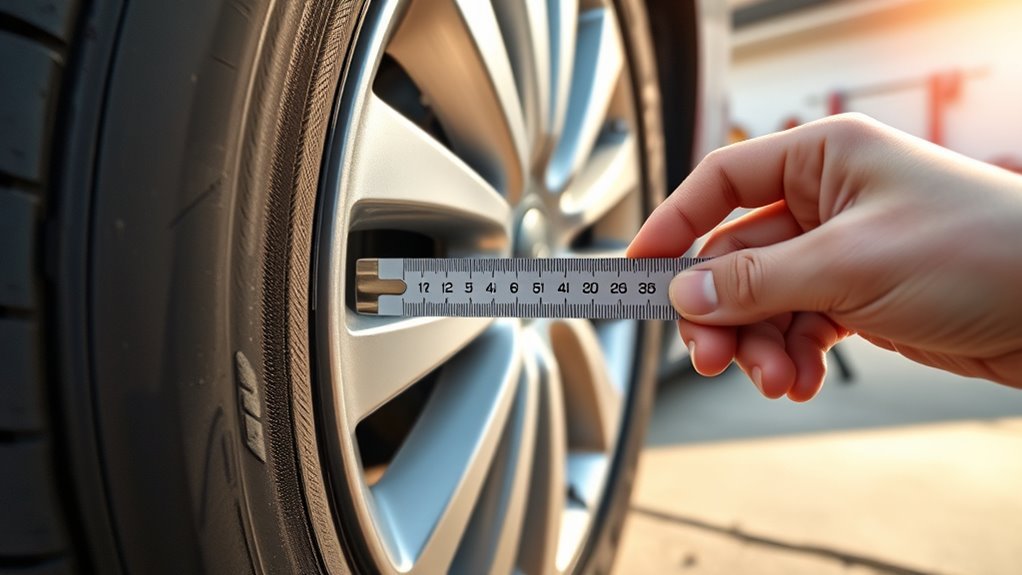
You can check your Hyundai Sonata’s tire tread at home with a coin or gauge: park on level ground, set the parking brake, then use the penny (Lincoln’s head) and quarter tests in several grooves around each tire to spot low tread, or clean grooves and take precise readings with a tread depth gauge at three positions per tire. Inspect for uneven wear, check pressures against the door placard, and note built‑in wear bars for replacement—keep going to learn detailed steps and fixes.
Quick Answer : Check Tire Tread Depth on Your Hyundai Sonata
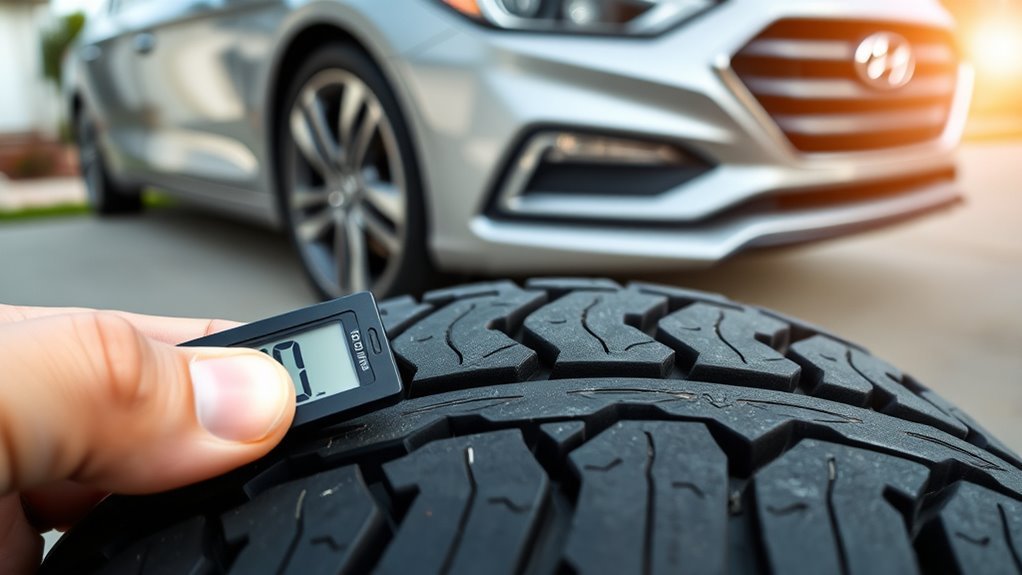
To check tire tread depth on your Hyundai Sonata, use the penny test: insert a penny into the tread with Lincoln’s head facing down—if you can see the top of his head, your tread is at or below 2/32″ and you should replace the tire. Start by parking on level ground, engaging the parking brake, and inspecting all four tires. Use the penny test as a quick indicator of critical tread wear; if it fails, act immediately for tire safety. For clearer measurement, use a tread depth gauge to get exact readings and record them. Check multiple spots around each tire to find uneven tread wear—this points to inflation or alignment problems you can correct to reclaim control. Replace tires at or below 2/32″, and consider replacement at 4/32″ for better wet traction. Stay proactive: regular checks free you from unexpected failures and keep your Sonata safe and mobile.
How to Do the Penny and Quarter Tests (Where to Insert Coins on Sonata Tires)
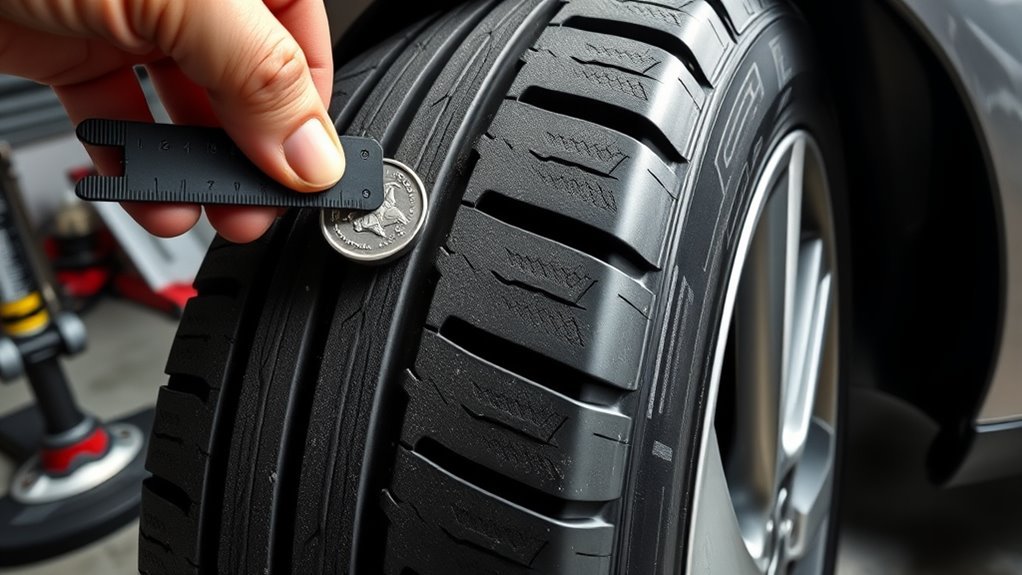
Place a penny or quarter vertically into a main tread groove with the coin’s head facing down to check depth—Lincoln for the penny, Washington for the quarter. Insert the coin at several points around each Sonata tire (inner, center, outer) since wear can vary. If the penny shows Lincoln’s head you’re at or below 2/32″; if the quarter’s head is partially covered you’re at or above 4/32″.
Proper Coin Placement
Start by inserting a penny into a major tread groove with Lincoln’s head pointing down; if the top of his head is visible, the tread is under 2/32” and the tire should be replaced. Use proper coin orientation every time: penny head down for the 2/32″ threshold, quarter head down for the 4/32″ check. For the quarter test, if the tread covers part of Washington’s head, you meet the 4/32″ minimum for better wet traction. Aim coins at ideal testing locations—deep, primary grooves where rubber contacts the road—to get consistent readings. Hold the coin straight and perpendicular to the tread surface, push to seat it fully, then inspect head visibility. These simple, deliberate steps free you to monitor tire safety and act decisively.
Check Multiple Locations
Check three to four spots around each Sonata tire—outer, inner, and two center grooves—to get a true sense of tread condition; insert the penny or quarter head-down into the deepest visible groove at each spot, seat it fully, and note whether the head is covered. Move systematically: mark the valve stem as a reference, then rotate placement clockwise to inspect the next groove. Use the penny test to flag tread at or below 2/32″ and the quarter test to confirm above 4/32″ for better wet-weather performance. Record which locations show reduced depth to reveal uneven tire wear and abnormal tread patterns. Repeat monthly or before long trips so you can act decisively—inflate, align, or replace—regaining control of your ride.
Measure Tire Tread Depth With a Gauge and Read Built‑In Wear Bars
Use a tread depth gauge to get precise measurements and inspect the built‑in wear bars in each groove; if the gauge reads 2/32 inch or the wear bar is flush with the tread, replace the tire. Start by cleaning debris from a groove, then press the gauge plate flat and extend the probe to contact the base. Note readings at three positions across the shoulder-to-center span and compare for uneven wear. Rely on gauge accuracy—calibrate or use a quality tool—to avoid false security.
Next, visually locate tread indicators (wear bars) molded perpendicular to grooves. If a bar sits level with the surrounding tread in any spot, that tire no longer protects you. Record depths for each tire and map low spots; persistent uneven readings signal alignment or inflation problems you shouldn’t ignore. You’re taking control: measure deliberately, act on clear data, and replace tires that fail the gauge or show flush wear bars to maintain safety and freedom on the road.
Tread Depth: Safety Thresholds and Legal Limits (2/32″, 4/32″, US & Canada)
Tire tread thresholds matter: in the U.S. you must replace tires at 2/32″ tread depth, while safety-minded experts and many Canadian recommendations push replacement to about 4/32” (roughly 3.175 mm) because wet‑weather traction and stopping distance degrade considerably below that. You should treat 2/32″ as the legal stop: driving on thinner tread risks fines and catastrophic hydroplaning. For liberation—control of your commute—aim for 4/32″ as a proactive threshold.
Check provincial rules if you’re in Canada; requirements vary (Alberta references 0.32 cm above wear indicators; Manitoba suggests about 4.75 mm). Use a gauge to confirm measurements and document results. Prioritize replacing tires that fall below 4/32″ to address safety concerns before they become emergencies. Make tread depth checks part of routine maintenance so you stay free from unexpected loss of traction, longer stopping distances, and avoidable accidents.
Find and Diagnose Uneven Wear on Your Sonata (Pressure, Alignment, Suspension)
Check your Sonata’s tread visually and with a gauge to spot patterns: center wear points to over‑inflation, edge wear to under‑inflation. If one side shows particularly more wear, get a wheel alignment to correct toe or camber issues. Also inspect struts, shocks, and bushings for play or leaks, since worn suspension parts change tire contact and accelerate uneven wear.
Tire Pressure Indicators
Start by measuring all four tires’ pressures with a reliable gauge and compare each reading to the recommended PSI on the driver-side door placard, because correct inflation prevents uneven wear patterns like center or edge scalloping. Check readings cold, record them, and apply inflation tips: add air to low tires, release from over-inflated ones, then recheck. If one side shows progressive loss or one tire consistently reads lower, inspect for leaks, valve issues, or suspension damage. Uneven center vs. edge wear points to pressure problems; one-side excess wear suggests alignment or suspension concerns. Stay proactive to reclaim control of your Sonata’s performance.
| Tire | PSI (measured) | Action |
|---|---|---|
| Front Left | ||
| Front Right | ||
| Rear Left |
Wheel Alignment Signs
Now that you’ve confirmed proper tire pressures, look for visual and handling cues that point to misalignment on your Sonata. Inspect tread depth at three positions across each tire; bald spots on one side mean misalignment and require attention. Outer-edge wear signals under-inflation, center wear means over-inflation—both affect handling and safety. If the steering wheel vibrates or you feel steering-wheel vibration causes while driving straight, note that as an alignment symptom. Record which tire shows uneven wear and any vibration causes, then drive slowly on a flat road to confirm pull or wander. With documented evidence, seek professional alignment adjustments to restore caster, camber, and toe. Do this promptly to reclaim control, extend tire life, and free yourself from avoidable risks.
Suspension Component Wear
When your Sonata shows uneven tread despite correct pressures and alignment, suspect worn suspension parts and inspect for play, leaks, or damaged bushings that change how the tire contacts the road. Start a suspension inspection by safely lifting the car and supporting it on stands. Grab each wheel at 12 and 6 o’clock, then 3 and 9, and feel for looseness indicating worn ball joints or tie rods. Visually check shocks/struts for oil leaks and bent mounts. Pry control arm bushings with a pry bar to reveal cracks or movement. If any play, leakage, or torn bushings appear, plan component replacement—replace in pairs and torque to spec. After repairs, recheck alignment and tire pressures to restore even wear and control.
Simple Maintenance to Extend Tire Life and When to Replace Tires
Check your tires regularly and you’ll extend their life while staying safer on the road: keep pressure at the manufacturer’s recommendation (check monthly and before long trips), rotate tires every 8,000–10,000 km to even out wear, and inspect tread depth and wear patterns so you can act before performance degrades. Use tire maintenance tips: check inflation, rotate on schedule, and scan for irregular wear. Do the penny test; if Lincoln’s head shows, follow your tread replacement schedule and replace now. Replace at 4/32″ for better wet traction; 2/32″ is legally worn out.
| Action | Why it matters |
|---|---|
| Monthly pressure check | Prevents uneven wear |
| Rotation every 8–10k km | Balances tread life |
| Visual wear inspection | Reveals alignment/pressure issues |
| Penny test | Quick tread depth check |
| Replace at 4/32″ | Restores wet braking performance |
Follow these steps to stay free from avoidable breakdowns and keep control on every drive.
Frequently Asked Questions
What Does a 2/32 Tread Look Like?
A 2/32 tread looks bald: tread wear bars sit flush with the surface and grooves are nearly gone, Lincoln’s head shows fully; you’ll use safety checks to confirm immediate replacement for safe, liberated driving.
How Much Is 4/32 Tread Depth?
4/32″ is four thirty-seconds of an inch; it’s the tread depth many experts set as the minimum for tire safety. Measure with a gauge or quarter, and replace when grooves reach that limit to protect yourself.
Conclusion
Now that you know the checks, don’t wait—inspect your Sonata’s tires like clockwork. Use the penny/quarter tests or a gauge, look for wear bars, and watch for uneven wear patterns caused by pressure, alignment, or suspension issues. Keep tread above safety thresholds (replace at or before 4/32″ for wet grip concerns, 2/32″ legal limit), rotate and balance regularly, and treat tire care as preventive medicine to extend life and protect yourself on the road.

Related Articles

Hyundai Sonata Overall Tire Diameter by Size: Full Chart
Hyundai Sonata overall tire diameter by size: discover exact measurements, common OEM examples, and fitment tips to ensure speedometer accuracy and proper clearance.
Read More
Hyundai Sonata Tire Aspect Ratio Explained: What the Number Means
Good to know: discover how the Sonata’s tire aspect ratio affects ride, handling, and speedometer accuracy — and why that number really matters.
Read More
Hyundai Sonata Compatible Tire Sizes: Full Fitment Guide
I need to show which Hyundai Sonata generations accept which tire sizes and why fitment, offset, and diameter matter—read on to get exact matches.
Read More