How Tire Weight Affects Hyundai Sonata Fuel Economy Explained
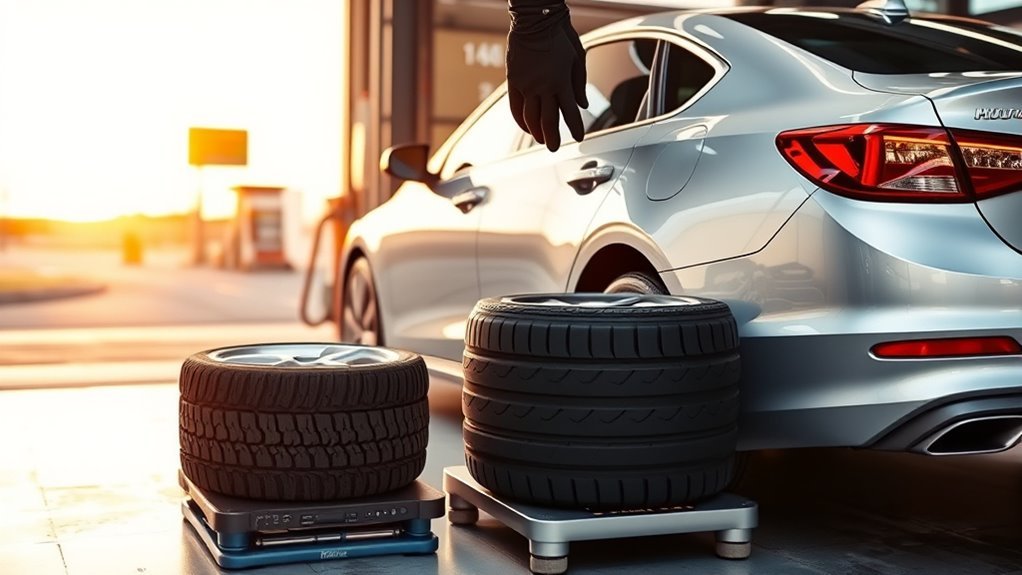
You’ll gain noticeable MPG and quicker acceleration by cutting unsprung weight on your Hyundai Sonata—each ~5 lb removed per wheel gives efficiency similar to shedding ~20 lb from the body. Lighter 16–18 lb wheels reduce rotational and translational inertia, lowering drivetrain load and improving launch and braking. Upsizing diameter or width raises rolling resistance and aero drag, hurting highway MPG. Expect single-digit percent highway penalties with aggressive sizes; keep going for specifics on weights, costs, and trade-offs.
Quick Answer: Will Lighter Wheels Improve My Sonata’s MPG?
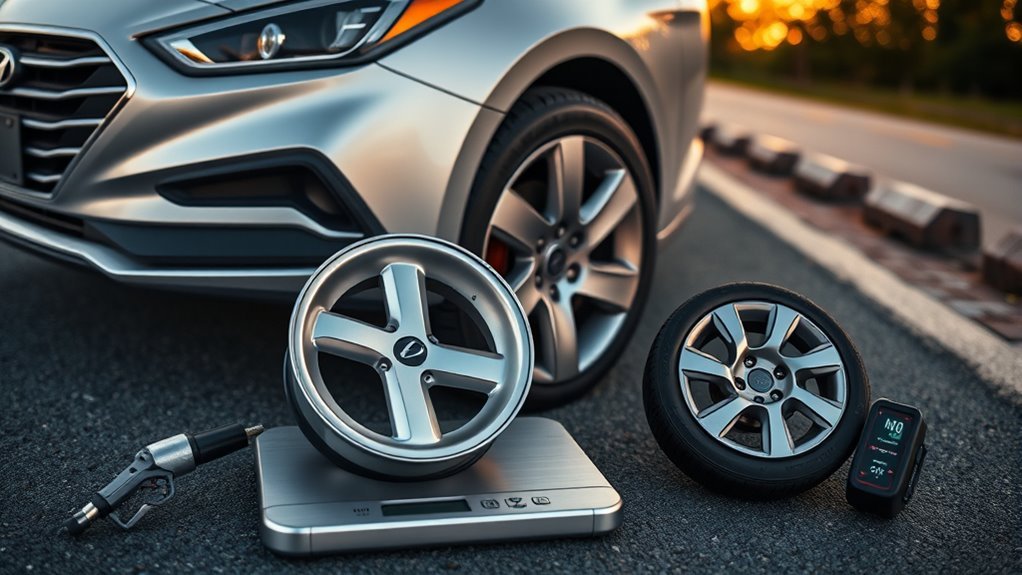
Curious whether lighter wheels will boost your Sonata’s MPG? You’ll see measurable gains: reducing wheel mass cuts unsprung weight, improving drivetrain efficiency and lowering fuel use. Because the performance ratio of unsprung to vehicle weight averages about 4:1, shaving a few pounds per wheel produces outsized MPG benefits versus equivalent curb-weight reductions. Choose wheel designs and tire materials that balance low mass with structural strength; lightweight aftermarket wheels under ~22 lbs typically improve efficiency without compromising durability. Remember that lighter rims only help if tires are maintained—under-inflated tires on light wheels raise rolling resistance and erase savings. Quantitatively, modest per-wheel reductions commonly translate to noticeable highway and urban MPG improvements as you accelerate and maintain speed with less energy. If you want liberation from frequent fuel stops, prioritize optimized wheel designs, advanced tire materials, and disciplined pressure maintenance to convert reduced rotating mass into consistent, real-world fuel-economy gains.
How Unsprung Weight Hurts Sonata Acceleration and Braking
Because unsprung mass multiplies its impact on vehicle dynamics, heavier wheel-and-tire assemblies particularly hinder your Sonata’s acceleration and braking: a 54‑lb 19″ package carries more rotational and translational inertia than a 40‑lb 15″ package, demanding extra torque to reach the same speed and increasing stopping distance. You’ll feel reduced launch authority and longer 0–60 times because the 4:1 performance ratio amplifies unsprung weight’s performance impact on the car’s sprung mass response.
| Metric | Effect |
|---|---|
| Unsprung weight increase | More rotational inertia |
| Acceleration | Slower 0–60, higher power demand |
| Braking | Longer stopping distance |
Choose lighter wheels to reclaim control and efficiency. Reducing unsprung weight lowers required torque, trims braking distance, and improves responsiveness—direct, measurable gains. For liberation-seeking drivers, swapping to low-mass rims and tires is a pragmatic upgrade that translates to sharper performance and better fuel use without compromising daily usability.
How Tire Diameter and Width Change Rolling Resistance
When you fit larger-diameter or wider tires on a Sonata, rolling resistance rises predictably: increased contact patch area and altered carcass deformation demand more energy per mile, which lowers MPG and shifts the effective torque curve toward higher load at acceleration. You’ll observe that increased tire diameter elevates the energy per revolution required to overcome rolling resistance, reducing fuel efficiency in measurable increments—often several percent depending on size change and pressure. Wider tire width expands the contact patch laterally, increasing hysteretic losses and friction; that higher friction converts more fuel into heat rather than motion. You should maintain correct pressure, because under-inflated tires amplify carcass flex and worsen rolling resistance dramatically. Quantify expectations: modest diameter or width gains give modest MPG penalties; aggressive upsizing yields steeper losses and a clear performance impact during acceleration. If you want liberation from needless consumption, prioritize narrower, properly inflated tires to minimize rolling resistance and maximize fuel efficiency.
How Tire Size Alters Sonata Aerodynamics and Highway RPM
If you fit larger-diameter or wider tires on your Sonata, expect measurable aerodynamic and driveline effects at highway speeds: increased frontal area and altered airflow around the wheel wells raise drag coefficient (Cd) slightly, while the larger rolling radius lowers engine speed for a given vehicle speed and can move the engine away from its ideal torque/BSFC zone. You’ll also see wider tires increase frontal turbulence and skin friction, raising parasitic losses that subtract from net propulsion power and reduce MPG. Larger contact patch area from wider or bigger tires improves traction but elevates rolling resistance; combined with suboptimal tire pressure this worsens energy dissipation. Conversely, smaller-diameter tires usually keep cruising RPM in a range that aligns engine load with peak efficiency, lowering fuel consumption at steady speeds. Quantitatively, expect single-digit percent penalties in highway fuel economy from aerodynamic and driveline shifts when changing tire size, depending on width, diameter, and inflation practices.
Real Trade-Offs: Acceleration, Braking, Handling, and MPG
You’ll trade acceleration for rotating mass: a 19″ wheel/tire package around 54 lb demands more power than a 40 lb 15″ setup and can cost roughly 0.2 s on 0–60 when moving from 16″ to 18″. Lighter wheels reduce unsprung weight (a 4:1 performance leverage vs. sprung mass), improving suspension response and braking, whereas larger/wider tires shorten stopping distance but raise rolling resistance and fuel use. Expect about a 2.2 mpg penalty switching from 15″ to 19″ wheels, so balance grip and handling gains against measurable MPG and acceleration losses.
Acceleration Versus Wheel Mass
Although heavier wheels and tires look substantial, they measurably hurt dynamic performance because you must accelerate, decelerate, and control more rotating and unsprung mass. You’ll notice wheel material choice and tire pressure interact with mass: denser alloys raise rotating inertia, low tire pressure amplifies energy losses, and both reduce launch responsiveness. A 19″ package (~54 lbs) versus a 15″ (~40 lbs) demonstrates the cost—heavier assemblies slow 0–60 and mimic lost engine output; switching 15″→19″ has cut fuel economy by ~2.2 mpg and added measurable acceleration lag. Unsprung weight affects acceleration at a roughly 4:1 effectiveness compared to sprung mass, so reducing wheel/tire mass yields outsized gains. Choose lighter wheels and correct tire pressure to reclaim performance and autonomy.
Braking And Unsprung Weight
When you cut unsprung weight—for example swapping a 54 lb 19″ wheel/tire assembly for a 40 lb 15″ package—you reduce the rotational and suspension inertia the brakes and chassis must control, which shortens stopping distances and sharpens handling while also improving acceleration and fuel economy. You’ll observe improved braking efficiency because less wheel inertia means the brake system dissipates kinetic energy more readily; a 4:1 unsprung-to-sprung performance ratio amplifies this benefit. Heavier wheels raise unsprung mass, increasing required braking torque and extending stopping distances while taxing the engine during acceleration, lowering MPG. Choose lighter wheel/tire combinations to reclaim control and efficiency: reduced inertia lets you brake later, accelerate sooner, and free yourself from the penalty heavier rolling assemblies impose on fuel consumption.
Handling, Grip, And MPG
Because tire choice directly links grip, unsprung mass, and rolling resistance, you need to balance handling gains against fuel-penalty costs on the Sonata. You’ll find heavier tires raise unsprung weight, degrading acceleration, braking, and handling; the effective impact is amplified by a roughly 4:1 performance ratio between unsprung and sprung mass. Wider rubber boosts tire performance and traction balance, improving cornering but increasing rolling resistance and lowering MPG. Choose tire width and mass to match your priorities: prioritize lighter, narrower options for fuel-efficient commuting; pick wider, lighter-construction tires for spirited driving while accepting reduced economy. Maintain correct tire pressure to optimize grip and minimize rolling resistance—under-inflation erodes both traction balance and fuel consumption. Data-driven choices free you from compromise.
Typical Weights: Stock vs Lightweight Rims and Full Tire Packages
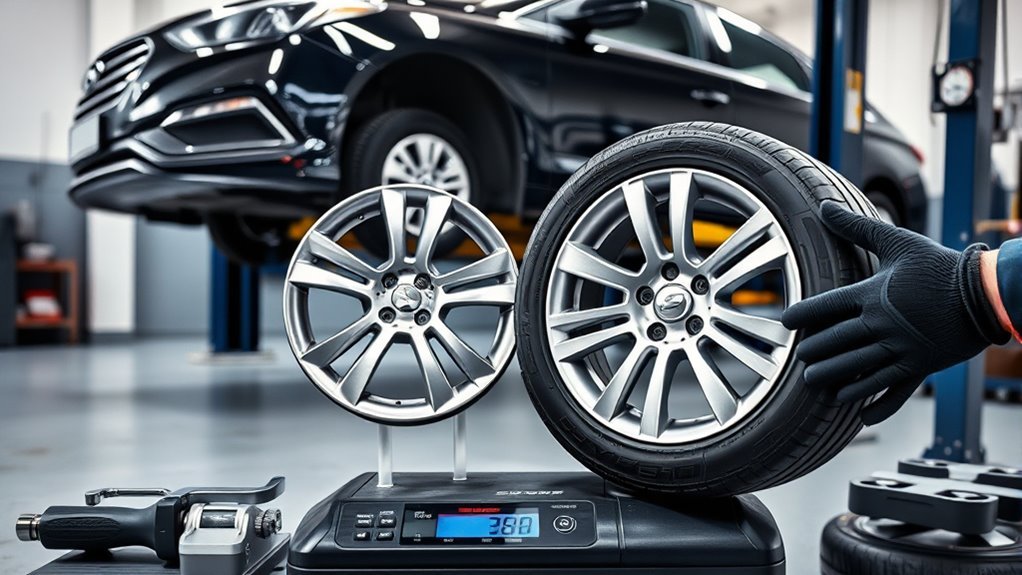
You’ll see stock Sonata rims at about 22 lb each, with full 15″ tire-and-wheel packages near 40 lb and 19″ packages around 54 lb. Choosing lightweight wheels (16–18 lb each) can save up to ~6 lb per corner, reducing unsprung mass and rotational inertia. Because unsprung weight affects performance roughly 4:1 versus sprung weight, those per-wheel savings translate into measurable gains in acceleration efficiency and fuel economy.
Stock Rim And Tire Weights
One clear way to cut weight on a Hyundai Sonata is swapping its stock 22 lb rims for lightweight alternatives that weigh 16–18 lbs, trimming 4–6 lbs of unsprung mass per corner. You’ll see gains because rim materials and weight distribution alter rotational inertia; lighter rims reduce the engine’s work and improve acceleration, braking, and handling. A full wheel+tire package ranges roughly 40 lbs for 15-inch setups up to 54 lbs for 19-inch kits, so choosing smaller or lighter packages lowers total vehicle mass. Remember the 4:1 performance ratio: reducing unsprung weight yields outsized dynamic benefits. Lightweight rims cost more, but you’ll free yourself from excess mass and recover fuel through improved efficiency and MPG.
Lightweight Wheel Package Options
After cutting 4–6 lbs per corner by replacing 22 lb stock rims with 16–18 lb lightweight options, you’ll want to compare full wheel+tire packages to quantify net gains. You’ll evaluate lightweight rim benefits against package weights: a stock 15″ wheel+tire ≈40 lbs versus a 19″ ≈54 lbs. Choose rim material options (forged aluminum, flow-formed, alloy) to balance weight, strength, and cost. Carefully select aftermarket wheels to avoid durability trade-offs while pursuing liberation from excess mass. Reduced package weight lowers rolling resistance and improves handling, yielding measurable fuel-economy and acceleration advantages. Use the table below to compare representative configurations and prioritize options that maximize efficiency per dollar.
| Configuration | Weight (lbs) | Notes |
|---|---|---|
| Stock 15″ | 40 | OEM baseline |
| Stock 19″ | 54 | Larger, heavier |
| Lightweight 15″ | 34–36 | Forged/flow-formed options |
Unsprung Weight Impact Estimates
Reducing unsprung mass by swapping 22 lb stock Sonata rims for 16–18 lb lightweight units trims roughly 4–6 lbs per corner (up to ~24 lbs total) and yields outsized performance gains because unsprung weight affects dynamics about four times more than the same change in sprung mass; that means a 5 lb drop at a wheel corresponds roughly to the handling/ride/acceleration effect of removing ~20 lbs from the car body. You’ll see measurable performance impact: reduced rotational inertia improves acceleration and transient response, while lower unsprung weight enhances suspension control and tire contact, improving ride and cornering. Comparing full packages, a 54 lb 19″ wheel/tire versus a 40 lb 15″ shows clear acceleration, handling, and fuel-economy penalties from added unsprung mass.
Costs and Long‑Term Ownership: Tire Prices, Lifespan, Mounting
Four key cost drivers determine the long‑term financial impact of tire choices: unit price differences (about $79 for 16‑inch vs. $132 for 18‑inch, a $212 gap per set), lifespan disparities (high‑performance larger tires often wear faster, projecting $2,800–$3,000 in replacement costs over ten years), mounting and balancing fees, and limited availability of long‑wear compounds in larger sizes that force more frequent replacements. You’ll evaluate tire longevity considerations and mounting cost implications against fuel and handling trade‑offs to free yourself from repeat, costly purchases.
Weigh tire price, longevity, mounting costs, and compound availability to minimize replacements and total ownership expense.
- Compare per‑set purchase price and projected decade replacement cost.
- Quantify wear rates: high‑performance 18‑inch vs. touring 16‑inch.
- Include mounting, balancing, and disposal fees in total cost models.
- Factor supply constraints for long‑wear compounds in larger sizes.
Use measured data to calculate annualized cost-per-mile, prioritize durable compounds to minimize replacements, and choose wheel sizes that align with your fiscal freedom and long‑term ownership goals.
Decision Checklist: Prioritize Economy, Handling, or Appearance
When you weigh economy, handling, and appearance, prioritize the attribute that most reduces your total cost-per-mile and meets your driving needs: choose lighter 16–18 lb wheels and narrower, touring tires if fuel economy and longevity matter. You’ll gain measurable benefits: reducing unsprung mass from ~22 lb stock rims to 16–18 lb improves acceleration and efficiency; upsizing wheels can cut fuel economy ~1–2 mpg and adds ~0.2 s to 0–60 mph from 16″→18″. Use quantitative thresholds: prefer wheel mass under 18 lb and moderate tire widths to limit rolling resistance. If you demand handling, accept wider tires but expect higher fuel and replacement costs (larger tires average ~$212 extra per set). Factor in tire maintenance—proper pressure, alignment, and rotation recover efficiency and extend life. Lightweight aftermarket wheels can deliver performance with limited durability tradeoffs; weigh upfront cost vs. recurring fuel and replacement savings. Choose freedom: optimize the metric mix that lowers your total operating cost.
Frequently Asked Questions
How Much Does 200 Pounds Affect Gas Mileage?
You’d gain roughly 1–2% fuel economy (about 0.5–1 mpg) by removing 200 pounds; maintain correct tire pressure and optimize weight distribution, since unsprung mass and rolling resistance still dictate real-world variance in efficiency.
Does 10 Lbs per Tire Make a Difference?
By and large, yes — a 10‑lb heavier tire per corner reduces fuel efficiency measurably; you’ll see higher rolling resistance, altered tire pressure sensitivity, and slightly worse MPG, so you’ll reclaim autonomy with lighter, optimized tires.
Conclusion
You’ll usually cut weight at the wheel to gain the biggest real-world MPG return: shaving 20 lb of unsprung mass (about a pair of lighter 18″ wheels plus tires) can improve acceleration and braking noticeably and yield roughly 1–2% better fuel economy in mixed driving. Balance that against cost and tire life—lighter performance wheels may wear faster or cost 20–50% more. Prioritize economy, handling, or appearance based on that trade-off.

Related Articles
Hyundai Sonata Tire Leaking From Valve Stem: How to Fix It
How to resolve a leaking valve stem in your Hyundai Sonata and ensure your tires are safe and reliable—discover the essential steps to fix it!
Read More
Hyundai Sonata Tire Stopping Distance: Snow vs Dry Pavement
Stopping distances for your Hyundai Sonata vary greatly between snow and dry pavement; discover how tire selection plays a crucial role in your safety.
Read More
Hyundai Sonata Tire Going Flat Overnight: Common Causes & Fixes
Uncover the common causes of your Hyundai Sonata's overnight flat tire and discover essential fixes to keep you rolling smoothly. Don't let flat tires slow you down!
Read More