
LT Tires vs P Metric Tires for a Toyota Tacoma
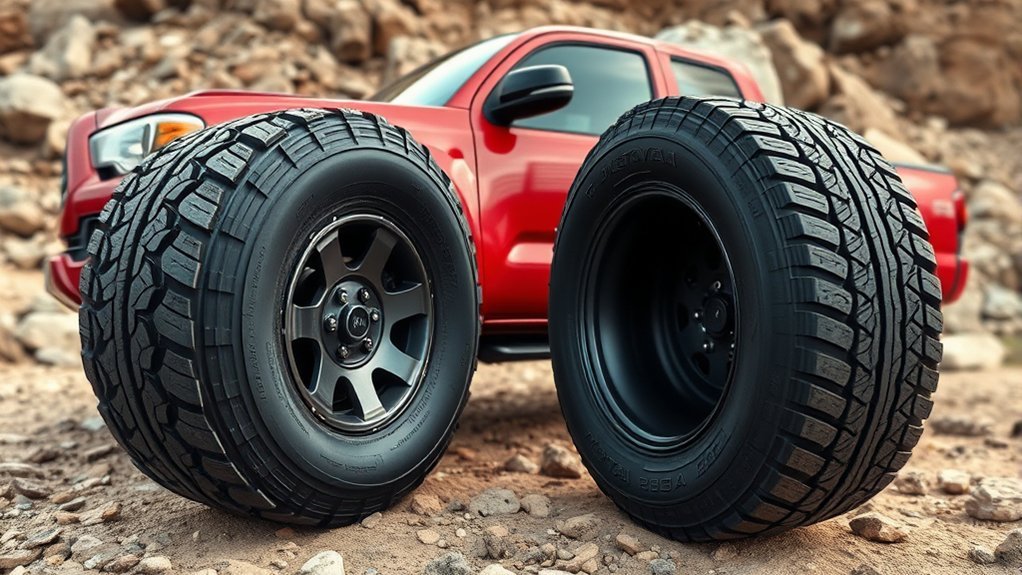
Choosing between LT and P-metric tires for your Toyota Tacoma is not as simple as picking the stronger-looking tire. Your correct choice depends on the Tacoma’s model year, factory specifications, actual axle load, towing or cargo use, road conditions, and the exact tire size and service description. An LT label can add useful capacity and durability, but it does not automatically provide better traction or make your truck safer.
Quick Answer
For most Tacoma owners who drive mainly on pavement and carry light loads, an approved P-metric or metric tire provides the best balance of comfort and efficiency. Choose an LT tire when your exact size, load table, and driving conditions justify added load capacity or durability. Never select a tire by the LT label alone.
Key Takeaways
- Start with the tire size, load requirement, speed rating, and cold pressure specified for your exact Tacoma.
- P-metric or metric tires often suit commuting, highway travel, and light-duty truck use when their load capacity is sufficient.
- LT tires can add load capacity, casing strength, and resistance to severe use, but may add weight, stiffness, noise, and rolling resistance.
- An LT prefix does not guarantee better rain, snow, mud, or ice traction. Tread pattern, compound, tread depth, and winter certification matter.
- Changing between P-metric, metric, and LT construction may require a different pressure based on manufacturer load-and-inflation tables.
Understanding Your Tacoma’s Tire Needs
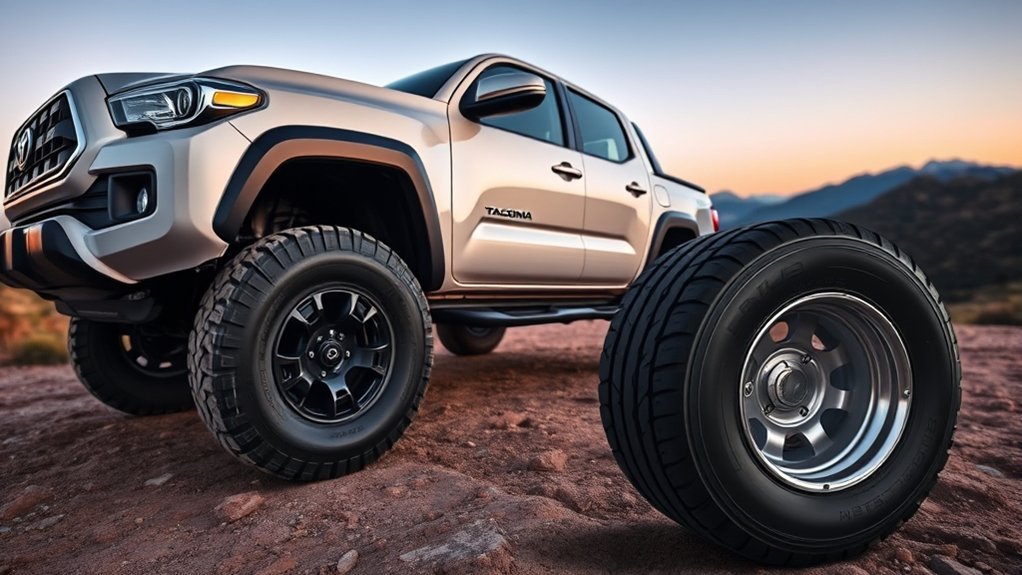
Your first step is to identify what your specific Tacoma requires. Tire sizes and recommended pressures vary by model year, trim, wheel package, drivetrain, and configuration. For example, Toyota lists several different tire sizes and cold inflation pressures for the 2024 Tacoma rather than one universal Tacoma specification.
Check the Tire and Loading Information label on the driver’s door jamb and your owner’s manual. The label normally gives the original tire size and recommended cold pressure. You should also inspect the certification label for the vehicle’s gross axle weight ratings, or GAWR.
NHTSA advises drivers to use the vehicle manufacturer’s tire information when choosing a replacement size and setting pressure. The maximum PSI molded on a tire’s sidewall is not a general recommendation for everyday driving.
[Products Worth Considering]

These aluminum alloy tire valve stem caps with an O-ring seal help protect valve stems from corrosion while adding a clean, stylish look to your vehicle. The universal fit works across cars, trucks, motorcycles, bicycles, and more, making them an easy upgrade for everyday driving and off-road use. Installation is quick, and the included four-pack keeps all your tires dressed and protected.
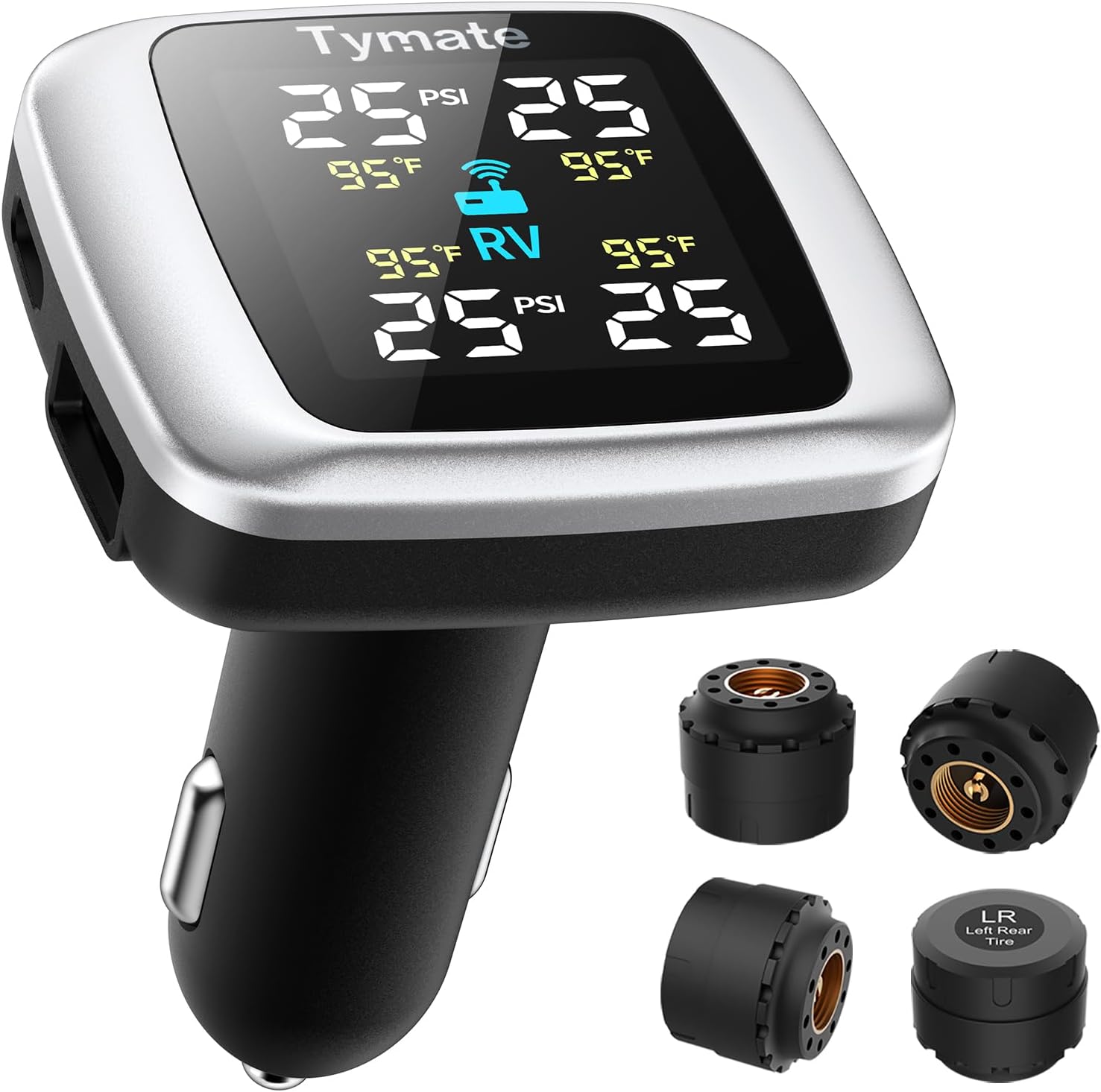
Tymate TM7 is a wireless tire pressure monitoring system that delivers real-time pressure and temperature readings for safer driving. It includes four external sensors, a bright color LCD display with adjustable backlight, and six alarm modes for high/low pressure, fast leakage, high temperature, and sensor signal or battery issues. The system covers a wide 0–144 PSI range and plugs into your vehicle’s cigarette lighter socket for quick DIY setup.

These universal tire valve stem caps help protect valve cores from dust, debris, and moisture while helping maintain stable tire pressure. The corrosion-resistant metal construction and sealed design provide reliable protection in road grime, mud, and winter conditions. Twist-on installation makes them quick to fit on cars, SUVs, trucks, and motorcycles.
Four Fitment Checks Before Buying
- Confirm the factory requirements: Record the original size, load index or load range, speed rating, and recommended cold pressure.
- Define how you use the truck: Consider normal passengers, bed cargo, trailer tongue weight, highway mileage, gravel roads, and severe off-road travel.
- Verify the proposed tire: Check its exact size, service description, approved wheel-width range, load capacity at the intended pressure, and physical dimensions.
- Check the complete installation: Confirm wheel pressure capacity, suspension and brake clearance, full-steering clearance, TPMS compatibility, and whether the system needs to be initialized again.
Warning: Installing higher-capacity tires does not increase your Tacoma’s GVWR, GAWR, payload rating, hitch rating, or maximum towing capacity. The vehicle manufacturer’s ratings still apply.
P-Metric, Metric, and LT Tire Markings
A Tacoma may use a P-metric tire, a metric tire without a prefix, or an LT tire, depending on its original equipment and configuration. The prefix is only one part of the tire’s full service description.
| Example | Type | What It Means |
|---|---|---|
| P265/70R17 | P-metric | A passenger-standard tire size that may be approved for cars, SUVs, and light-duty pickups. |
| 265/70R17 | Metric or hard-metric | A metric tire without a P or LT prefix. Do not assume its load table is identical to a P-metric tire. |
| LT265/70R17 | LT-metric | A light-truck-standard tire intended for more severe service and evaluated under LT load-and-inflation standards. |
The numbers that follow the size usually include a load index and speed symbol. Those markings matter because two tires with similar dimensions can have different capacities and pressure requirements. Michelin’s tire-marking guide explains how the prefix, size, load index, and speed rating work together.
What Are LT Tires and Their Advantages?
LT tires are designed for light trucks, SUVs, vans, and other applications that may face heavier loads or more severe operating conditions. Depending on the exact model and size, an LT tire may offer higher load capacity, a stronger casing, deeper tread, or improved resistance to cuts and impacts.
Those benefits can help when your Tacoma regularly carries a slide-in camper, heavy tools, recovery equipment, or substantial trailer tongue weight. They may also help on sharp rock, broken gravel, washboard roads, and other terrain that repeatedly stresses a passenger-standard tire.
Enhanced Durability Features
LT tires often use construction intended to handle greater pressure and more demanding service. However, durability varies between products. A mild LT highway tire and an aggressive LT mud-terrain tire can behave very differently.
- Stronger casing: Can improve stability under load and resistance to severe service.
- Higher pressure capability: May allow the tire to carry a greater load when the wheel and application support that pressure.
- Deeper or more aggressive tread: Available on many LT all-terrain and mud-terrain products, but not guaranteed by the LT prefix.
- Tradeoffs: Added weight and stiffness may affect ride comfort, acceleration, braking response, and fuel use.
Load Range and Load Capacity
LT tires may be labeled Load Range C, D, E, or another classification. Treat the load range as a load-and-inflation category, not as a literal count of physical casing plies. Modern tires can achieve a given load range with different materials and internal designs.
The only safe comparison uses the tire manufacturer’s load-and-inflation table for the exact size. An LT tire does not necessarily carry more weight than every P-metric tire at every pressure. Toyo warns that an LT replacement may require substantially more pressure to carry a load that a P-metric tire supports at a lower pressure.
Understanding P-Metric Tires and Their Benefits
P-metric tires are passenger-standard tires, but that does not mean they are unsuitable for a pickup. Vehicle manufacturers use P-metric and metric tires on many SUVs and light-duty trucks when the tire’s capacity and performance match the vehicle’s design.
For a Tacoma used mostly for commuting, highway trips, school runs, and light cargo, an approved P-metric or metric tire may provide a quieter and more compliant ride. Its lower mass may also help steering response and efficiency compared with a heavier LT alternative of similar dimensions.
| Potential Benefit | Important Limitation |
|---|---|
| Smoother response over pavement and small bumps | Ride quality still depends on pressure, sidewall height, tread, and suspension. |
| Usually lower tire weight | Weight varies significantly by model and size. |
| Often well suited to daily driving | The tire must still meet the Tacoma’s adjusted load requirement. |
| Wide choice of highway and all-terrain designs | Not every tread or size is approved for every Tacoma configuration. |
Note: When evaluating a P-metric or metric tire for a light-truck application, manufacturer guidance may require its listed load capacity to be divided by 1.10. Use the tire manufacturer’s current load table and have the conversion checked by a qualified tire professional.
Comparing LT and P-Metric Tires
| Factor | P-Metric or Metric | LT |
|---|---|---|
| Typical use | Commuting, highway driving, light cargo, and occasional mild trails | Heavy cargo, frequent towing, campers, commercial use, and repeated severe terrain |
| Ride | Often softer and more compliant | Often firmer, especially when the required pressure is higher |
| Load capacity | May be sufficient for the truck when properly selected and adjusted | Can provide additional capacity in an appropriate size and load range |
| Operating pressure | Follow the placard for an approved original-equipment equivalent | May require a recalculated pressure from an LT load table |
| Fuel economy | Often favorable when the tire is lighter and has low rolling resistance | May use more fuel if weight, diameter, or rolling resistance increases |
| Off-road durability | Can be adequate for maintained gravel and occasional moderate trails | Often better suited to repeated rock, sharp gravel, and heavy off-road loads |
| Wet or snow traction | Depends on tread, compound, depth, and weather certification | Also depends on tread, compound, depth, and weather certification |
| Cost | Often lower, but model and size matter | Often higher because of construction, size, and material differences |
Can LT Tires Handle Off-Road Adventures?
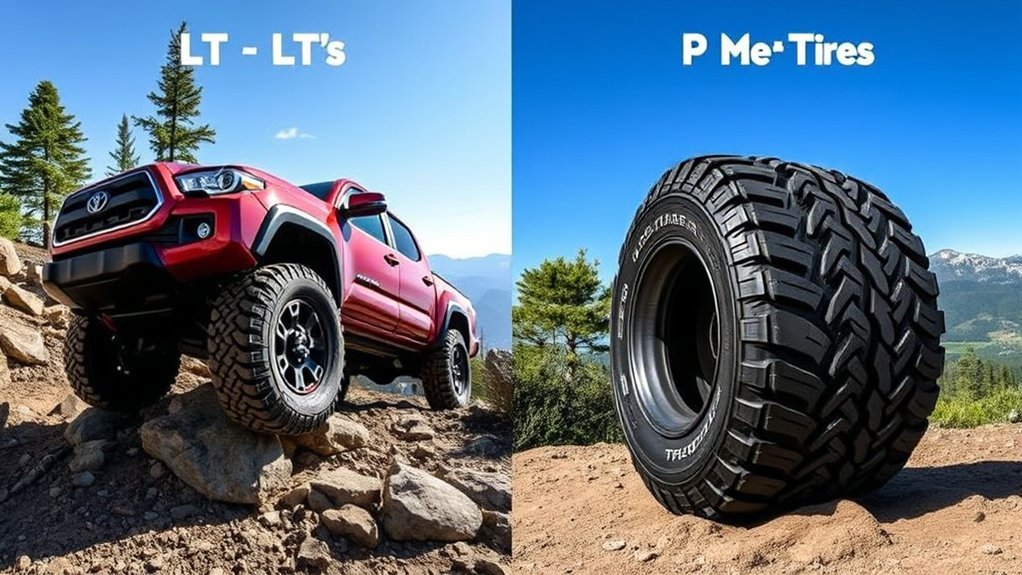
LT tires can be a strong choice for demanding off-road travel because many are designed for severe loads, impacts, and surface hazards. However, the LT prefix alone does not tell you whether a tire will grip mud, loose sand, wet pavement, snow, or ice.
Tread and Compound Determine Traction
A highway-terrain tire usually favors quiet pavement performance. An all-terrain tire balances road manners with gravel, dirt, and moderate trail use. A mud-terrain tire uses larger voids and aggressive tread blocks for loose surfaces, but may be louder and less refined on pavement.
For winter driving, look beyond an M+S marking. A tire carrying the Three-Peak Mountain Snowflake symbol has passed a standardized snow-traction test. Even then, a 3PMSF all-terrain tire may not match a dedicated winter tire on ice or in severe cold.
Durability in Rugged Terrain
An LT casing can help when the truck repeatedly encounters sharp rock, deep potholes, washboard roads, or heavy gear. Deeper tread and stronger sidewall features may also improve service life in those conditions. You still need to control speed, avoid overloading, and inspect the tires after hard trail use.
Pro Tip: For occasional gravel roads and mild trails, an approved P-metric or metric all-terrain tire may provide enough capability without the full weight and stiffness of an LT tire. Reserve heavier LT construction for loads and terrain that justify it.
LT vs P-Metric Tires: Load Capacity
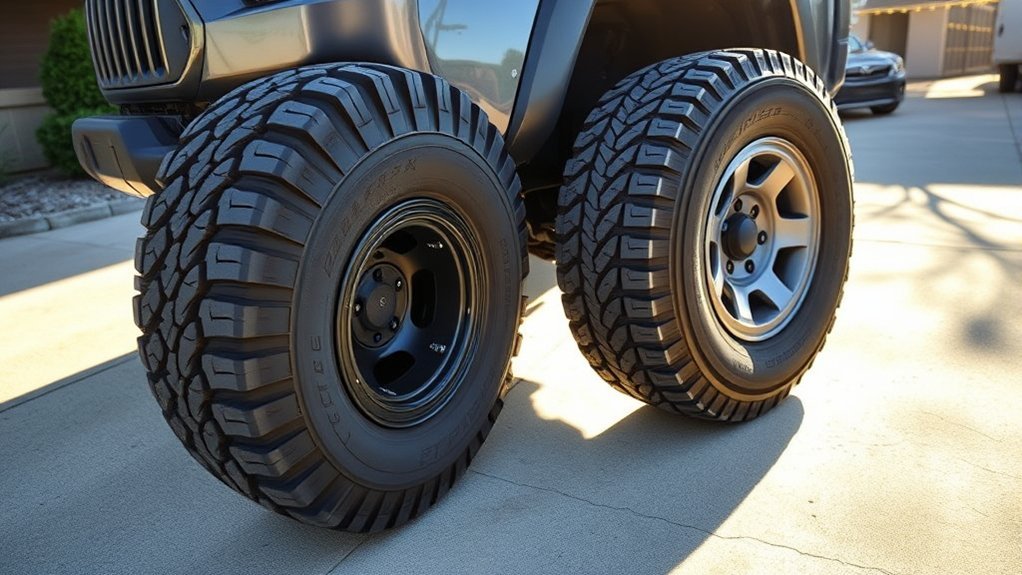
Do not compare P-metric and LT capacity by using broad numbers such as 2,500 or 3,750 pounds. The correct capacity depends on the exact tire size, load index or load range, inflation pressure, and whether a passenger-standard tire is being evaluated for light-truck service.
How to Check Load Capacity
- Find the original size and pressure on your Tacoma’s tire placard.
- Find the front and rear GAWR on the certification label.
- Obtain the proposed tire manufacturer’s current load-and-inflation table.
- Confirm that each tire can support the required axle load at the planned cold pressure.
- Apply the manufacturer’s light-truck adjustment when evaluating a P-metric or metric tire.
- Confirm that the wheel is rated for the size, load, and pressure.
Toyo’s light-truck replacement guidance states that a P-metric or metric tire’s capacity is reduced by dividing it by 1.10 when it is evaluated for light-truck use. Toyo also warns that an LT replacement can require a higher pressure to carry an equivalent load.
The correct tire is not the one with the highest sidewall number. It is the tire that supports your Tacoma’s required load at an approved pressure while fitting the wheel and preserving safe handling.
Impact of Tire Type on Fuel Economy
A heavier LT tire may reduce fuel economy compared with a lighter original-equipment-style tire, but no universal 2 MPG penalty exists. The actual change depends on tire weight, rolling resistance, tread aggressiveness, overall diameter, pressure, alignment, road speed, and driving habits.
NHTSA explains that materials, construction, and tread design all influence rolling resistance. It estimates that a 10% reduction in tire rolling resistance can improve vehicle fuel economy by approximately 1% to 2%. That relationship does not mean every LT tire uses a fixed amount of extra fuel.
Moving to a larger-diameter tire can add another variable. It may increase rotating mass, change effective gearing, affect acceleration, and cause displayed fuel-economy calculations to differ if the vehicle is not recalibrated.
[Products Worth Considering]

Upgrade your Toyota’s wheels with durable aluminum alloy valve stem caps that help protect valve cores from corrosion and direct exposure to road grime, clay, water, and snow. Rubber rings improve sealing to help prevent air leakage and maintain stable tire pressure for safer driving. These caps are easy to install or remove without tools and add a unique, stylish look to your car.

Protect tire valves from water, dust, and sand to help prevent leaks and support safe driving. These universal stem caps install quickly by hand and feature durable aluminum alloy construction with an inner sealing ring for better air retention. Compatible with cars, SUVs, trucks, motorcycles, and bicycles for everyday convenience.

Keep your tires properly inflated with this analog VONDIOR tire pressure gauge, designed for fast, easy readings without batteries. The swiveling, two-axis hose and large glow dial help you measure at any tire angle with instant visibility. Built with a protective rubber shield, it supports durable, low-maintenance use for cars and trucks.
Ride, Steering, and Braking Differences
LT tires often feel firmer because of their construction and operating pressure. Some drivers prefer that controlled feel when the Tacoma is loaded. Others find the ride unnecessarily harsh when the bed is empty.
Additional tire weight can also affect acceleration, steering response, and braking. The amount varies by tire, so compare the published weight of the exact replacement with the original tire rather than assuming every LT option has the same penalty.
Changing overall diameter or tread type can alter steering effort, road noise, stopping behavior, and electronic-system response. A physical fit inside the wheel well does not prove that a tire is an appropriate load, pressure, or handling match.
What Should You Consider for Tire Longevity?
Neither construction type always lasts longer. An LT tire may resist damage better in severe service, while a suitable P-metric highway tire may wear more evenly during daily pavement driving. Match the tire to the conditions it will actually face.
- Maintain cold pressure: Check all tires, including the spare, at least monthly and before towing or long trips.
- Do not overload the truck: Stay within the Tacoma’s payload, axle, and towing ratings.
- Rotate as specified: Follow the pattern and interval in your owner’s manual unless the tire setup prevents normal rotation.
- Check alignment and balance: Correct pulling, vibration, cupping, or one-sided wear promptly.
- Inspect after trail use: Look for cuts, bulges, exposed cords, lodged stones, sidewall damage, and pressure loss.
- Use the right tread: Aggressive tread can wear quickly or unevenly when used mostly on pavement.
- Check tire age: Read the DOT date code and follow the vehicle and tire manufacturers’ inspection and replacement guidance.
How to Choose Between LT and P-Metric Tires
Choose P-Metric or Metric When
- Your Tacoma is primarily a commuter or highway vehicle.
- You normally carry light cargo and tow infrequently.
- The exact tire provides sufficient adjusted load capacity.
- You value a compliant ride, lower tire weight, and quieter operation.
- Your off-road use is limited to maintained gravel roads or moderate trails.
Choose LT When
- You regularly carry heavy tools, camping equipment, a camper, or substantial bed cargo.
- You frequently tow and need additional tire capacity within the Tacoma’s existing vehicle ratings.
- You repeatedly drive on sharp rock, broken gravel, rough construction sites, or severe trails.
- A tire professional confirms the size, load range, wheel rating, and operating pressure.
- You accept possible increases in stiffness, tire weight, noise, and fuel consumption.
An aggressive mud-terrain product, such as a suitable Cooper Discoverer STT Pro fitment, serves a different purpose from a highway-terrain product in the Toyo Open Country H/T family. Do not choose either one by model name alone. Verify the exact size, load rating, speed rating, wheel compatibility, pressure requirement, and current manufacturer specifications.
Installation and Safety Checklist
- Use a replacement size and capacity approved by Toyota or confirmed by a qualified tire professional.
- Do not mix P-metric and LT tires on the same vehicle during normal use.
- Avoid mixing different sizes, constructions, tread patterns, or significantly different tread depths.
- Confirm that the wheel supports the tire’s required load and inflation pressure.
- Check clearance at full steering lock and through the suspension’s range of movement.
- Register or initialize TPMS settings when required after changing tires, wheels, IDs, or pressure targets.
- Have each tire professionally mounted and balanced.
- Recheck pressure when the tires are cold after installation.
- Investigate rubbing, vibration, pulling, warning lights, or unusual handling immediately.
USTMA recommends that replacement tires match the vehicle manufacturer’s size, load index, and speed-rating requirements and should not have less load-carrying capacity than the original specification.
Frequently Asked Questions
Are P-metric tires better than LT tires for a Tacoma?
Neither type is universally better. An approved P-metric or metric tire often suits daily driving and light loads. An LT tire may be better for frequent towing, heavy cargo, campers, commercial work, or severe terrain. The exact size, load capacity, pressure, tread, and driving conditions decide which is appropriate.
Can I put LT tires on my Toyota Tacoma?
Yes, an LT tire may be used when its size, load table, wheel requirements, clearance, speed rating, and operating pressure are suitable for your Tacoma. Because an LT replacement may need a different pressure from the original tire, have the conversion checked by a qualified tire professional.
What are the disadvantages of LT tires?
Possible disadvantages include a firmer empty-truck ride, greater tire weight, more road noise, slower acceleration, higher replacement cost, and increased fuel consumption. The size and tread design may have as much effect as the LT construction itself.
Are P-metric tires common on pickup trucks?
P-metric and metric tires are common on light-duty pickups, SUVs, and crossovers. They can be appropriate when the vehicle manufacturer specifies them and their adjusted load capacity supports the application.
Do LT tires increase a Tacoma’s towing capacity?
No. Higher-capacity tires may provide an additional tire-load margin, but they do not change Toyota’s maximum towing capacity, payload rating, GVWR, GAWR, hitch rating, brake capability, or cooling limits.
What PSI should I use after switching to LT tires?
Do not automatically use the Tacoma’s original pressure or the maximum pressure molded on the LT tire. The correct pressure must support the required load according to the exact LT tire’s load-and-inflation table while staying within the wheel and tire limits. Have the conversion calculated professionally.
Can I mix LT and P-metric tires on my Tacoma?
You should not mix them during normal driving. Differences in construction, deflection, traction, diameter, and pressure requirements can create uneven handling. Use four compatible tires unless the owner’s manual permits a temporary emergency spare arrangement.
Conclusion
Choose a P-metric or metric tire when your Tacoma mainly handles daily driving, light cargo, and occasional mild trails, provided the tire meets the adjusted load requirement. Choose an LT tire when regular towing, heavy payloads, severe roads, or repeated off-road impacts justify its additional capacity and construction.
The prefix is only the starting point. Confirm the exact size, service description, load table, wheel rating, cold pressure, clearance, and TPMS requirements before installation. That process gives you a safer result than assuming every LT tire is stronger, every P-metric tire is more efficient, or one pressure works for every Tacoma.
Sources
- National Highway Traffic Safety Administration: TireWise — tire sizing, placard pressure, maintenance, traction, and rolling-resistance guidance.
- Toyota 2024 Tacoma Owner’s Manual: Maintenance Data — examples of configuration-specific tire sizes, pressures, and wheel specifications.
- Toyo Tires Safety Information — P-metric and LT replacement capacity, pressure, and light-truck load-adjustment guidance.
- U.S. Tire Manufacturers Association: Replacing Tires — replacement size, load index, speed rating, and capacity guidance.
- Michelin: Tire Markings Explained — P, LT, load index, speed rating, M+S, and 3PMSF explanations.
- Michelin Tire Glossary — definitions for load range, load capacity, pressure, plies, GAWR, and GVWR.
[Products Worth Considering]

Monitor tire tread wear with a smart, color-coded depth gauge that shows clear condition ranges at a glance. The bar is range marked for fast, easy readings, helping you maintain safer traction and performance. Each gauge is portable with a pocket clip, and the set includes 20 units for daily use and sharing.

Upgrade your ride with a 2-pack set of 26x1.95 folding mountain bike tires built for dependable traction on mud, rocks, and trail surfaces. A reinforced puncture-resistant layer helps protect against sharp debris, while included butyl inner tubes provide strong sealing and shock absorption. Ready for fast swaps with included tire levers and universal sizing for most bikes.

The SAFELIFE dial tire tread depth gauge measures tread depth in 1/32 inch increments with clear, easy-to-read 2-inch dial face. Color zones using a traffic light system help you quickly judge whether tread is low, marginal, or ample for safer driving. Built with a durable zinc cast body and a metal detect probe for precise, comfortable use across cars, motorcycles, trucks, and buses.

Related Articles
How Tire Weight Affects Toyota Tacoma Performance
How does tire weight influence your Toyota Tacoma's performance and efficiency? Discover the surprising effects that could change your driving experience.
Read More
Tire Noise Levels by Tire Type on a Toyota Tacoma
A comprehensive look at how tire types affect noise levels in your Toyota Tacoma reveals surprising insights that could enhance your driving experience.
Read More
How To Choose Tires for a Dual Use Toyota Tacoma
Unlock the secrets to selecting the perfect tires for your dual-use Toyota Tacoma, ensuring optimal performance and comfort on every adventure. Discover more inside!
Read More