
How Often To Rotate Tires on a Toyota Tacoma
To keep your Toyota Tacoma stable, smooth, and predictable, rotate the tires on a regular schedule and inspect them before every rotation. Most Tacoma owners can use a 5,000 to 7,500-mile interval as a practical range, but your exact schedule should come from your model-year Toyota owner’s manual and Warranty & Maintenance Guide. If you tow, haul heavy loads, drive off-road, or notice uneven tread wear, inspect the tires sooner and rotate them earlier when needed.
Quick Answer
Rotate Toyota Tacoma tires about every 5,000 to 7,500 miles, or sooner if you see uneven wear, vibration, cupping, or heavy off-road use. Use the pattern that matches your tire type, check cold tire pressure, inspect tread depth, tighten lug nuts with a torque wrench, and reset or relearn TPMS if your model requires it.
Key Takeaways
- Use your Tacoma owner’s manual as the final authority, but 5,000 to 7,500 miles is a useful general rotation range.
- Off-road driving, towing, heavy loads, gravel roads, and visible uneven wear can justify earlier tire checks.
- Directional tires usually stay on the same side of the truck unless they are dismounted and remounted.
- Never work under a Tacoma supported only by a jack; use jack stands on a level surface.
- After rotating, check cold tire pressure, verify TPMS behavior, and recheck lug nut torque after a short drive.
At a Glance
| Time Required | 45 to 90 minutes for a careful DIY rotation |
| Difficulty | Moderate; safe lifting and correct torque matter |
| Tools Needed | Floor jack, jack stands, wheel chocks, lug wrench or breaker bar, torque wrench, tire pressure gauge, tread depth gauge, gloves, and tire chalk |
| Cost | Free if you already own the tools; typically a modest shop fee if done by a tire shop or dealer |
Understanding the Importance of Tire Rotation
Tire rotation moves each tire to a different position on your Tacoma so the tread wears more evenly. That matters because the front and rear tires do not do the same job. Front tires handle most steering input and a large share of braking force, while rear tires carry load and help keep the truck stable. On a 4WD Tacoma, trail driving and loose surfaces can add even more uneven wear.
NHTSA tire safety guidance explains that poor tire maintenance, including low pressure and missed rotation, can lead to tire damage, flat tires, blowouts, and tread separation. Rotation, proper pressure, balance, and alignment can also help tires last longer.
A good Tacoma tire rotation is not just moving tires around. It is also a chance to catch low pressure, tread damage, cupping, feathering, sidewall cracks, and alignment problems before they become expensive.
[Products Worth Considering]

This portable cordless tire inflator delivers fast, efficient inflation for cars, motorcycles, bikes, and sports balls with a digital pressure gauge. Use the one-click PSI preset with auto shut-off for accurate, hands-free topping to your target pressure up to 150 PSI. It’s compact and rechargeable with a built-in emergency LED light plus valve adapters and accessories for quick, ready-to-go use.

EVOULTES heavy duty tire inflator with an integrated gauge delivers accurate pressure readings from 10–120 PSI, helping you inflate, deflate, and check tires in one tool. The 16.5-inch extended dual-head air chuck with swivel base reaches hard-to-access dual wheel valves on trucks and RVs. A brass trigger core and side-mounted air release valve make operation smooth, with standard 1/4" NPT threading and quick-connect compatibility for easy setup.

Universal magnetic jack pad with aluminum grooved design to protect vehicle pinch welds during lifting. Durable nylon pad inserts are upgraded and secured with screws to resist damage and keep in place. Designed to fit most single vehicle pinpoint welds for safer, stable jacking when changing tires, repairs, or performing oil changes.
Tire Rotation Schedule: Recommended Intervals for a Tacoma
For many Toyota Tacoma models and tire setups, a rotation interval of about every 5,000 to 7,500 miles works well. NHTSA advises drivers to check the owner’s manual for the correct frequency and pattern, and notes that some manufacturer-recommended rotations fall in the 5,000 to 8,000-mile range.
Use a shorter inspection window if your Tacoma sees hard use. That includes frequent off-road trails, washboard roads, towing, hauling, aggressive all-terrain tires, large tire sizes, or repeated driving on gravel. These conditions can create faster shoulder wear, heel-and-toe tread wear, and cupping.
Note: Do not treat drivetrain alone as the only reason to rotate early. A 4WD Tacoma used mostly on pavement may not need a 3,000-mile rotation, while a 2WD Tacoma used for heavy hauling may need closer tire checks. Let your manual, tire wear, and driving conditions guide the interval.
How Can You Tell When to Rotate Your Tires?
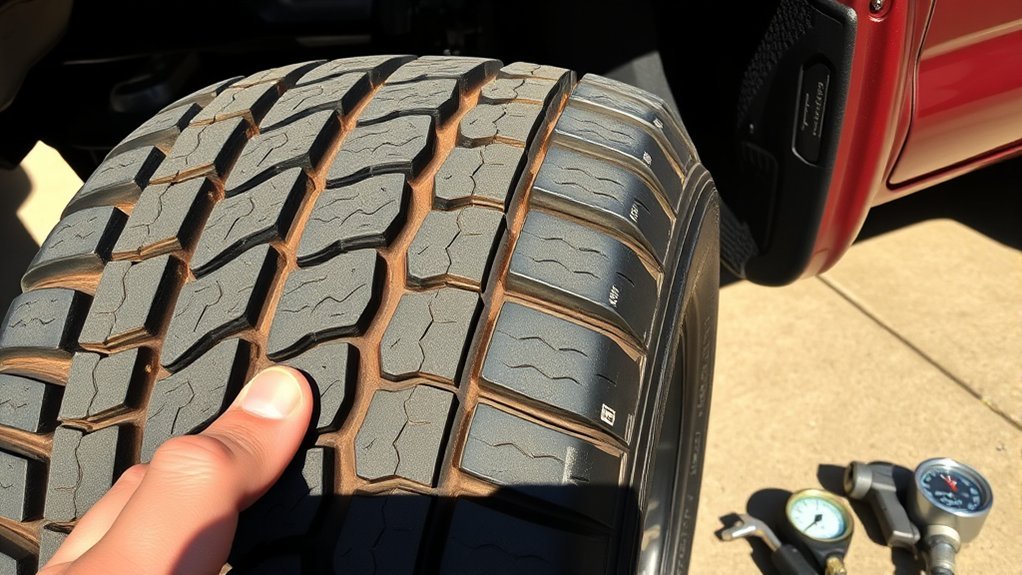
Mileage is the easiest reminder, but tread condition tells the real story. Check all four tires before the rotation, not after. Measure tread depth across the inner shoulder, center, and outer shoulder of each tire. Also run your hand lightly across the tread blocks to feel for high-low wear.
- Mileage milestone: Rotate around your planned 5,000 to 7,500-mile service window, unless your owner’s manual says otherwise.
- Uneven tread depth: Rotate sooner if the front and rear tires show clear depth differences.
- Cupping or scalloping: Wavy tread dips can point to worn suspension parts, imbalance, or alignment problems.
- Feathered tread: Sharp edges on tread blocks often suggest toe alignment issues.
- Shoulder wear: Both outer edges worn can suggest low pressure; center wear can suggest overinflation.
- Vibration or road noise: New humming, shaking, or pulling may mean the tires need balancing, alignment, or inspection before rotation.
NHTSA recommends checking tire pressure at least monthly when the tires are cold and replacing tires when tread reaches 2/32 inch. For a Tacoma that tows, carries gear, or runs all-terrain tires, a tread depth gauge is better than guessing by eye.
Choose the Right Tacoma Tire Rotation Pattern
The right Toyota Tacoma tire rotation pattern depends on your tire type, wheel size, and whether the tires are directional. Before moving any tire, check the sidewall for rotation arrows, “outside” markings, and size differences between front and rear tires.
| Tacoma Setup | Recommended Pattern | Important Note |
|---|---|---|
| Same-size, non-directional tires | Rearward cross is commonly used on rear-wheel-drive and 4WD trucks: rear tires move straight forward; front tires move to the rear opposite sides. | Confirm with your Tacoma manual and tire maker. |
| Directional tires | Front-to-back on the same side only. | Do not cross directional tires unless they are dismounted and remounted correctly. |
| Different front and rear tire sizes | Usually not rotatable front-to-rear. | Follow the tire and wheel setup guidance. Some aftermarket setups limit rotation. |
| Full-size matching spare | Use a five-tire pattern only if the spare matches the road tires in size, type, load rating, and wear level. | Do not add a temporary, mismatched, or heavily older spare into normal rotation. |
Warning: If your tires have arrows on the sidewall, they are directional. Crossing them to the opposite side can make the tread run backward, which may reduce wet traction and increase noise.
How to Rotate Tires on Your Toyota Tacoma: A Step-by-Step Guide
Rotating the tires on your Toyota Tacoma is straightforward if you work slowly and use the right safety equipment. Do not rely on the emergency scissor jack for a full rotation unless you are only changing one wheel in an emergency. For a driveway rotation, use a stable floor jack, properly rated jack stands, wheel chocks, and the lift points listed in your owner’s manual.
Tools and Supplies You Need
- Floor jack rated for your Tacoma’s weight
- Four jack stands or a safe two-axle lifting method
- Wheel chocks
- Lug wrench or breaker bar
- Torque wrench
- Tire pressure gauge
- Tread depth gauge
- Tire chalk or masking tape for marking tire positions
- Gloves and eye protection
Step 1: Park and Prepare the Truck
Park on a flat, solid surface. Shift into Park or gear, set the parking brake, and chock the wheels that will stay on the ground during the first lift. Remove heavy loose cargo from the bed if it makes the truck unstable.
Step 2: Loosen the Lug Nuts Slightly
Before lifting the Tacoma, loosen each lug nut about a quarter turn. Do not fully remove them while the tire is still on the ground. This makes removal easier and helps prevent the wheel from spinning while raised.
Step 3: Lift and Support the Tacoma Safely
Use the correct lift points from your owner’s manual. Raise the truck high enough to remove the tires, then set it on jack stands. Shake the truck gently before removing wheels to confirm it is stable.
Warning: Never put any part of your body under a Tacoma that is supported only by a jack. A jack is for lifting. Jack stands are for holding the truck safely.
Step 4: Remove and Inspect Each Tire
Remove the lug nuts and wheels. Inspect each tire for nails, cuts, bubbles, cracked sidewalls, exposed cords, uneven tread, and embedded stones. Check the inside shoulder too, because alignment wear can hide there.
Step 5: Move the Tires to the Correct Positions
Move each tire according to the pattern that matches your setup. Marking the tire positions with chalk before removal helps prevent confusion. For many same-size, non-directional Tacoma tire setups, a rearward-cross pattern is common. Directional tires usually move front-to-back on the same side.
Step 6: Hand-Thread the Lug Nuts
Place each wheel on the hub and hand-thread every lug nut. If a lug nut will not start smoothly by hand, stop and check for cross-threading. Do not force it with an impact wrench.
Step 7: Lower and Torque in a Star Pattern
Lower the Tacoma until the tires just touch the ground and cannot spin. Tighten the lug nuts in a star or crisscross pattern using a torque wrench set to the specification in your owner’s manual. After torqueing, fully lower the truck and repeat the torque check.
Pro Tip: Recheck lug nut torque after 25 to 50 miles, especially after DIY rotation, wheel removal, or trail use. This quick check helps catch a wheel that did not seat fully on the hub.
Pre-Rotation Checklist: Essential Inspections
Use this checklist before you move the tires. It helps you catch problems that rotation alone will not fix.
- Check cold tire pressure: Use the driver-door tire label or owner’s manual, not the max pressure printed on the tire sidewall.
- Measure tread depth: Check inside, center, and outside tread channels on each tire.
- Inspect sidewalls: Look for bubbles, cuts, cracks, or impact damage.
- Check tread surface: Remove stones and look for nails or screws.
- Look for uneven wear: Cupping, feathering, and one-sided shoulder wear may need alignment or suspension inspection.
- Inspect wheels and studs: Look for bent rims, damaged lug nuts, rust buildup, or broken studs.
- Confirm tire type: Directional tires, staggered tires, and mismatched spare tires need special handling.
Post-Rotation: How to Initialize Your TPMS
After rotating your tires, set all tires to the recommended cold pressure. Toyota Tacoma TPMS behavior can vary by model year, trim, wheel sensor setup, and infotainment system. Some trucks learn positions automatically after driving, while others may require a menu reset, a TPMS button, or a relearn procedure at a shop.
Federal TPMS rules require covered vehicles to warn drivers when tires are significantly underinflated, but they do not create one universal reset method for every Tacoma. The safest approach is to follow your exact owner’s manual procedure and confirm the warning light turns off after the system has had time to read the sensors.
Verify Tire Pressures
Check pressure when the tires are cold, meaning the truck has been parked for at least three hours or driven only a short distance at low speed. Inflate or deflate each tire to the pressure shown on the Tacoma’s tire information label or in the owner’s manual.
Follow the Model-Year Reset Procedure
If your Tacoma has a TPMS reset option, follow the exact steps in the manual. If the light flashes for about a minute and then stays on, that can point to a TPMS malfunction rather than simple low pressure. If the light stays on after pressure is correct and the truck has been driven, have the system checked.
What Mistakes Should You Avoid When Rotating Tires?
Most tire-rotation problems come from rushing. Avoid these common mistakes:
- Crossing directional tires: Keep directional tires on the same side unless they are remounted correctly.
- Skipping jack stands: A jack can fail or roll. Always support the truck safely.
- Using an impact wrench for final tightening: Final tightening should be done with a torque wrench.
- Guessing lug nut torque: Too loose can be dangerous; too tight can damage studs or rotors.
- Ignoring uneven wear: Rotation will not fix bad alignment, worn shocks, bent wheels, or suspension problems.
- Forgetting tire pressure: Pressure should be checked after the tires are moved.
- Adding a mismatched spare: Only include a full-size matching spare if it is safe and appropriate for normal rotation.
[Products Worth Considering]

Secure your parked vehicle quickly with AFA Tooling 4T rubber wheel chocks in a 4-pack for two dual-wheel sets. The ribbed design and textured base grip fast without pounding, so you can chock tires on trailers, RVs, ATVs, and work vehicles with confidence. EZ rustproof handles with rope ties keep the pair together for easy placement and removal, while nylon-reinforced rubber stands up to dirt, ice, salt, and harsh weather.

The AstroAI 2 pack air chucks provide a heavy-duty, closed-flow locking design that helps keep air flowing during inflation while securely attaching to the valve stem. Built with 250 PSI rated brass components and compatible with Schrader valves, they feature 1/4" female NPT threads for a wide fit with common inflators. The straight tip and locking clip make filling tires and monitoring pressure more convenient.
Uneven Wear Troubleshooting After Rotation
If your Tacoma still vibrates, pulls, or makes tire noise after rotation, use the wear pattern to narrow down the issue.
| What You See or Feel | Possible Cause | What to Do |
|---|---|---|
| Truck pulls left or right | Alignment issue, tire pull, uneven pressure | Check pressure first, then schedule alignment if pull remains. |
| Steering wheel shakes | Wheel imbalance, bent wheel, uneven tire wear | Have tires balanced and inspected. |
| Cupped or scalloped tread | Worn shocks, imbalance, suspension wear | Inspect suspension and balance tires. |
| Inner or outer shoulder wear | Alignment issue or aggressive cornering | Schedule alignment and inspect steering components. |
| Both shoulders worn | Low tire pressure or overloading | Set cold pressure correctly and check payload limits. |
| Center tread worn faster | Overinflation or load mismatch | Set pressure to the truck’s label, not the sidewall max. |
Benefits of Regular Tire Maintenance
Regular tire maintenance goes beyond rotation. Pressure checks, tread inspections, balancing, alignment, and timely replacement all work together to keep your Tacoma safe and efficient.
| Benefit | Description | Why It Matters |
|---|---|---|
| Longer Tire Life | Helps reduce irregular tread wear. | You get more usable miles from each tire set. |
| Better Traction | Keeps tread depth more even across all four corners. | More consistent grip in rain, gravel, and light snow. |
| Smoother Ride | Helps limit noise, vibration, and uneven tire feel. | Improves comfort on highways and rough roads. |
| Better Fuel Efficiency | Proper pressure and tire maintenance help reduce wasted energy. | You avoid fuel loss caused by neglected or underinflated tires. |
| Early Problem Detection | Rotation exposes inner tread, sidewalls, and wheel hardware. | You can catch damage before a roadside failure. |
When to Stop and See a Professional
Do not continue a DIY rotation if something looks unsafe. A tire shop or Toyota service center should inspect the truck if you find:
- A sidewall bubble, deep cut, or exposed cord
- A broken wheel stud or stripped lug nut
- A wheel that will not sit flat on the hub
- Severe cupping, feathering, or one-sided wear
- A vibration that remains after rotation
- A TPMS light that flashes and then stays on
- Uneven tread depth that suggests a tire pair is no longer safe to match
Engaging With the Tacoma Community for Tips and Tricks
Tacoma owner groups and forums can be useful for real-world tips, especially if you run all-terrain tires, larger aftermarket tires, beadlock-style wheels, or trail-focused suspension. Use community advice as a supplement, not a replacement for the owner’s manual and tire manufacturer guidance.
- Track your rotation pattern: Write each tire’s old and new position on a note or use tire chalk.
- Pair rotation with oil changes: This makes the schedule easier to remember.
- Record tread depth: A simple log helps you spot alignment problems early.
- Compare tire models carefully: Off-road tires may need more frequent balancing and pressure checks.
Frequently Asked Questions
Is it okay to rotate Toyota Tacoma tires every 10,000 miles?
A 10,000-mile interval is usually too long if your manual or tire maker recommends rotation closer to 5,000 to 7,500 miles. It can also be too long if you tow, haul, drive off-road, or see uneven wear. Use the owner’s manual as the final guide and rotate sooner when tread wear appears uneven.
Will Toyota rotate Tacoma tires for free?
It depends on your coverage. ToyotaCare and some prepaid maintenance plans may include factory scheduled maintenance for eligible vehicles, but coverage varies by vehicle, time, mileage, region, and dealer. Check your ToyotaCare status or ask your local Toyota dealer before booking.
Is it okay to rotate Tacoma tires every 7,500 miles?
Yes, 7,500 miles can be acceptable for many Tacoma owners if the tires are wearing evenly and the owner’s manual allows that interval. If you use the truck off-road, tow often, carry heavy loads, or notice uneven tread, rotate closer to 5,000 miles or sooner.
What tire rotation pattern should I use on a Toyota Tacoma?
For same-size, non-directional tires, many rear-wheel-drive and 4WD trucks use a rearward-cross pattern. Directional tires usually move front-to-back on the same side only. Always confirm with your Tacoma manual and tire sidewall markings before crossing tires.
Do I need to reset TPMS after rotating Tacoma tires?
Maybe. Some Tacoma systems relearn automatically after driving, while others may require a reset or relearn procedure. Set all tires to the correct cold pressure first, then follow the TPMS steps for your model year. If the TPMS light flashes and then stays on, have the system checked.
Conclusion
Regular tire rotation is one of the simplest ways to protect your Toyota Tacoma’s tires, handling, and ride quality. Use your owner’s manual as the final authority, inspect the tires before each rotation, choose the correct pattern, and tighten lug nuts with a torque wrench. If you see uneven wear, vibration, sidewall damage, or a TPMS warning that will not clear, stop and have the truck inspected before the problem gets worse.
Sources
- Toyota Manuals and Warranties — official portal for model-year owner’s manuals and warranty/maintenance guides.
- ToyotaCare and Maintenance Plans — Toyota maintenance-plan coverage information.
- NHTSA TireWise Tire Safety — tire pressure, tread depth, rotation, fuel efficiency, and tire safety guidance.
- 49 CFR 571.138 — federal tire pressure monitoring system performance requirements.

Related Articles
How Tire Weight Affects Toyota Tacoma Performance
How does tire weight influence your Toyota Tacoma's performance and efficiency? Discover the surprising effects that could change your driving experience.
Read More
Tire Noise Levels by Tire Type on a Toyota Tacoma
A comprehensive look at how tire types affect noise levels in your Toyota Tacoma reveals surprising insights that could enhance your driving experience.
Read More
How To Choose Tires for a Dual Use Toyota Tacoma
Unlock the secrets to selecting the perfect tires for your dual-use Toyota Tacoma, ensuring optimal performance and comfort on every adventure. Discover more inside!
Read More