
Why Does My Toyota Camry Shake at 40 MPH? Tire and Wheel Causes

Your Toyota Camry can shake around 40 mph for several reasons, but tire and wheel problems are the first place to check. A vibration that appears at one speed often comes from an out-of-balance tire, bent wheel, tire damage, or uneven wear. Brake, steering, suspension, and drivetrain problems can feel similar, so use the symptoms below to narrow it down safely.
Quick Answer
A Toyota Camry that shakes at 40 mph usually has a tire or wheel assembly that is not rolling smoothly. Start with cold tire pressure, visible tire damage, wheel balance, bent rims, and uneven wear. If it pulls, shakes while braking, or vibrates only during acceleration, check alignment, brakes, suspension, CV axles, or drivetrain issues next.
Key Takeaways
- A speed-specific shake near 40 mph often starts with tire balance, a bent wheel, tire damage, or uneven tread wear.
- A steering wheel shake usually points to the front tires, wheels, brakes, or steering parts; a seat or floor vibration can point to the rear tires or driveline.
- If the shake gets worse while braking, inspect the brake rotors and pads before assuming the tires are the only problem.
- Do not keep driving on a tire with a sidewall bulge, exposed cords, loose lug nuts, or a vibration that suddenly becomes severe.
- For Toyota shudder or recall concerns, check your VIN instead of relying on a general “Camry shudder recall” claim.
At a Glance
| Time Required | 15–30 minutes for a safe visual check; longer if a shop performs balance, alignment, brake, or suspension tests. |
| Difficulty | Easy for tire pressure and visible damage checks; moderate to professional for balancing, alignment, brakes, and suspension play. |
| Tools Needed | Tire pressure gauge, flashlight, tread-depth gauge, torque wrench, wheel chocks, and jack stands if the vehicle must be lifted. |
| Cost | Visual checks are free if you own the tools. Professional balancing, alignment, tire replacement, brake work, or suspension repair varies by shop, tire size, and local labor rates. |
Warning: Stop driving and arrange a professional inspection if you find a tire bulge, exposed cords, loose lug nuts, grinding brakes, heavy clunking, or a shake that suddenly gets much worse. If you lift the Camry, use wheel chocks and jack stands on solid ground; never rely on a jack alone.
Why Does a Camry Shake at 40 MPH?

If your Toyota Camry shakes at 40 mph, the first suspects are the tire and wheel assemblies. Tire vibration can come from an out-of-balance tire, a bent rim, uneven tread wear, tire damage, or a steering and suspension fault, so the best approach is to match the shake to the symptom.
A shake in the steering wheel usually points toward the front tires, front wheels, front brakes, or steering parts. A vibration in the seat or floor may point more toward the rear tires, rear wheels, or driveline. If the shake appears only when you brake, look at the brake rotors and pads. If it appears only during acceleration, consider CV axles, engine mounts, transmission mounts, or drivetrain shudder.
Before replacing parts, check the simple items first: cold tire pressure, tread condition, sidewall damage, wheel bends, missing wheel weights, and lug nut tightness. The National Highway Traffic Safety Administration tire safety guidance stresses proper tire pressure and routine tire inspection because damaged or neglected tires can lead to failures such as tread separation or blowouts.
[Products Worth Considering]

This VEVOR tire bead breaker uses a slide-hammer impact and wedge tip to separate tire beads from rims quickly and efficiently without damaging hub surfaces. The long handle and sturdy steel construction help reduce user strain while providing reliable, portable tire changing for cars, trucks, and more. Ideal for home mechanics and repair shops handling multiple vehicle tire sizes.

Universal magnetic jack pad with aluminum grooved design to protect vehicle pinch welds during lifting. Durable nylon pad inserts are upgraded and secured with screws to resist damage and keep in place. Designed to fit most single vehicle pinpoint welds for safer, stable jacking when changing tires, repairs, or performing oil changes.

Salior’s tire plug kit provides a fast, reliable self-service fix for punctured or leaking tires without the need for flaring tools. Choose the correct plug size, then screw the nail into the puncture using the included screwdriver for an enhanced seal. The set is durable and convenient for on-the-go maintenance across multiple vehicle types.
Use the Symptoms to Narrow the Cause
The way the Camry shakes tells you where to look first. Use this table before spending money on parts.
| Symptom | Start Here |
| Steering wheel shakes around 35–50 mph | Front tire balance, bent front wheel, uneven front tire wear, front brake rotor runout, or steering linkage play. |
| Seat or floor vibrates more than the steering wheel | Rear tire balance, rear wheel damage, rear tire cupping, wheel bearing noise, or driveline vibration. |
| Shake gets worse when braking | Brake rotor runout or thickness variation, worn pads, sticking caliper, or loose front-end parts. |
| Car pulls to one side | Tire pressure mismatch, tire pull, wheel alignment, brake drag, or suspension damage. |
| Shake happens only during acceleration | Inner CV joint, axle shaft, engine/transmission mount, or torque converter/drivetrain shudder. |
Check Tire Pressure and Balance First
Start with cold tire pressure. Use the pressure listed on the driver-door placard, not the maximum pressure printed on the tire sidewall. Low or uneven pressure can change how the tire contacts the road and can make a vibration feel worse.
Next, check tire balance. Wheel balancing uses small weights to balance the tire and wheel assembly, and Goodyear notes that balancing helps minimize wheel vibration and uneven tire wear. If the steering wheel twitches side to side near 40 mph, a balance issue is a strong first test.
- Check all four tire pressures when the tires are cold.
- Look for missing wheel weights on the rim.
- Check whether the shake changed after a recent tire rotation or new tire installation.
- Ask the shop to balance all four tire/wheel assemblies, not only the front pair, if the vibration location is unclear.
- If standard balancing does not fix it, ask about a Road Force test.
Toyota’s scheduled maintenance guidance says tire rotation helps equalize tire wear and extend tire life, with many Toyota schedules calling for rotation every 5,000 to 7,500 miles. Rotation is not the same as balancing, but the two are often handled during the same tire service visit if vibration is present.
Pro Tip: If a tire balances normally but the Camry still shakes, ask for a Hunter Road Force or similar load-roller test. It can help find radial force variation, tire stiffness problems, and wheel/tire match issues that a basic spin balance may miss.
Look for Bent Wheels or Tire Damage
Next, inspect the wheels and tires for visible damage. A bent wheel, flat spot, tire bulge, tread separation, impact break, exposed cord, or severe cupping can create a shake that shows up around 40 mph.
Do a slow walkaround with a flashlight. Look across the tread and sidewall, not just at the outer face of the tire. Run your hand gently over the tread only if there are no exposed cords or sharp objects. A scalloped or choppy tread pattern can point to worn shocks, struts, suspension play, or long-term imbalance.
- Sidewall bubble: replace the tire; do not try to balance it out.
- Exposed cords or deep cuts: replace the tire before driving at speed.
- Bent rim lip: have the wheel measured for runout or replaced if repair is unsafe.
- Cupped tread: inspect balance, shocks/struts, wheel bearings, and alignment.
- Loose or missing lug nut: stop driving until the wheel is properly secured and torqued.
Do not rely on a basic balance check alone. A tire can be balanced by weight but still roll poorly because of internal damage or excessive road-force variation.
See If Alignment Is the Problem
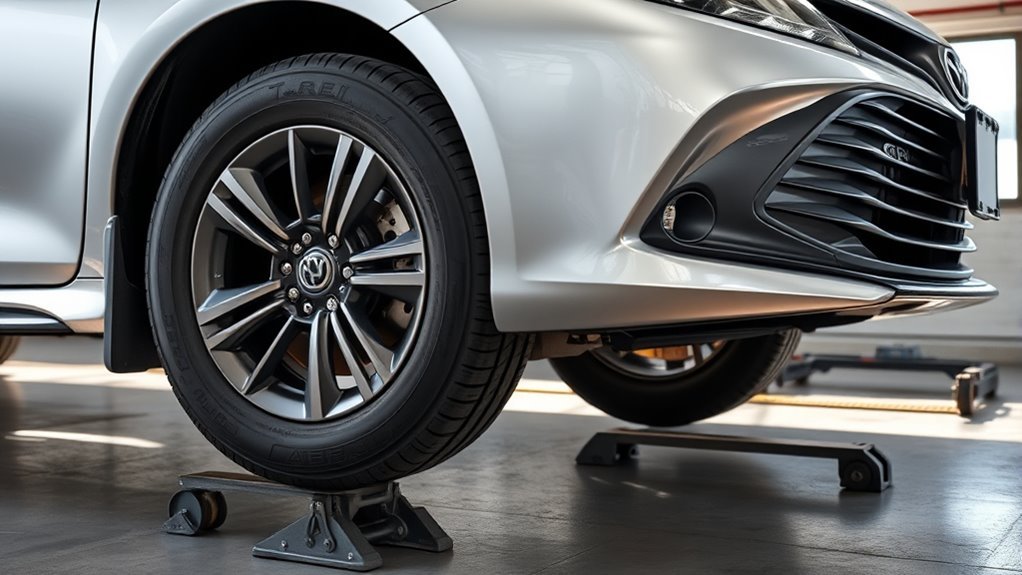
Alignment can make your Camry pull, wander, wear tires unevenly, and feel unstable. It is not always the cause of a pure speed-specific shake, but it can make tire vibration worse and can ruin new tires if ignored.
Look for alignment symptoms:
- Feathered tread or heavy inside-edge or outside-edge wear.
- A steering wheel that sits off-center on a flat road.
- A pull that stays the same after checking tire pressure.
- New vibration after hitting a pothole, curb, or road edge.
- A shake that improved after balancing but returned as the tires wore unevenly.
Do not use the tire-rotation interval as a fixed alignment schedule. Instead, get an alignment check after a hard impact, after replacing steering or suspension parts, when the Camry pulls, or when tread wear shows the wheels are not meeting the road evenly.
Note: Balance and alignment solve different problems. Balancing corrects uneven weight in the tire/wheel assembly. Alignment corrects wheel angles. A car can need one, both, or neither depending on the symptom.
Rule Out Brakes and Suspension
If your Camry still shakes at 40 mph after tire pressure, tire condition, wheel damage, and balance checks, inspect the brakes and suspension. A brake rotor with runout or thickness variation, often called a “warped rotor,” can pulse through the steering wheel when you press the brake pedal.
Start with a brake inspection if the shake gets worse while braking. Look for worn pads, uneven pad transfer, overheated rotors, sticking calipers, and rotor runout. Toyota maintenance guidance also calls for brake disc checks for runout and excessive wear by a qualified technician.
Then check the front-end and rear suspension parts that can let the tire wobble instead of tracking straight:
- Ball joints and dust boots
- Tie rod ends and steering linkage
- Control-arm bushings
- Struts, shocks, and mounts
- Wheel bearings
- Sway bar links and bushings
Any looseness can make the Camry shimmy over bumps, vibrate in turns, or wander at steady speed. If you hear clunks, grinding, or humming along with the shake, get the suspension and wheel bearings checked before driving long distances.
[Products Worth Considering]

This multi-function tire valve stem removal tool set makes it fast to remove, install, bleed, and clean valve cores for easier tire maintenance. It includes valve core removers, a 4-way spool tool, replacement valve caps, and spare cores to handle replacements and repairs with confidence. Universal compatibility suits cars, trucks, motorcycles, bicycles, and more for roadside convenience.

EVOULTES heavy duty tire inflator with an integrated gauge delivers accurate pressure readings from 10–120 PSI, helping you inflate, deflate, and check tires in one tool. The 16.5-inch extended dual-head air chuck with swivel base reaches hard-to-access dual wheel valves on trucks and RVs. A brass trigger core and side-mounted air release valve make operation smooth, with standard 1/4" NPT threading and quick-connect compatibility for easy setup.
Do Not Ignore Axles, Mounts, or Drivetrain Shudder
Most 40 mph shakes start with tires and wheels, but not all of them do. If the vibration appears mainly when you accelerate and fades when you coast, look beyond wheel balance.
Possible acceleration-only causes include a worn inner CV joint, bent axle shaft, worn engine mount, worn transmission mount, or torque converter/drivetrain shudder. These problems can feel like a tire shake, but balancing the tires will not fix them.
A useful test is to note the exact condition:
- Shakes while coasting at 40 mph: tires, wheels, bearings, or suspension are more likely.
- Shakes only under throttle: CV axle, mount, or drivetrain shudder becomes more likely.
- Shakes only while braking: brake rotors, pads, or front-end looseness become more likely.
- Shakes while turning: CV joints, wheel bearings, tire damage, or suspension play need attention.
What About Toyota Shudder Recalls and TSBs?
Do not assume every 40 mph vibration is a Toyota transmission shudder issue. First, check your exact VIN on the Toyota recall lookup page or the NHTSA recall lookup page. Recalls and service campaigns depend on model year, engine, transmission, production date, and VIN.
The “Toyota shudder” topic people mention online often refers to different service documents:
- Certain 2012–2014 Camry models: Toyota Limited Service Campaign E03 covered U760E torque converter shudder between about 25 and 50 mph and provided an engine-control software update for eligible vehicles, but the campaign document lists availability through October 31, 2017.
- Certain 2018–2019 Camry models: Toyota T-SB-0152-19 addressed hesitation from a slow roll or rolling stop at 6 mph or below after a 3–1 downshift. That is not the same as a tire or wheel shake at 40 mph.
If your Camry shakes at 40 mph with no acceleration hesitation, no warning lights, and no drivability change, start with tires, wheels, brakes, and suspension before chasing a transmission update.
What to Do Before You Drive to a Shop
Before booking repairs, collect clear symptoms. This helps the shop avoid guessing and saves diagnostic time.
- Write down the exact speed where the shake starts and stops.
- Note whether the steering wheel, seat, floor, or whole car shakes most.
- Check cold tire pressure and adjust it to the door-placard specification.
- Inspect each tire for bulges, cuts, exposed cords, nails, and uneven tread wear.
- Look for bent rims, missing wheel weights, and loose or damaged lug nuts.
- Test carefully on a smooth road only if the vehicle feels safe to drive.
- Tell the shop whether the shake changes during braking, acceleration, coasting, or turning.
Ask the technician to start with tire/wheel balance and runout checks, then move to alignment, brakes, suspension, wheel bearings, CV axles, and drivetrain checks based on the symptoms.
Frequently Asked Questions
Why is my Toyota Camry steering wheel shaking at 40 mph?
A steering wheel shake around 40 mph often points to the front tire and wheel assemblies. Start with tire pressure, tire balance, bent rims, uneven tread wear, and tire damage. If the shake gets worse while braking, inspect the brake rotors and pads. If the steering feels loose or clunks, inspect tie rods, ball joints, bushings, struts, and wheel bearings.
Is it safe to drive my Camry if it shakes at 40 mph?
A light vibration may be safe enough for a short trip to a repair shop, but do not keep driving if the shake is severe, sudden, or paired with a tire bulge, exposed cords, loose lug nuts, grinding brakes, clunking, or steering wander. Those signs can point to a tire, wheel, brake, or suspension problem that needs immediate attention.
Can alignment cause a Camry to shake at 40 mph?
Alignment can contribute to shaking, but it usually comes with other clues such as pulling, off-center steering, wandering, or uneven tire wear. A pure speed-specific shake is more often checked first through tire pressure, wheel balance, bent wheels, tire damage, and brake or suspension issues.
What is the Toyota Camry shudder recall?
There is not one universal Toyota Camry shudder recall that applies to every Camry. Certain 2012–2014 Camry vehicles had a Limited Service Campaign for U760E torque converter shudder between about 25 and 50 mph, and that document listed an expiration date in 2017. Certain 2018–2019 Camrys had a separate technical service bulletin for slow-roll hesitation at 6 mph or below. Check your VIN on Toyota’s recall page or NHTSA before assuming your car is covered.
What causes a Toyota Camry to shake when braking?
If the Camry shakes mainly when you press the brake pedal, inspect the brake rotors, pads, and calipers. Rotor runout or thickness variation can send a pulse through the steering wheel. Loose suspension or steering parts can make that brake vibration feel worse.
Should I balance all four tires or only the front tires?
If the steering wheel shakes, the front tires are strong suspects, but balancing all four tires is often smarter when the vibration source is unclear. Rear tire imbalance can travel through the seat and floor, and tire rotation can move the problem from one end of the car to the other.
Conclusion
If your Camry shakes at 40 mph, treat it as a warning signal and diagnose it in order. Start with cold tire pressure, tire damage, wheel balance, bent rims, and uneven tread wear. Then check alignment, brakes, suspension, wheel bearings, axles, mounts, and drivetrain symptoms if the shake remains. Catching the problem early helps keep your Camry smooth, stable, and safe.
Sources
- Toyota Scheduled Maintenance Guide — supports tire rotation intervals and inspection items for brakes, steering linkage, and suspension components.
- NHTSA TireWise — supports tire pressure, tread, tire safety, and recall-checking guidance.
- Goodyear Tire Maintenance — supports wheel balancing as a way to reduce wheel vibration and uneven tire wear.
- Michelin Handling Problems: Vibration — supports tire imbalance and steering/suspension malfunction as vibration causes.
- Hunter Road Force Wheel Balancer — supports road-force testing as a diagnostic method for vibration complaints.
- Toyota Recall Lookup, Toyota LSC E03 document, and Toyota T-SB-0152-19 — support VIN-based recall checks and the corrected shudder/hesitation explanation.

Related Articles

Toyota Camry All-Season Tires Explained: What They Can and Can’t Do
In exploring Toyota Camry all-season tires, discover their benefits and limitations—are they really the right choice for your driving needs?
Read More
Toyota Camry Tire Traction in Ice and Snow: A Practical Winter Driving Guide
Learn essential tips for maximizing tire traction on ice and snow in your Toyota Camry, ensuring your winter driving is safe and confident. Discover more now!
Read More
Do Toyota Camry Tires Need Snow Chains? When They Help and When They Don’t
How do snow chains enhance your Toyota Camry's winter driving safety, and when should you avoid using them? Discover the essential details inside!
Read More