
Tire Foam Fill Explained: Pros, Cons & Best Applications
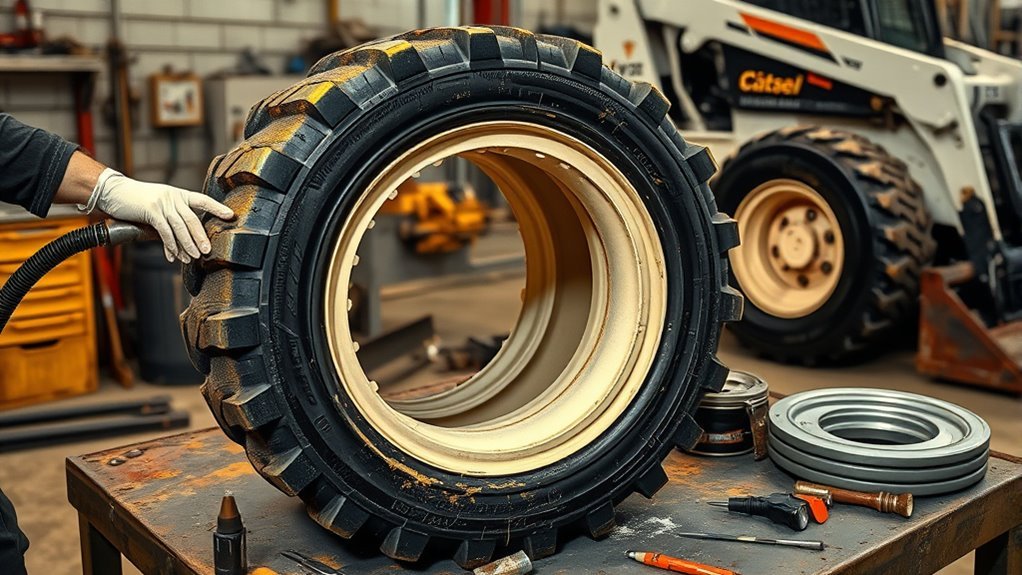
You’ll get a durable, puncture‑proof solution: two‑part polyurethane is injected into the tire cavity, cures to a solid core, and eliminates flats and pressure variability. You’ll trade some ride comfort, added unsprung mass, and tougher removals for lower downtime and fewer replacements—ideal for telehandlers, skid steers, forklifts, and harsh jobsite use. Compare against pneumatic for comfort and solid tires for max durability. Keep going to see maintenance, diagnostics, and cost/ROI metrics.
What Is Tire Foam Fill and How It Works
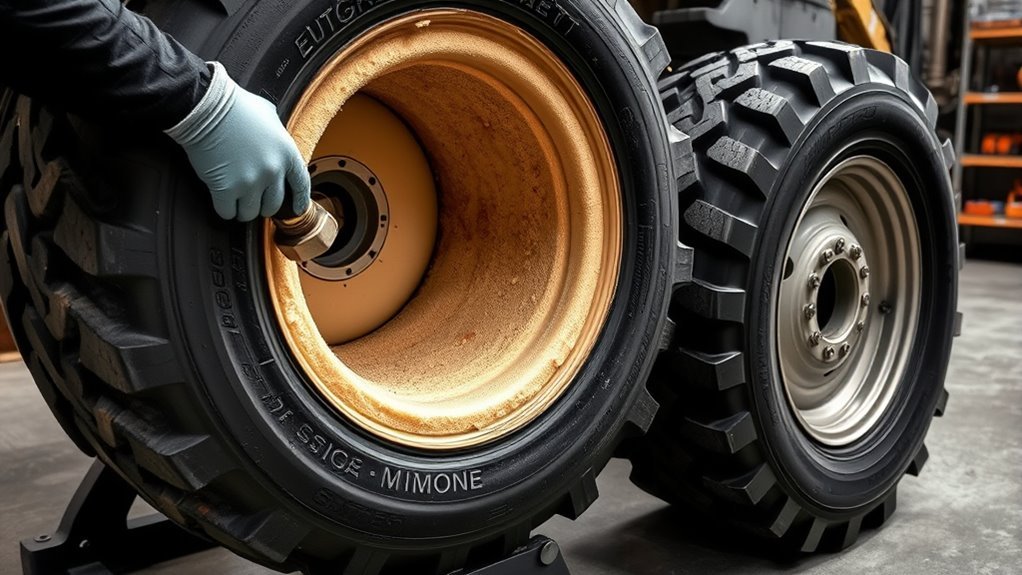
Tire foam fill uses a two-part liquid polyurethane injected into the tire cavity that cures into a solid, puncture-resistant core; this process removes air from the tire and eliminates flats. You’ll use foam injection to replace pressurized air with a tunable polymer matrix that delivers predictable mechanical behavior under load. Data show filled units maintain handling consistency by removing pressure variability and preventing puncture-induced downtime. Adjust foam density to target payload and ride compliance; higher density raises load capacity and reduces deflection, while lower density improves comfort at reduced loads. Core stability from the cured polymer minimizes sidewall collapse and abrasion in harsh environments like construction sites, extending service intervals and lowering lifecycle costs. Note permanence: once filled, tires can’t be converted back to air, so plan fleet deployment and salvage strategies accordingly. This method frees you from flat-related constraints while requiring commitment to application-specific specifications and maintenance protocols.
Quick Recommendation: When to Use Foam-Filled Tires
One clear rule: choose foam-filled tires when your operations face frequent puncture risks or require consistent load-bearing and stability. You’ll gain foam filled benefits like immunity to flats and blowouts, which cuts unplanned downtime by a measurable margin. Use them in high-risk terrains—construction, landscaping, similar sites—after quantifying puncture incidence and cost-per-downtime-hour.
Assess load profiles and terrain: the solid core raises stability and load capacity, improving handling under constant loads, but adds mass that alters ride dynamics. Run a maintenance protocol: scheduled visual inspections and tread-depth measurements to preserve service life and validate expected operational efficiency gains. Perform a simple cost-benefit: compare replacement/repair costs and lost productivity versus increased fuel use and potential wear from added weight.
If your priority is liberation from frequent tire failures and predictable uptime, foam-filled tires are a data-backed choice; if lightweight agility matters more, consider alternatives.
Advantages for Telehandlers, Skid Steers & Forklifts
Because telehandlers, skid steers, and forklifts often operate in debris-filled, high-impact environments, foam-filled tires give you flat-proof uptime and a predictable load-bearing platform that cuts unplanned stoppages and maintenance interventions. You get immediate operational resilience: the polyurethane core prevents pressure loss, so your machines maintain rated load capacity under puncture conditions and avoid reactive downtime costs common on construction and waste sites. Measured benefits include fewer service calls, reduced replacement frequency, and more consistent cycle times due to stable tire geometry.
Terrain adaptability improves: foam fill dampens shock on rough surfaces, enhancing traction and control in demolition and uneven yards, which raises operator efficiency and safety margins. You’ll accept added unsprung mass, which can alter driving dynamics, but the tradeoff is lower lifecycle maintenance costs and extended tire service intervals. For liberated fleets focused on uptime and predictable performance, foam-filled tires deliver quantifiable returns in reliability and total cost of ownership.
Drawbacks & When Foam Fill Makes Sense to Avoid
Although foam fill delivers flat-proof uptime, it introduces tradeoffs you should weigh against operational needs. You’ll gain puncture resistance but lose the rebound dynamics of pneumatic tires, reducing ride comfort and transferring more vibration to operators. The irreversible fill increases replacement complexity and downtime when tires wear out.
Consider avoiding foam fill in scenarios where mobility, long service life, or frequent tire changes matter:
- Reduced ride comfort: harsher response limits operator endurance and precision in tasks requiring fine control.
- Weight impact: added mass slows skid steers and similar machines, degrading acceleration, braking, and maneuverability.
- Component strain: increased rigidity raises load on rims and bearings, accelerating wear and potential failure.
Data-driven teams choose foam only when uptime outweighs these costs. If you prioritize operator comfort, vehicle dynamics, and lower lifecycle maintenance, opt for alternatives that preserve rebound behavior and simplify servicing.
Foam-Filled vs Pneumatic vs Solid Tires: A Decision Guide
Having weighed when foam fill makes sense, you’ll now compare foam-filled, pneumatic, and solid tires to match performance, cost, and maintenance to your applications. You’ll choose based on puncture immunity, ride quality, and lifecycle cost. Foam benefits include consistent stability, reduced downtime, and shock absorption versus solid tires’ harsher ride. Pneumatic tires deliver superior traction and comfort but demand regular pressure checks and risk flats. Solid tires give maximum durability and flat-proof service on smooth floors but sacrifice flexibility. Foam-filled tires cost about $150 per tire initially yet often win on total cost through fewer repairs and less lost time. For off-road, harsh environments, foam-filled is recommended; solids suit longevity on flat surfaces; pneumatics suit varied terrain and comfort.
| Criteria | Best for liberation | Trade-off |
|---|---|---|
| Foam-filled | Puncture resistance, stability | Higher upfront cost |
| Pneumatic | Comfort, traction | Maintenance, flats |
Daily, Weekly, and Seasonal Maintenance Checklist
You should perform daily visual inspections of foam-filled tires to verify sidewall integrity, remove debris, and spot immediate hazards. Weekly, measure tread depth with a gauge and log values to quantify wear rates and trigger corrective action when thresholds are crossed. Seasonally, schedule a deep maintenance check—alignment, torque checks, and full condition documentation—to correct cumulative issues and optimize service life.
Daily Visual Inspections
When operating foam-filled tires, perform a daily visual inspection to verify sidewall integrity, check for embedded debris in the tread, and note obvious tread wear so you catch defects before they affect safety or productivity. You’ll record inspection frequency and current tire condition, flagging bulges, cuts, or uneven wear. Use a tread depth gauge and torque wrench when possible; document every anomaly to build actionable data.
- Check sidewalls and bead seating for cuts, bulges, or separation.
- Scan tread for embedded debris, punctures, and foreign objects.
- Log visible wear patterns, pressure anomalies, and immediate corrective actions.
Consistent, disciplined inspection creates operational freedom by reducing unexpected failures and informing preventive maintenance decisions.
Weekly Tread Measurements
Measure tread depth weekly using a calibrated gauge at three points (inner, center, outer) on each foam-filled tire to quantify wear rates and spot uneven patterns that predict replacement needs. You’ll apply specific tread measurement techniques, recording values per tire to enable objective wear progression tracking. For heavy-use assets you’ll keep weekly records; for lighter-use units you may extend to monthly. Log readings, note sidewall condition and debris, and flag any asymmetric loss—uneven wear often signals misalignment or overloading that demands correction. Your data-driven log liberates decision-making: you’ll predict replacements, optimize rotation schedules, and reduce downtime.
| Point | Action |
|---|---|
| Inner | Gauge, record mm |
| Center | Gauge, record mm |
| Outer | Gauge, record mm |
| Analysis | Compare trends |
| Action | Repair/replace as needed |
Seasonal Deep Maintenance
Because seasonal cycles impose different loads and environmental stresses, your deep-maintenance checklist combines daily visual scans, weekly tread-gauge measurements, and a detailed seasonal inspection to catch cumulative damage and degradation early. You’ll perform daily checks for sidewall integrity, debris, and visible tread loss; log findings to support predictive maintenance and reduce downtime. Weekly, you’ll use a tread depth gauge at multiple points and verify wheel-fastener torque to keep foam-filled tires secure. Seasonal inspections compile wear progression, identify uneven wear or bulges, and trigger repairs or replacement to maximize tire longevity.
- Daily: visual scan, debris removal, log entry.
- Weekly: measured tread depths, torque verification, trend update.
- Seasonal: extensive inspection, documented wear progression, corrective action.
Troubleshooting: Wear, Separation, Heat & Repair Tips
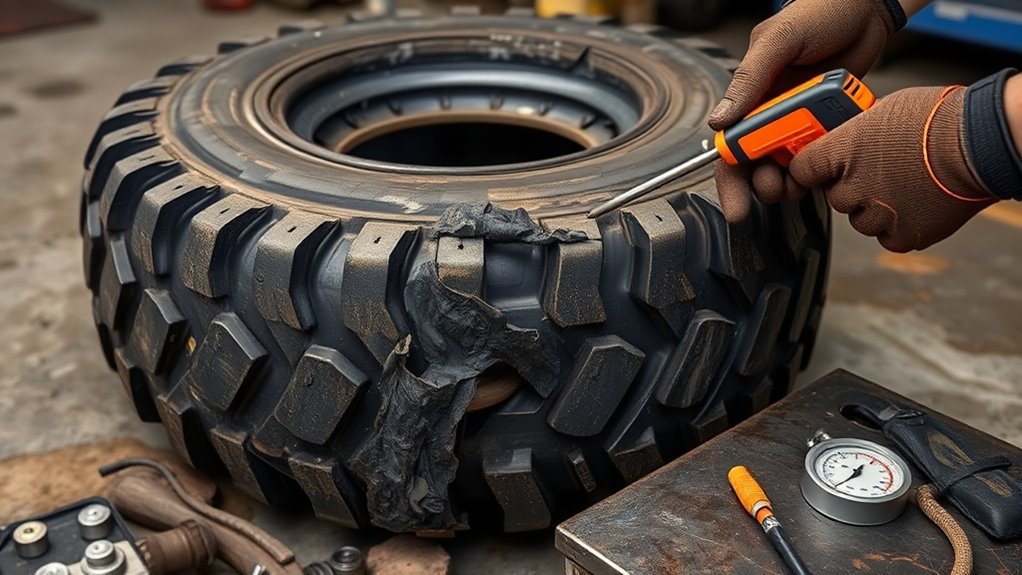
Check tread depth with a gauge and compare wear patterns against load and alignment records to pinpoint rim misalignment, underinflation, or suspension issues. Monitor casing temperature and inspect for bulges or circumferential cracks — sustained temperatures above manufacturer limits correlate with foam breakdown and increased separation risk. If you find tread punctures under 1/4 inch, document and repair per spec; any sidewall damage or evidence of structural delamination requires immediate replacement.
Wear Pattern Diagnosis
When you inspect foam-filled tires for wear patterns, focus on tread symmetry, sidewall integrity, and heat indicators to identify root causes quickly. You’ll perform tread analysis with depth gauges, record asymmetric wear, and correlate with load distribution and operator technique. If inner or outer edges show accelerated loss, initiate alignment adjustments and verify camber/toe settings. Check sidewalls for delamination; any separation often means overload or prior heat exposure and may require replacement. Limit repairs to punctures under 1/4 inch; multiple patches or sidewall damage eliminate repair viability.
- Measure tread depth across multiple points per tire.
- Log wear trends and link to vehicle setup and operator behavior.
- Enforce operator training to reduce aggressive inputs and extend service life.
Heat And Separation
Although foam-filled tires tolerate more abuse than pneumatic ones, excessive heat still accelerates foam and casing degradation and raises the risk of foam-to-casing separation. You must prioritize heat monitoring during prolonged use; continuous temperature logs reveal trends that predict failure. Data show overheating produces chemical breakdown in filler and adhesive interfaces, reducing foam durability and promoting delamination. Inspect for uneven tread, bulges, or localized soft spots—these are quantitative indicators of internal heat damage. Control variables: maintain correct inflation, redistribute load, and avoid sustained overloads that spike internal temperatures. Where operational heat is unavoidable, specify heat-resistant formulations or cooling technologies in the foam to extend service life. Act on anomalies immediately to preserve structural integrity and reclaim operational freedom.
Cost, ROI, and When to Refill or Replace
One key consideration is upfront cost: foam filling averages about $150 per tire (with larger industrial tires sometimes adding roughly $20 per unit for materials and labor). Your cost analysis should compare that initial outlay against projected reductions in flats, downtime, and service calls to produce a clear ROI evaluation. Foam fill eliminates many puncture-related costs but can shorten lifespan under heavy duty cycles, so quantify usage intensity and replacement cadence.
Consider upfront foam-fill costs—typically $150 per tire—against reduced flats, downtime, and service calls for clear ROI.
- Calculate annualized cost per hour: include fill, expected replacement frequency, and maintenance.
- Track operational savings: downtime avoided, fewer tire swaps, and labor reductions to refine ROI evaluation.
- Monitor and inspect regularly: foam is irreversible; poor fills accelerate wear and force earlier replacement.
You’ll free resources by adopting data-driven policies: set thresholds for replacement versus refilling (if applicable), schedule inspections, and update financial models quarterly to guarantee foam filling delivers expected liberation from recurring tire failures.
Frequently Asked Questions
Why Don’t We Use Foam-Filled Tires?
You avoid foam-filled tires because reduced tire performance from high foam density raises vibration, rim and bearing wear, traction loss, irreversible installation, and upfront cost—data shows tradeoffs that limit freedom to choose ideal rolling characteristics.
Are Foam-Filled Tires Worth It?
Yes — 95% puncture immunity makes them worth it if you need reliability; your cost analysis should weigh $150/tire versus downtime savings, and a performance comparison shows improved stability but reduced ride comfort and added wear.
What Are the Disadvantages of Foam-Filled Tires?
You’ll face heavier weight, degraded ride quality, increased strain on bearings/rims, smaller contact footprint reducing traction, faster tread wear, irreversible installation; cost considerations and performance limitations mean higher lifecycle costs and constrained operational capability.
Conclusion
You’ll choose foam fill when you want puncture immunity, consistent load capacity, and reduced downtime; you’ll avoid it when heat buildup, repairability, or high-speed use matter more. Use foam-filled tires for telehandlers, skid steers, and forklifts hauling heavy loads on rough surfaces; monitor heat, tread wear, and separation; expect higher upfront cost but lower operational interruptions. Inspect daily, measure temps and tread, and plan refill or replacement based on load cycles and manufacturer data.
Related Articles

10 Best Tires for 2021 Toyota Rav4
Picking the right tires for your 2021 Toyota RAV4 matters because they directly affect your safety, fuel economy, ride comfort, and how confident you…
Read More
10 Best Tires for 2020 Toyota Rav4
You depend on the tires under your RAV4 for safety, fuel economy and a comfortable ride. Choosing the right set affects braking in rain,…
Read More
10 Best Tires for 2019 Toyota Rav4
Choosing the right tires for your 2019 RAV4 matters because they directly affect your safety, fuel economy, and ride comfort. That makes this more…
Read More