
How Tires Are Made: Manufacturing Process Explained
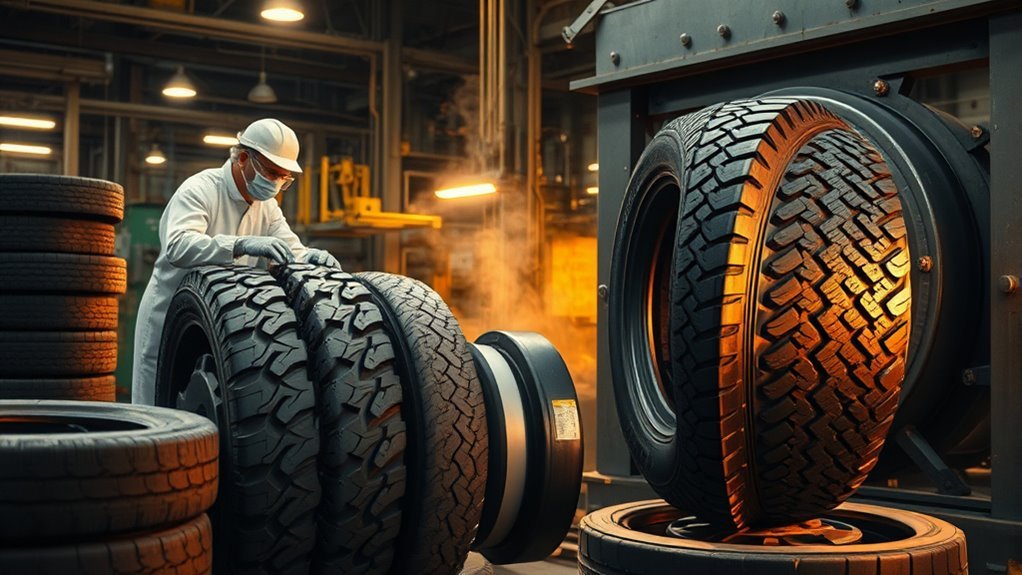
You’ll see up to 30 ingredients—natural and synthetic elastomers, fillers like carbon black or silica, sulfur and accelerators—precisely blended in high‑shear mixers to target durability and rolling resistance. Compounds are calendered and extruded into treads, sidewalls, liners and cord plies, then assembled on a tire builder into a green tire. The green tire’s vulcanization in heated molds at 140–160°C bonds and shapes the tire; continue for step‑by‑step insights and tests.
How Tires Are Made: A Quick Process Roadmap
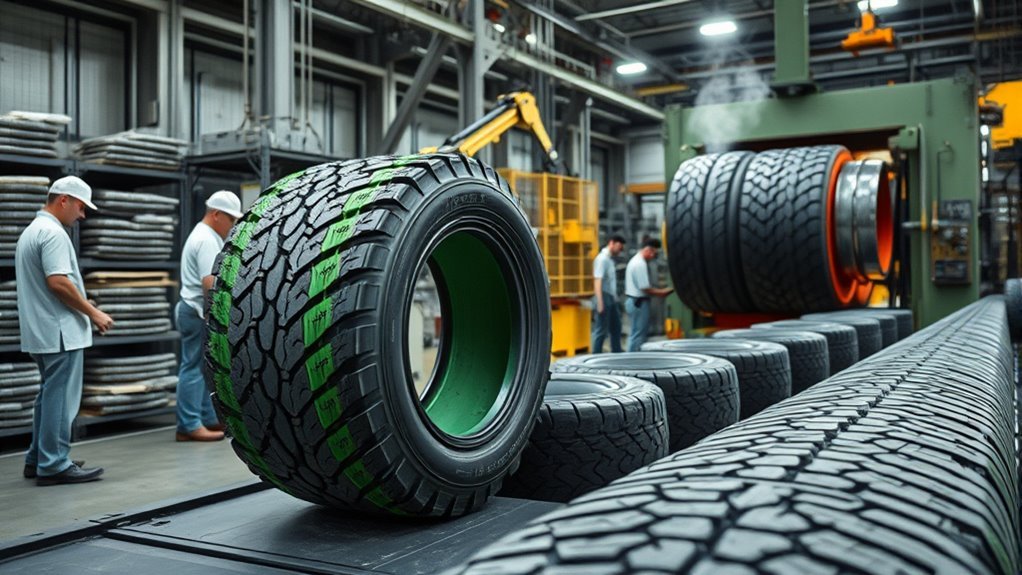
Start with a clear sequence: tire manufacturing begins by precisely blending up to 30 ingredients—natural and synthetic rubber, carbon black, sulfur and accelerators—into a homogeneous compound that sets the material properties for the entire tire. You then move components through calendering and extrusion to form sidewalls, treads and inner liners, controlling thickness and profile to spec. On the tire building machine you assemble semi-finished elements into a green tire, aligning ply edges and beads, then apply a release and anti-scuff spray to prepare for cure. You cure the green tire in a heated mold at 140–160°C, where vulcanization cross-links polymers, locks in tread geometry and embosses sidewall markings. After cooling, you perform visual inspections, dimension checks and X-ray scans to detect defects and verify balance. You’ll note tire history informs current quality standards and choices; you’ll also assess environmental impact at each stage, minimizing waste streams and energy use to support liberated, responsible manufacturing.
Raw Materials and Compound Formulation for Modern Tires
A precise blend of natural and synthetic elastomers—about 60% synthetic (predominantly styrene-butadiene copolymer)—serves as the basis for modern tire compounds, and you’ll typically work with as many as 200 distinct raw materials (fillers, oils, curatives, antioxidants, processing aids) to tune traction, rolling resistance and wear life. You select carbon black or silica as primary fillers to control wear resistance and hysteresis; choice affects rolling resistance and fuel efficiency. You balance curatives and antioxidants to lock durability without sacrificing grip. You’ll incorporate sustainable materials where they meet performance targets, advancing tire innovations while preserving liberation from dependency on finite resources.
| Component | Function | Design Target |
|---|---|---|
| Elastomers | Elastic matrix | Traction, flexibility |
| Fillers | Reinforcement | Wear, stiffness |
| Additives | Processing & ageing | Durability, safety |
You document formulations modularly, enabling rapid iteration and disciplined innovation.
Mixing and Prep: Turning Rubber, Fillers, and Additives Into Compounds
You’ll start by specifying the compound formulation—balancing natural or synthetic rubber with carbon black, silica, and tailored fillers to meet targeted durability and rolling resistance. Then you’ll run high‑shear batch mixing (200+ kg in 3–5 minutes) while controlling temperatures up to 160–170°C and finishing below 110°C so ingredients disperse uniformly. Finally, you’ll sheet the compound into continuous “slaps,” cool and store them under controlled conditions to preserve homogeneity until tire assembly.
Compound Formulation Basics
Because formulation sets a tire’s fundamental properties, compound mixing is a tightly controlled, high-throughput operation that transforms base rubbers, fillers, oils, and curatives into homogeneous sheets ready for downstream layup. You’ll specify compound types to tune performance characteristics: low rolling resistance, wear life, or traction. Rubber blending and filler selection—carbon black or silica—are chosen for targeted stiffness, hysteresis, and durability. Mixing techniques are batch production operations: sophisticated rotors process over 200 kg in 3–5 minutes, demanding strict temperature control to reach 160–170°C during dispersion then limit the final stage to 100–110°C for proper ingredient integration. You’ll convert the finished batch into a continuous slap, maintaining traceability and consistency so each tire can fulfill its liberated purpose.
High‑Shear Mixing
Consistency drives high‑shear mixing: in a 3–5 minute cycle sophisticated rotor mixers break down and disperse over 200 kg of rubber, fillers, oils, and curatives into a homogeneous compound, while you monitor torque and temperature to hit precise dispersion targets. You optimize mixing efficiency by sequencing carbon black or silica additions, controlling rotor speed, and watching shear profiles to achieve targeted polymer-filler interaction. Temperature management is critical: peak mix zones reach 160–170°C, but you finish the dispersion stage near 100–110°C to avoid polymer degradation. You record real-time metrics and adjust feed rates to sustain consistency and liberate production from trial-and-error.
| Rotor speed | Temperature |
|---|---|
| Feed start | 160–170°C |
| Mid mix | 120–140°C |
| Final stage | 100–110°C |
Sheet Cooling And Storage
After mixing, operators quickly transfer the hot compound to cooling mills or calendar rolls so it’s flattened into uniform sheets at 100–110°C to lock in dispersion and prevent thermal degradation. You monitor thickness tolerances and cooling curves, confirming each sheet meets dimensional and thermal specifications for downstream cutting. Controlled cooling stabilizes polymer networks and filler distribution, directly affecting sheets durability during storage and later processing. You then rack or spool sheets into climate-controlled storage where storage conditions—temperature, humidity, light exposure—are logged and maintained to prevent oxidation, odour pickup, or tack changes. Inventory is managed by batch and cure index so you can retrieve and cut sheets into precision blanks for sidewalls, treads, and plies when assembly demands liberation of supply.
Making Tire Parts: Treads, Sidewalls, Cords, Beads, and Liners
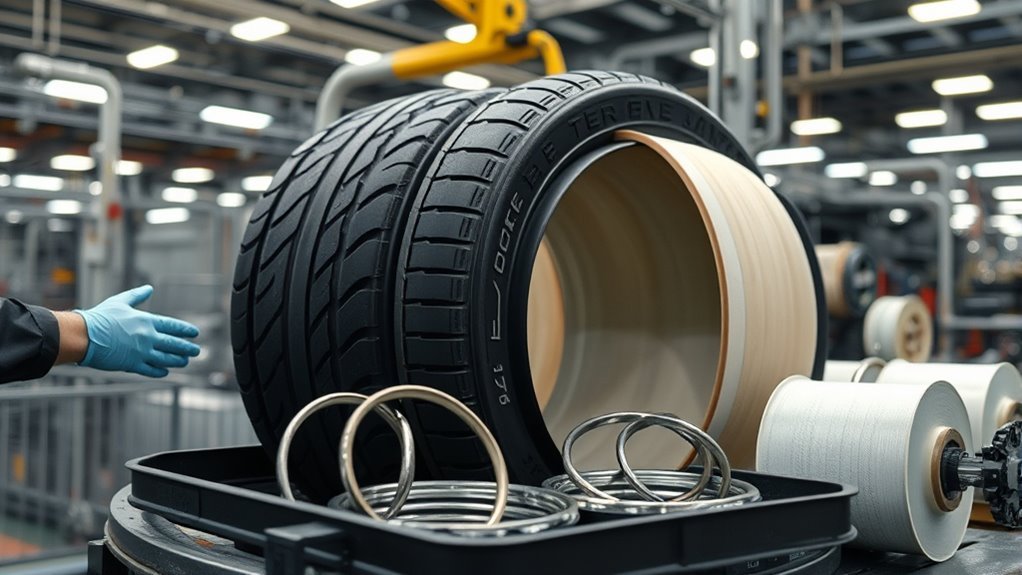
Start by assembling the tire’s individual functional layers—tread, sidewall, reinforcement cords, beads, and inner liner—each produced through specialized compounding and fabrication steps that control mechanical properties and dimensional tolerances. You’ll form tread blocks from engineered rubber compounds optimized for abrasion resistance; tread patterns are molded to balance grip and wear, directly influencing tire durability. Sidewall construction uses varied rubber compounds to tune sidewall flexibility and impact resistance while maintaining shape between tread and bead. During calendering you embed textile or steel cords using precise reinforcement techniques to prevent elongation and sustain structural loads. Bead integrity is achieved by winding steel wire loops, coating them with rubber, and controlling geometry so the rim seal and air retention remain reliable. The inner liner, typically butyl, is calendered to a controlled thickness to minimize permeation. These manufacturing innovations let you tailor components for performance and freedom from compromise without assembling the green tire here.
Tire Building: Assembling the Green Tire Step by Step
Having prepared the individual components—tread, sidewall, cords, beads, and inner liner, you’ll assemble them into a green tire on a specialized tire building machine that sequences semi-finished parts with tight dimensional control. You first form the casing: automated feeders lay the inner liner and body plies onto the drum, aligning cord angles and ply edges to specified tolerances. You place each bead assembly into chucks; you inspect seating and tension to guarantee anchoring and prevent slippage. After casing build, you transfer the blank to the second stage where you apply belts and tread with controlled wrap tension and concentricity checks. Sensors monitor bead positioning, ply overlap, and liner continuity; PLC logic rejects anomalies. You then spray the green tire with the specified prep fluid to condition interfaces for the next process. The sequence emphasizes repeatable precision and throughput, giving you mechanical freedom through consistent, liberation-minded workmanship while maintaining strict quality-control documentation.
Curing (Vulcanization): Shaping and Bonding the Final Tire
Place the green tire into a heated curing press where controlled heat (140–160 °C), pressure, sulfur and accelerators initiate vulcanization to form cross-links that lock the compound’s molecular network, set the tire’s final geometry, and imprint the tread and sidewall detail. You monitor cycle time—about 12 minutes—and guarantee temperature uniformity and molding pressure to drive cross link formation uniformly through the carcass. The press compresses molds against the green rubber, forcing compound into cavities so tread pattern and markings become permanent. You control dwell, cooling onset, and demolding sequence to preserve tire elasticity while achieving dimensional stability. Properly executed curing increases wear resistance and environmental durability, extending service life and liberating users from premature failure.
| Parameter | Purpose | Typical Value |
|---|---|---|
| Temperature | Activate sulfur accelerators | 140–160 °C |
| Pressure | Mold contact & shape | Specified kPa |
| Time | Complete vulcanization | ~12 minutes |
| Additives | Facilitate cross link formation | Sulfur, accelerators |
| Outcome | Final tire elasticity | Improved durability |
Inspection, Testing, and Quality Control Before Shipment
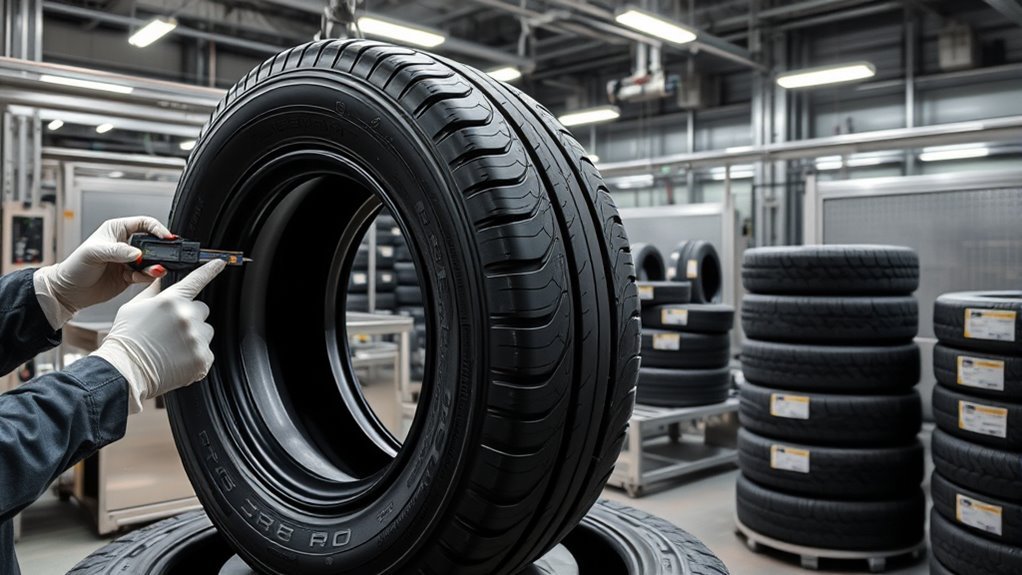
Now you’ll inspect each tire visually for surface defects and appearance, then run X‑ray scans to verify internal structural integrity. You’ll follow that with uniformity and balance testing to measure weight, dimension consistency, and dynamic behavior under simulated driving loads. Only tires that meet all acceptance criteria proceed to the distribution warehouse.
Visual And X‑Ray Inspection
The visual and X‑ray inspection stage subjects each finished tire to a coordinated set of surface and internal checks that catch defects invisible to the naked eye and verify uniformity before shipment. You perform visual inspection to identify surface defects, trim mold flash and micro‑vents, and confirm tread and sidewall appearance meet standards. You then X‑ray the carcass to assess internal structure, locating separations, foreign inclusions, or ply misalignments. Final acceptance hinges on objective criteria; only tires that conform to tolerances proceed to distribution. You’re empowered to reject or rework components, ensuring collective safety and freedom from failure.
- Surface scan: remove flash, inspect bead, sidewall, tread.
- X‑ray: image plies, belts, inner liner for discontinuities.
- Documentation: record passes, rejections, corrective actions.
Uniformity And Balance Testing
Because uniformity and balance testing verifies a tire’s dynamic behavior under simulated driving conditions, you’ll subject each finished unit to a sequence of precision measurements that quantify radial and lateral runout, conicity, and mass distribution. You’ll measure weight distribution to expose imbalance that causes vibration or uneven wear, then apply calibrated corrective weights or reject nonconforming units. X-ray examinations reveal internal anomalies—separations, foreign inclusions, ply defects—while visual inspections confirm surface integrity. Your multi-layered quality control protocol links these data streams so you can trace failures to process steps and prevent recurrence. This regimented approach preserves tire performance, guarantees safety, and underscores balance importance in delivering liberated drivers a consistent, durable product ready for shipment.
Frequently Asked Questions
How Long Does a Tire Last Once in Use?
A tire typically lasts 3–6 years or 25,000–50,000 miles, though tire lifespan factors and driving conditions impact longevity; you’ll monitor tread depth, rotation, alignment, and wear patterns to maximize safe, liberating mobility.
Are Tires Recyclable and How Are They Reused?
Yes—tire recycling transforms scrap into mulch, crumb rubber, and reclaimed rubber; you’ll sort, shred, devulcanize, and reprocess using sustainable materials; you’ll reclaim value, reduce waste, and liberate communities through circular systems.
What Safety Standards Must Tires Meet Internationally?
You must guarantee tires meet international tire regulations and global standards like UNECE R30/R117, ECE, FMVSS; you’ll follow testing protocols for load, speed, wear, traction, and environmental compliance, documenting processes to liberate oversight and consumer safety.
How Are Run-Flat Tires Manufactured Differently?
You reinforce run flat technology by molding reinforced sidewalls or inserting self-supporting rings during assembly; manufacturing innovations add stiffer compounds, heat-controlled curing, and precise bead-seat tolerances so you retain mobility and autonomy after pressure loss.
Can Tire Manufacturing Cause Environmental Pollution?
Yes — you’ll see tire emissions and production waste throughout mixing, curing, and finishing; monitor VOCs, particulate, wastewater, and scrap rubber, implement closed-loop solvent recovery, recycling, and cleaner-energy processes to reduce pollution and reclaim control.
Conclusion
You’ve seen how raw materials become compounds, how compounds become parts, and how parts become a green tire; you’ve watched the green tire enter the mold, cure into shape, and emerge bonded and balanced; you’ve witnessed inspection catch defects, testing confirm performance, and quality control release only certified units. Follow this roadmap, apply precise formulations, and maintain rigorous process control—and you’ll turn inputs into safe, reliable tires every time.
Related Articles

10 Tires That Will Transform Your 2017 Toyota RAV4
You rely on your RAV4 for commuting, errands, and weekend adventures, so the right tires change more than grip — they improve safety, fuel…
Read More
10 Tires That Will Transform Your 2016 Toyota RAV4
You rely on your RAV4 for daily driving, trips and errands, so the right tires make a dramatic difference in safety, comfort and fuel…
Read More
10 Tires to Boost Your 2015 Toyota RAV4’s Performance This Year
You rely on your 2015 Toyota RAV4 for daily driving, road trips and unpredictable weather, so the tires you choose will change how it…
Read More