
EPAuto 12V DC Portable Air Compressor Review: Digital Tire Inflator for Cars and Bikes
Disclosure: As an Amazon Associate, we earn from qualifying purchases. If you click a link on this page and make a purchase, we may receive a small commission at no extra cost to you.
A low-pressure warning can leave you choosing between finding a working gas-station pump and driving on an underinflated tire. The EPAuto 12V DC Portable Air Compressor gives you a corded inflator that stays in your vehicle and runs from a 12V accessory socket. Its digital pressure setting, automatic shut-off, and compact design make routine top-ups simple. However, its loud operation and passenger-vehicle limits mean it is not the right compressor for every tire.
This review explains the verified specifications, compatible tire types, setup process, safety limits, and real-world tradeoffs so you can decide whether it belongs in your trunk.
Quick Verdict
Rating: 8/10, recommended with caveats
Best For: Drivers who need a simple 12V compressor for routine pressure checks, roadside top-ups, bicycles, and small inflatables.
Bottom Line: The EPAuto inflator combines preset pressure control, automatic shut-off, and useful accessories in a compact package. It is loud and unsuitable for truck tires, but it is a practical choice for occasional passenger-vehicle use.
Key Specifications
| Specification | Detail |
|---|---|
| Brand | EPAuto |
| Product | 12V DC Portable Air Compressor Pump and Digital Tire Inflator |
| Model number | X1351D2 |
| ASIN | B01L9WSTEG |
| Power source | Corded 12V DC vehicle accessory socket |
| Rated power | 120W, with a listed operating range of 10 to 15 amps |
| Maximum pressure | 70 PSI |
| Listed airflow | 1.06 CFM |
| Hose length | 3 feet |
| Pressure units | PSI, KPA, BAR, and KG/CM² |
| Automatic functions | Preset pressure shut-off and overload heat protection |
| Lighting | Built-in LED flashlight |
| Listed dimensions | 13.5 x 8.1 x 5.6 inches |
| Listed weight | 1 pound |
| Material | Metal |
| Listed noise level | 92 dB |
| Included adapters | Ball needle plus short and long tapered nozzles |
| Best use | Occasional inflation of compatible passenger-vehicle tires, bicycle tires, sports balls, and small inflatables |
[Products Worth Considering]

This portable cordless tire inflator delivers up to 160 PSI with fast 17 L/min airflow to help you quickly top up tires and get back on the road. It features dual power mode, running on a 21V rechargeable battery or a 12V DC adapter for convenient roadside use. An automatic shut-off with digital pressure gauge helps prevent overinflation, and a built-in LED light improves visibility in low-light conditions.

This compact capsule-style tire repair kit helps you quickly fix punctures and plug flats with minimal effort. The rugged stainless steel shell protects the contents for reliable roadside use, while the simple plug assembly makes repairs fast and tool-free. Suitable for motorcycles, cars, ATVs, UTVs, and even mountain bikes.

Keep your Milwaukee M18 inflator 2848-20 and accessories protected with a custom-fit, foam-insert hard case. The weatherproof IP67 design helps guard against water, dust, and debris for jobsite durability and safer storage. Includes organized space for the inflator, multiple batteries, charger, and essential tools for quick roadside readiness.
At a Glance
|
Feature |
Verdict |
|---|---|
|
Ease of Use |
The digital display, plus and minus controls, preset pressure, and automatic shut-off simplify routine inflation. |
|
Performance |
Its listed 1.06 CFM airflow suits pressure top-ups and occasional passenger-tire inflation rather than high-volume workshop use. |
|
Portability |
The compact housing stores more easily than a tank compressor, although it must remain connected to a vehicle outlet. |
|
Compatibility |
It supports compatible car, sedan, bicycle, and midsize-SUV tires, but EPAuto excludes LT and truck tires. |
|
Noise |
The listed 92 dB output is loud enough to make quiet residential or late-night use inconvenient. |
Before You Buy: This is a 12V DC inflator for occasional use. It does not accept 110V AC or 24V power, and EPAuto states that it must not be used for LT, heavy-duty, or other truck tires.

What Is the EPAuto 12V DC Portable Air Compressor?
The EPAuto is a corded digital tire inflator designed to draw power from a vehicle’s 12V accessory socket. It combines a compressor, digital pressure display, preset controls, screw-on Schrader connector, LED flashlight, and automatic pressure shut-off in one portable unit.
You choose the preferred pressure unit, set the target with the plus or minus button, and switch on the compressor. Once the selected pressure is reached, the unit stops pumping automatically. This system is easier to manage than watching an analog needle and repeatedly switching a basic compressor on and off.
The included ball needle and tapered nozzles also let you inflate sports balls and compatible pool or recreational inflatables. Bicycle use depends on the valve. The supplied connector attaches directly to Schrader valves, while a Presta valve requires a suitable adapter.
Who Should Buy It?
Best For
- Drivers who want a trunk inflator for routine pressure top-ups.
- Owners of compatible cars, sedans, motorcycles, bicycles, and midsize SUVs.
- Buyers who prefer preset digital controls over an analog pressure gauge.
Skip If
- You need to inflate LT, commercial, heavy-duty, or other truck tires.
- You want a cordless compressor or a model that also plugs into a household outlet.
- You need continuous workshop use or fast inflation of several large tires.
Design, Build Quality, and Storage
The metal housing gives the EPAuto a more substantial feel than many lightweight plastic emergency pumps. Its listed dimensions are 13.5 by 8.1 by 5.6 inches, so it remains small enough for a trunk, cargo compartment, or garage shelf.
The 3-foot air hose gives you room to position the unit beside a wheel instead of leaving it hanging from the valve. The power cord must still reach the vehicle’s 12V socket, so test the setup on every wheel after purchase. This check is especially useful on longer sedans and SUVs.
Storage habits matter because the hose and power cord are common wear points on any portable compressor. Coil both loosely, avoid sharp bends near their connection points, and let the housing cool before packing it away.
Digital Controls and Automatic Shut-Off
The display supports PSI, KPA, BAR, and KG/CM². You can select the unit used on your vehicle’s tire placard, enter the recommended pressure, and start inflation without making a separate conversion.
Automatic shut-off is the EPAuto’s most useful convenience feature. The compressor stops when it reaches the selected target, which reduces the need to crouch beside the tire and watch the display throughout the process. You should still remain close to the unit and inspect the tire, hose, and connection while it runs.
A small amount of air can escape while you unscrew the connector. The product instructions account for this by allowing a slight pressure offset before stopping. Remove the connector promptly instead of leaving it partly attached and releasing more air.
Inflation Performance and Pressure Limits
EPAuto lists a maximum working pressure of 70 PSI and airflow of 1.06 CFM. Those figures are suitable for restoring pressure in normal passenger tires, handling seasonal adjustments, and correcting a tire-pressure warning caused by gradual air loss.
The maximum PSI does not make the compressor suitable for every tire that uses less than 70 PSI. Tire volume, construction, duty cycle, and heat also matter. EPAuto specifically excludes LT, heavy-duty, and other truck tires, so this model should not be treated as a compact truck compressor.
Inflation time changes with tire size, starting pressure, temperature, and the vehicle’s electrical output. A tire that is only a few PSI low will take much less time than one that is heavily deflated. A completely flat tire may also have bead damage, a puncture, or sidewall damage that adding air cannot fix.
Noise and Heat Management
The product listing gives a noise level of 92 dB. You should expect a loud mechanical sound while the compressor is running, especially in a closed garage or quiet neighborhood. The noise is acceptable for brief emergency work, but it may be disruptive during early-morning or late-night use.
Compressing air also produces heat. The built-in overload protection can stop the unit if it becomes too hot, but that feature should be treated as backup protection rather than a reason to run it continuously. Stop if the compressor smells unusually hot, loses output, or shuts itself down.
Pro Tip: Check all four tires while they are cold, use the pressure printed on the driver’s-door placard, and test the EPAuto on every wheel before relying on it for a road trip.
How It Performs in Real Use
Routine Monthly Pressure Checks
The digital preset works well when you inspect your tires once a month. Attach the connector, enter the placard pressure, and let the compressor stop automatically. This process is more convenient than making repeated trips to a gas-station pump.
Road Trips and Emergency Storage
The EPAuto is easy to keep with a tire plug kit, pressure gauge, gloves, and warning light. It can restore pressure after a slow leak or temperature-related pressure drop, giving you time to reach a safe service location. It cannot repair a puncture, damaged valve, separated tread, or torn sidewall.
Bicycles and Sports Equipment
The ball needle and tapered nozzles extend its usefulness beyond car tires. Schrader-equipped bicycles connect directly, while Presta-equipped bicycles require a separate valve adapter. Use a low target pressure carefully on small inflatables because their volume is much lower than a car tire’s.
Several Tires in One Session
You can top up multiple passenger tires, but the compressor may become hot during a longer session. Check the housing and follow the operating instructions for cooling breaks. A larger dual-cylinder compressor is a better choice when you regularly service large tires or several vehicles at once.
How to Use It Correctly
- Park on a stable surface, set the parking brake, and check the recommended cold-tire pressure on the vehicle placard.
- Confirm that the compressor switch is off before connecting power.
- Start the vehicle as directed by the product instructions, then plug the compressor into a compatible 12V outlet.
- Remove the valve cap and screw the air connector firmly onto the Schrader valve.
- Use the mode button to select PSI, KPA, BAR, or KG/CM².
- Set the recommended target pressure with the plus and minus controls.
- Switch on the compressor and remain nearby while it runs.
- After automatic shut-off, turn the power switch off and remove the connector promptly.
- Recheck the pressure if accuracy is critical, replace the valve cap, and unplug the compressor.
[Products Worth Considering]
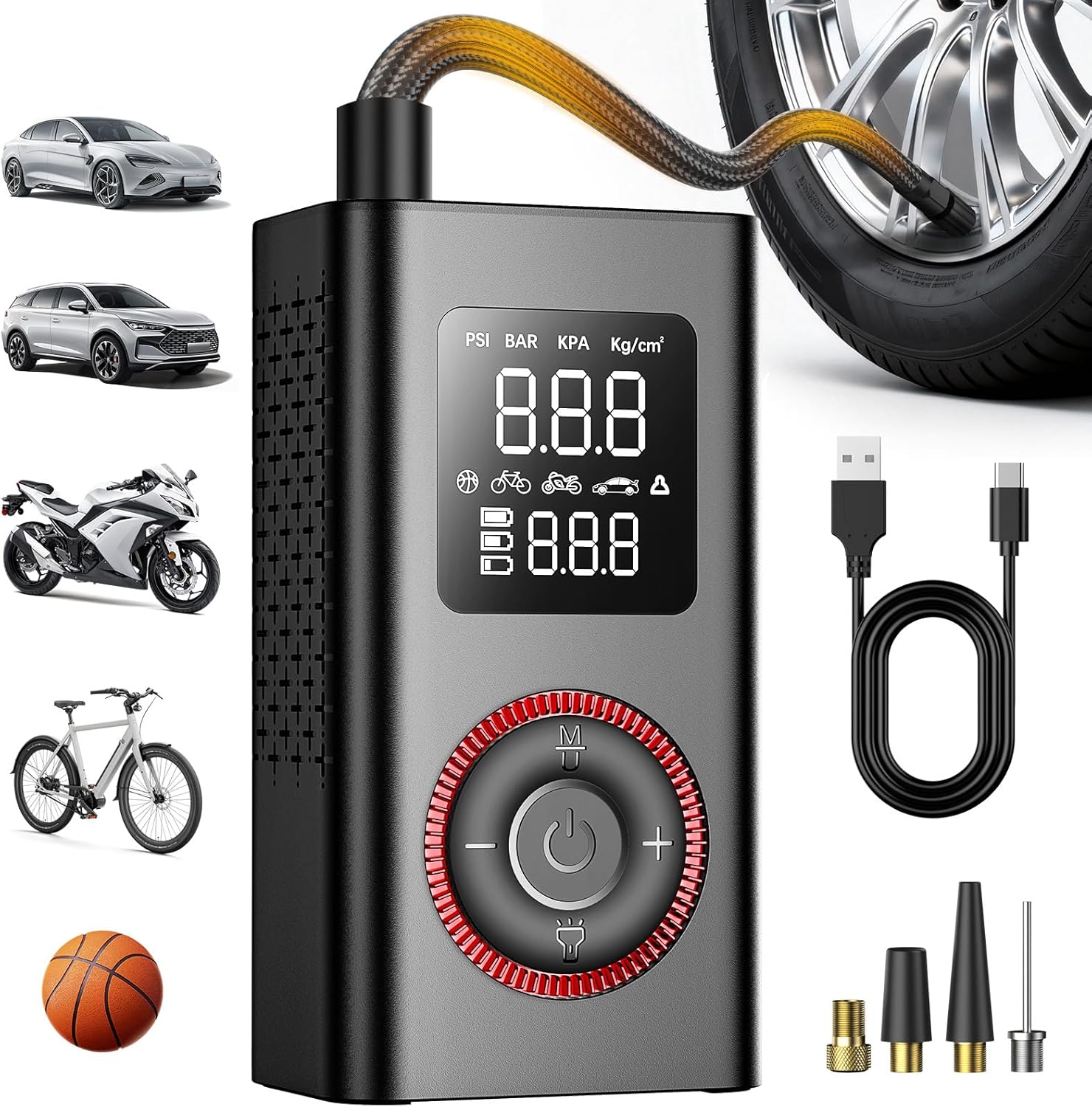
This portable tire inflator delivers fast, efficient inflation with a maximum 150 PSI rating and accurate pressure control for cars, motorcycles, bikes, and more. It features preset modes with automatic shutoff to help prevent overinflation, plus a real-time digital gauge and bright LED light for roadside use. Powered by a rechargeable 6000mAh battery with Type-C charging and a USB output, it’s also useful as an emergency power source for devices.

The Fanttik X10 Pro is a cordless portable tire inflator that reaches up to 150 PSI and can inflate an R15 tire in about 35 seconds for quick roadside or home top-ups. With AccuInFlate auto-stop and smart start/stop controls, it helps maintain accurate pressure and frees your hands once the target is reached. A high-visibility digital display and preset modes make it easy to set and monitor inflation for cars, motorcycles, bikes, and balls.
Common Mistakes to Avoid
- Do not use the tire’s sidewall maximum as your normal target pressure.
- Do not connect the compressor to 110V AC or a 24V vehicle system.
- Do not use it on excluded truck-tire categories.
- Do not walk away while the compressor is operating.
- Do not pack the unit away while it is still hot.
- Do not assume a tire is safe merely because it accepts air.
Compatibility and Safety
The EPAuto uses a 12V DC vehicle accessory plug and draws approximately 10 to 15 amps according to the listing. Check the fuse rating and instructions for your vehicle’s outlet before use. Some vehicles have accessory sockets that switch off with the ignition, while others remain powered.
The compressor is designed for compatible passenger cars, bicycles, sedans, and midsize SUVs. EPAuto also references midsize SUVs with engines under 3.5 liters, but tire construction and volume matter more than engine size when deciding whether a compressor is suitable.
Keep the unit dry, away from children, and clear of moving engine parts. Never use it in standing water or place it where the hose or cord creates a trip hazard. When a tire repeatedly loses pressure, have the tire and wheel inspected instead of relying on repeated inflation.
Cleaning and Maintenance
Disconnect the compressor and allow it to cool before cleaning. Wipe the housing with a soft, dry cloth, and avoid soaking the display, switches, plug, or air connector.
Inspect the power plug, fuse, hose, and threaded connector for cuts, looseness, heat damage, or air leakage. The listing states that the power cable uses a 15-amp fuse and includes a backup fuse. Replace a fuse only with the specified type and rating.
Store the unit in a cool, dry location away from direct sunlight and extreme heat. Loose cord coils place less stress on connection points than tight wrapping around the housing.
What People Say
Customer feedback summarized in the original review commonly praises the simple digital controls, automatic shut-off, and ability to correct a low passenger tire without visiting a service station.
The most relevant concerns are the loud operating sound, heat during longer sessions, and possible wear near hose or cord connections. These tradeoffs support using the EPAuto as an occasional personal-vehicle inflator rather than a continuous-duty shop compressor.
Overall Sentiment: Positive

Pros and Cons
Pros
- Preset digital pressure control with automatic shut-off.
- Four selectable pressure units reduce conversion mistakes.
- Built-in LED light helps during low-light roadside use.
- Ball needle and tapered nozzles support several small inflatables.
- Compact corded design avoids battery charging and battery aging.
Cons
- The listed 92 dB noise level is loud during operation.
- It requires a working 12V outlet and is not a cordless or 110V model.
- EPAuto excludes LT, heavy-duty, and other truck tires.
Why People Choose It
The EPAuto appeals to drivers who prefer a corded compressor that can remain in the vehicle without needing battery charging. Its digital target setting and automatic shut-off remove much of the guesswork from routine inflation.
The combination of passenger-tire capability, an LED light, multiple display units, and small-inflatable adapters also gives it more versatility than a basic analog emergency pump. Buyers who understand its noise, heat, and tire-size limits are most likely to be satisfied with it.
Is It Worth the Price?
The EPAuto sits in the practical budget-to-mid-range category for corded digital inflators. Its value comes from combining the pressure gauge, preset controls, automatic shut-off, LED light, heat protection, and small-inflatable adapters in one unit.
It offers the strongest value to a passenger-vehicle owner who needs occasional top-ups and wants to store the compressor for roadside use. Because it draws power directly from the vehicle, you do not have to maintain a rechargeable battery that may be empty when needed.
It is not the best value for truck owners, frequent off-road users, or anyone who regularly inflates large-volume tires. Those buyers should spend more for a higher-output dual-cylinder or continuous-duty compressor.
How It Compares to Alternatives
An AstroAI 12V and 110V dual-power inflator may be more convenient if you want to use the same compressor in your garage and vehicle. Cordless models can be easier to carry around a parked car, but their batteries require charging and may lose capacity over time.
A GSPSCN dual-cylinder 12V compressor is worth comparing when faster airflow or support for larger vehicle tires matters more than compact storage. The EPAuto makes the most sense when you want simple digital controls, passenger-tire compatibility, and occasional emergency use.
Frequently Asked Questions
Does the EPAuto compressor stop automatically?
Yes. Select the pressure unit, enter the target pressure, and start the compressor. It stops pumping when the preset target is reached, although you should remain nearby throughout operation.
Can it inflate truck tires?
No. EPAuto states that this model does not support LT, heavy-duty, or other truck tires. Choose a higher-output compressor designed for your truck’s tire construction and volume.
Can I plug it into a household outlet?
Not directly. This model uses 12V DC vehicle power and does not include a 110V AC plug. Do not connect it to 24V power or an unapproved adapter.
Does it work with bicycle tires?
It connects directly to Schrader bicycle valves. A bicycle with a Presta valve needs a suitable Presta-to-Schrader adapter. Set the correct bicycle pressure before starting because small tires fill faster than car tires.
Should the vehicle engine be running?
EPAuto’s operating instructions say to run the vehicle while using the compressor. Follow your vehicle manual, keep the vehicle outdoors or in a properly ventilated area, and never run an engine inside a closed garage.
What pressure should I enter?
Use the cold-tire pressure listed on the driver’s-door placard or in the vehicle manual. Do not use the maximum pressure molded into the tire sidewall as the normal inflation target.
Why did the compressor stop before I finished?
It may have reached the preset pressure or activated its heat protection. Turn it off, check the displayed pressure, and allow it to cool before trying again if it feels hot.
Can it repair a flat or leaking tire?
No. The compressor only adds air. A puncture, damaged valve, broken bead, or sidewall failure requires proper inspection and repair before the tire can be considered safe.
The Bottom Line
The EPAuto 12V DC Portable Air Compressor is a sensible choice for drivers who need digital preset inflation, automatic shut-off, and compact passenger-tire support. Its main limitations are loud operation, dependence on a 12V outlet, and the manufacturer’s exclusion of truck tires.
Choose it for occasional car, bicycle, sports-equipment, and roadside use. Skip it when you need cordless operation, household power, continuous duty, or reliable inflation of large truck tires.
Ready to Buy?
Check the latest price, seller, included accessories, and product details before you decide.

Related Articles
5614 Pro Max 150 PSI Tire Inflator Review: Cordless Air Pump for Cars and Bikes
You want a compact, reliable way to keep your tires at the right pressure whether you are driving or cycling, and a cordless inflator…
Read More
AIRSURE 150 PSI Tire Inflator Review: 3X Faster Portable Air Compressor for Cars and Bikes
You want a compact pump that actually makes maintaining tire pressure easy and fast. The AIRSURE 150 PSI portable inflator aims to give you…
Read More
Vinid 150 PSI Tire Inflator Review: Pink Cordless Air Pump for Car, Bike, and Balls
You want a compact, reliable way to keep tires, bikes, and sports gear properly inflated without hunting for an outlet. The Vinid 150 PSI…
Read More