
How to Choose the Right Tire Size for a Lifted Toyota Tundra
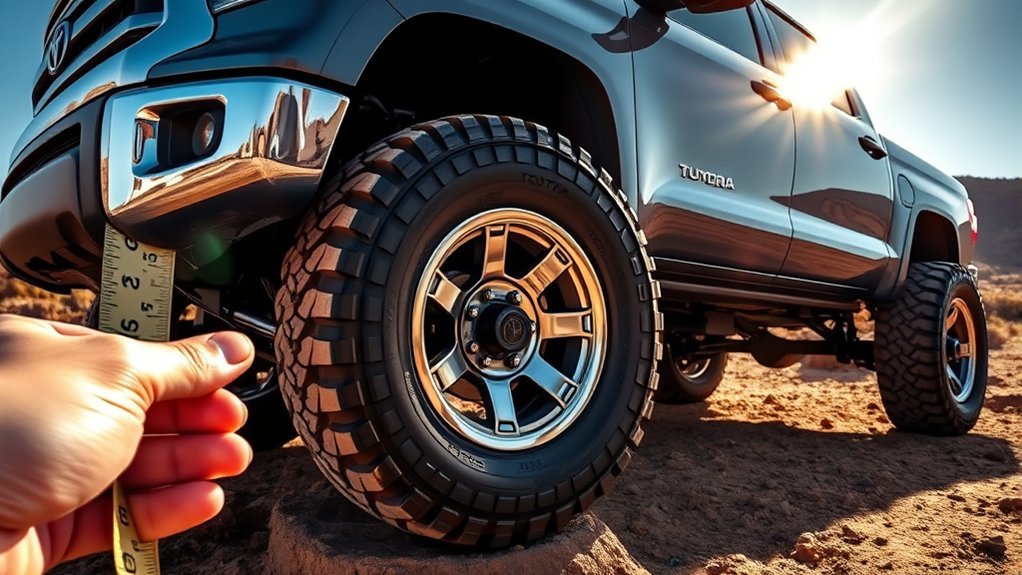
Choosing the right tire size for a lifted Toyota Tundra is not just about filling the wheel wells. The best fit depends on your Tundra generation, stock tire size, lift height, wheel width, offset, load rating, and how much trimming you are willing to do. A 33-inch tire is usually the easier upgrade, a 35-inch tire is the common aggressive choice on many lifted builds, and a 37-inch tire is usually reserved for taller lifts with extra clearance work.
Quick Answer
For many lifted Toyota Tundras, 33- to 35-inch tires offer the best mix of clearance, drivability, and appearance. A 3-inch lift often works best with 33- to 35-inch tires depending on wheel offset and trimming, while 37-inch tires usually need a 6-inch lift and more modifications.
Key Takeaways
- Always start with the stock tire size, door placard, owner’s manual, and tire load rating before choosing a larger size.
- A lift creates clearance, but it does not guarantee that a tire with the same extra height will fit without rubbing.
- Wheel offset and backspacing can matter as much as tire diameter because they decide whether the tire hits the fender, frame, mud flap, or upper control arm.
- Larger tires can affect speedometer accuracy, braking, gearing, fuel economy, and safety-system behavior, so plan for calibration and alignment after installation.
At a Glance
| Time Required | 30–60 minutes to compare sizes and inspect clearance; longer if test-fitting wheels and tires |
| Difficulty | Moderate; professional mounting, balancing, and alignment are recommended |
| Tools Needed | Tape measure, tire-size calculator, flashlight, tire-pressure gauge, owner’s manual, and access to a qualified tire/alignment shop |
| Cost | Varies by tire size, tire type, wheels, trimming, alignment, TPMS service, and speedometer calibration needs |
Understanding Tire Specifications for Your Tundra
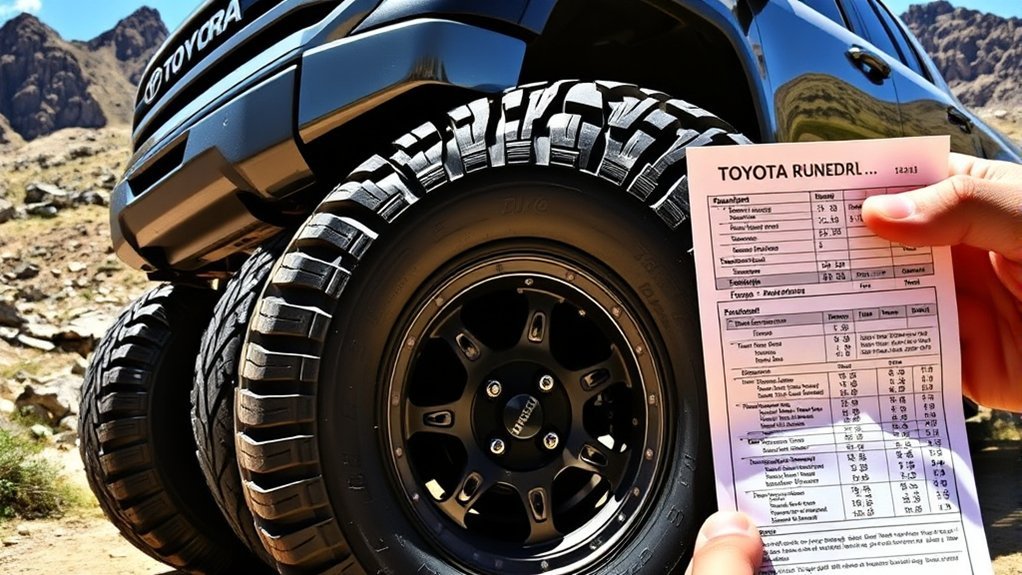
When you see a tire size such as 285/70R18, each part tells you something important. The first number, 285, is the tread section width in millimeters. The second number, 70, is the aspect ratio, which means the sidewall height is 70% of the tire width. The R means radial construction, and 18 is the wheel diameter in inches. Toyota’s owner information explains these tire symbols and sidewall markings in the Toyota Tundra tire information section.
To estimate overall tire diameter, convert the sidewall height to inches, double it, and add the wheel diameter. For example, a 285/70R18 tire is about 33.7 inches tall:
- 285 mm × 0.70 = 199.5 mm sidewall height
- 199.5 mm ÷ 25.4 = about 7.85 inches
- 7.85 inches × 2 + 18-inch wheel = about 33.7 inches overall diameter
Note: Tire brands can measure slightly differently even when the printed size is the same. Always check the tire manufacturer’s published diameter, approved rim-width range, load index, and revolutions per mile before buying.
[Products Worth Considering]

This 13-inch flat-free wheelbarrow tire uses solid polyurethane foam construction with steel rims, so it will not puncture, rot, or go flat. The anti-skid tread improves...
Start With Stock Size, Load Rating, and the Door Placard
Before choosing larger lifted tires, check the tire and loading placard on the driver’s door jamb, your current tire sidewall, and your owner’s manual. The NHTSA tire safety guide recommends using the vehicle’s original tire size or another size recommended by the manufacturer, and it points owners to the placard, manual, or tire sidewall for tire information.
Your new tires should meet or exceed the original load index and be appropriate for how you use the truck. This matters even more if your Tundra tows, carries tools, runs a camper shell, or uses heavy off-road accessories. Large all-terrain or mud-terrain tires can be much heavier than stock tires, which can increase strain on wheel bearings, suspension parts, brakes, and steering components.
Warning: Do not choose a tire only because it clears the fender. The tire must also fit the wheel, carry the truck’s load, maintain safe pressure, clear at full steering lock, and work safely with braking and stability systems.
How to Choose the Right Tires for Your Lifted Tundra
The safest way to choose tires is to work from the truck’s real measurements instead of relying on lift height alone. A 3-inch lift does not automatically mean the truck can fit a tire that is 3 inches taller. Tire diameter adds height by radius, wheel offset changes the tire’s path while turning, and suspension compression can create rubbing even when the truck looks clear while parked.
Use this simple process:
- Confirm your stock tire size from the placard, manual, and current sidewall.
- Choose your target diameter, such as 33, 34, 35, or 37 inches.
- Check wheel width and offset against the tire maker’s approved rim-width range.
- Confirm load index so the new tire can safely support the truck and payload.
- Compare overall diameter to estimate speedometer and gearing changes.
- Test clearance at full lock, in reverse, and under suspension compression.
- Plan post-install work, including balancing, alignment, TPMS checks, and calibration if needed.
A conservative tire upgrade keeps diameter close to stock, but many Tundra owners go larger for clearance and stance. The bigger the tire, the more important wheel offset, load rating, trimming, alignment, and recalibration become.
Common Tire Sizes by Lift Height
The table below gives practical starting points, not guaranteed fitments. Your exact Toyota Tundra year, trim, suspension, wheel offset, tire brand, and fender liner setup can change the result.
| Lift Height | Common Tire Range | Best For | Likely Fitment Notes |
|---|---|---|---|
| Stock to 2-inch level | 32–33 inches, such as 275/70R18 or 285/70R17 depending on wheel setup | Daily driving, mild trails, stock-like drivability | Usually the easiest range, but check mud flaps, fender liner, and upper control arm clearance. |
| Around 3 inches | 33–35 inches, such as 285/70R18, 295/70R18, or 35×12.50R20 | Aggressive street stance, overlanding, moderate off-road use | 35-inch tires may need the right offset, liner adjustment, mud flap removal, or light trimming. |
| 4–6 inches | 35–37 inches, such as 35×12.50R18, 35×12.50R20, or 37×12.50R20 | More ground clearance, larger wheel wells, stronger off-road look | 37-inch tires commonly require trimming, careful offset choice, and possible gearing or calibration work. |
| 6 inches or more | 37 inches and larger on purpose-built setups | Show builds, heavy off-road use, maximum stance | Expect more weight, more trimming, more drivetrain load, and a greater need for professional setup. |
Toyota’s official TRD 3-inch lift kit for applicable 2022 and newer Tundra models raises the front 3.0 inches and rear 2.0 inches, adds 2.6 inches of ground clearance, and is designed to work with Toyota Safety Sense. That makes it a useful reference point, but it still does not replace a real tire-and-wheel clearance check.
Wheel Width, Offset, and Backspacing Matter
Two Tundras with the same lift and tire size can rub differently if the wheels have different offsets. Offset is how far the wheel mounting pad sits from the wheel centerline. More positive offset tucks the tire inward, which can create upper control arm or frame clearance issues. More negative offset pushes the tire outward, which can create fender, mud flap, and bumper clearance issues.
Backspacing is the distance from the wheel mounting surface to the inner wheel lip. More backspacing usually pulls the tire closer to the suspension. Less backspacing pushes it outward. Wider tires often need a careful offset/backspacing match so they clear the upper control arm without sticking out so far that they hit the fender liner during turns.
Pro Tip: If you are choosing between two tire sizes, compare the actual section width and diameter from the tire maker. A narrow 35-inch tire often fits more easily than a wide 35×12.50 tire on the same truck.
Popular Tire Sizes for Lifted Tundras
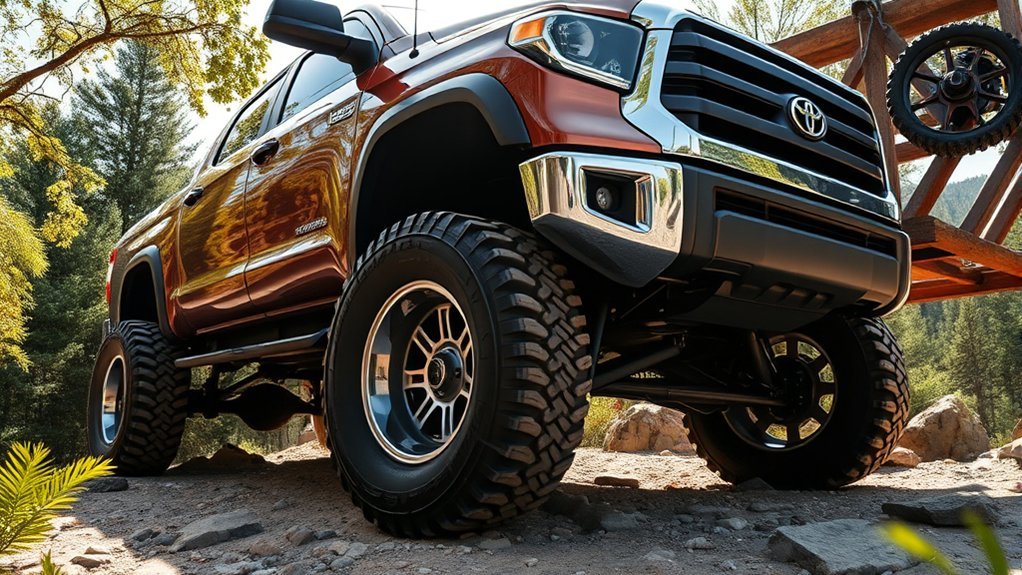
Popular lifted Tundra tire sizes include 285/70R17, 285/70R18, 295/70R18, 33×12.50R20, 35×12.50R20, and 37×12.50R20. The right choice depends on whether you want easy daily drivability, a fuller wheel-well look, or maximum off-road clearance.
- 285/70R17: A common balanced size for a beefier look without jumping straight to a wide 35-inch tire.
- 285/70R18: A strong daily-driver and overland-style option that usually keeps width manageable.
- 295/70R18: Taller and wider than many 285 options, often used for a more aggressive stance.
- 33×12.50R20: Wide and bold, but the width can create rubbing depending on offset.
- 35×12.50R20: A popular aggressive lifted size, often requiring careful wheel offset and possible trimming.
- 37×12.50R20: Best for taller lifts and more modified builds; expect more weight, rubbing checks, and drivability tradeoffs.
Choose the Tire Type for Your Driving Needs
Size is only half the decision. The tread type decides how your lifted Tundra behaves on pavement, gravel, mud, snow, and wet roads.
- Highway-terrain tires: Best for quiet daily driving, towing, and long tread life on pavement.
- All-terrain tires: Best all-around choice for many lifted Tundras because they balance road manners with trail traction.
- Mud-terrain tires: Best for mud, rocks, and aggressive off-road use, but usually louder and heavier on pavement.
- Winter or 3PMSF-rated tires: Best if snow and ice are part of your regular driving conditions.
Also compare P-metric and LT tires. LT tires often have stronger construction for towing, payload, and off-road use, but they can ride firmer and may require different pressure guidance. Use the tire maker’s load chart or a qualified tire shop when changing tire type, load range, or size.
Speedometer, Safety Systems, and Calibration
Changing tire diameter changes how far the truck travels with each wheel rotation. Tire Rack explains that overall tire diameter affects the speed data used by modern vehicle computers, and large changes can affect speedometer accuracy as well as ABS, traction control, and stability systems. Its tire-selection guidance says staying within a 3% diameter change is desirable for cars and vans, while pickups and SUVs may be engineered for larger oversize tires; either way, large changes should be checked carefully.
For a lifted Tundra, treat the 3% rule as a conservative planning target, not the only thing that matters. If you go larger than that, plan to check speedometer error and ask your installer whether recalibration is needed. This is especially important if your truck uses advanced driver-assistance features, towing features, or aftermarket suspension parts.
Warning: Larger and heavier tires can increase stopping distance, reduce fuel economy, change shift feel, and add stress to steering and suspension parts. Do not skip the road test, alignment, and clearance check after installation.
Installation Tips for Your New Lifted Tires
When installing new lifted tires on your Toyota Tundra, start with a professional mount and balance. Then check every clearance point before normal driving. Look at the front bumper edge, fender liner, mud flaps, sway bar, upper control arms, cab mount or body mount area, brake lines, and inner frame clearance.
After the tires are installed, complete this checklist:
- Set cold tire pressure using the placard, tire maker’s load chart, or installer’s guidance. Toyota’s owner information includes Tundra tire inflation guidance, and NHTSA recommends checking pressure when tires are cold.
- Turn full lock both directions while parked and again while slowly rolling forward and backward.
- Check suspension compression by driving slowly over a driveway apron or mild articulation point.
- Schedule a wheel alignment after the lift and tires are installed to reduce uneven wear and preserve handling.
- Check TPMS operation and confirm there are no warning lights after the road test.
- Verify speedometer accuracy with a GPS speed reading or calibration tool when tire diameter changes significantly.
- Recheck lug torque using the owner’s manual or wheel manufacturer’s torque specification after the installer’s recommended break-in distance.
NHTSA notes that wheel alignment helps maximize tire life and should be performed by a qualified technician. That is especially important after changing lift height, wheel offset, or tire diameter.
Troubleshooting Rubbing, Vibration, and Uneven Wear
If your lifted Tundra rubs after new tires, the location of the rub tells you what to fix:
- Rubbing at full steering lock: Check fender liner, mud flap, sway bar, and upper control arm clearance.
- Rubbing only in reverse: The tire may move into the liner or mud flap at a different angle; inspect both front and rear edges of the wheel well.
- Rubbing over bumps: The tire may clear while parked but hit during compression; more trimming, bump-stop adjustment, or a smaller tire may be needed.
- Highway vibration: Recheck balance, tire roundness, wheel centering, lug torque, and alignment.
- Uneven tire wear: Check alignment, tire pressure, worn suspension parts, and rotation schedule.
- Speedometer reads slow: The new tire diameter is larger than stock; recalibration may be needed.
If the tire contacts metal, brake lines, or suspension parts, stop driving and correct the fitment before continuing. Cosmetic liner rub is one thing; contact with structural or safety parts is not acceptable.
Frequently Asked Questions
What’s the ideal lift size for a Tundra?
The ideal lift size depends on your target tire size and how you use the truck. A mild level or 3-inch lift is usually enough for a clean daily-driver or overland-style setup with 33- to 35-inch tires. A 6-inch lift is better suited for 35- to 37-inch tires, but it can add cost, weight, and drivability tradeoffs. Toyota’s official TRD lift kit is a useful reference because it provides 3.0 inches of front lift and 2.0 inches of rear lift for applicable 2022+ Tundras while maintaining Toyota Safety Sense compatibility.
Can I fit 35-inch tires on a Toyota Tundra with a 3-inch lift?
Often, yes, but it depends on the wheel offset, tire width, Tundra generation, suspension setup, and trimming tolerance. A 35×12.50 tire is much wider than many metric 35-inch options, so it may rub sooner. Always test full-lock steering, reverse turns, and suspension compression before assuming the fit is safe.
Are 37-inch tires too big for a lifted Tundra?
They are not too big for every build, but they are usually too much for a simple daily-driver setup. A 37-inch tire often needs a taller lift, careful wheel offset, trimming, calibration, and extra attention to braking, gearing, and suspension wear. For most owners, 35-inch tires are the more practical aggressive size.
Will bigger tires affect my speedometer?
Yes. A taller tire travels farther per wheel rotation, so the speedometer can read slower than your actual road speed. The larger the diameter change, the more important it is to check speedometer error and recalibrate if needed.
Do I need an alignment after installing lifted tires?
Yes. Any lift, leveling kit, wheel-offset change, or larger tire installation should be followed by a professional alignment. Alignment helps protect tire life, steering feel, braking stability, and predictable handling.
Sources
- Toyota Owners — 2025 Tundra Tire Information — tire symbols, sidewall markings, and tire information.
- Toyota Owners — 2025 Tundra Tire Inflation Pressure — manufacturer tire-pressure reference.
- NHTSA Tire Safety Brochure — tire size, tire pressure, tread, alignment, and maintenance safety guidance.
- Toyota USA Newsroom — TRD 3-inch Lift Kit — official Toyota lift-kit specifications and Toyota Safety Sense compatibility notes.
- Tire Rack — How Do I Select the Right Tires? — overall diameter, load capacity, and plus-sizing considerations.
Conclusion
Choosing the right tire size for your lifted Toyota Tundra is about fit, safety, and purpose. Start with the stock size and load rating, then compare tire diameter, width, wheel offset, and clearance before you buy. For many owners, a 33- to 35-inch tire gives the best balance of stance, trail clearance, and daily drivability. If you want 37-inch tires or a wide 12.50-inch setup, plan for trimming, calibration, alignment, and a more careful inspection. Get the fit right, and your Tundra will look stronger, drive better, and stay safer on and off the road.

Related Articles
Toyota Tundra Tire and Wheel Package: What to Consider Before Buying
Unlock the secrets to choosing the perfect tire and wheel package for your Toyota Tundra—essential tips await to enhance your ride.
Read More
Do Bigger Tires Void a Toyota Tundra Warranty? Magnuson-Moss Act Explained
Bigger tires might not void your Toyota Tundra warranty, but understanding the Magnuson-Moss Act is crucial—discover how to protect your investment effectively.
Read More
Toyota Tundra Tire Rack Setup: Garage Storage Ideas for Seasonal Sets
Better tire storage for your Toyota Tundra awaits—discover essential tips to maximize space and protect your seasonal sets in the garage!
Read More