
ZERINT 96 pcs Self-Vulcanizing Tire Patch Kit Review: Heavy-Duty Radial Patches for Cars and Trucks

Disclosure: As an Amazon Associate, we earn from qualifying purchases. If you click a link on this page and make a purchase, we may receive a small commission at no extra cost to you.
A small tread puncture may be repairable, but the quality of the repair depends on using the right materials and inspecting the tire from the inside. The ZERINT TP-MRSV5 set gives you 96 internal tire patches in five size-and-shape combinations for radial tires, bias-ply tires, and inner tubes. Its large count and useful size mix make it appealing for a well-equipped garage or tire shop, but it is not a complete roadside kit and should not be treated as a patch-only solution for passenger or light-truck tires. This review explains what is included, what else you need, and when professional tire service is the safer choice.
Quick Verdict
Editorial Rating: 8/10, recommended with important safety caveats
Best For: Tire shops, fleet maintenance areas, and experienced DIY users who already have tire-removal and repair equipment
Bottom Line: You get 96 chemical-vulcanizing patches in five useful sizes, which offers strong value when you perform repeated internal repairs. The main tradeoff is that the box does not replace the cement, tools, tire inspection, or injury-filling component required for a complete passenger or light-truck tire repair.
ZERINT 96-Piece Tire Patch Kit

| Specification | Detail |
|---|---|
| Brand | ZERINT |
| Model | TP-MRSV5 |
| Product type | Internal chemical-vulcanizing tire repair patches |
| Total quantity | 96 patches |
| Round patches | 24 at 41 mm and 12 at 57 mm |
| Square patches | 24 at 45 × 45 mm and 12 at 57 × 57 mm |
| Rectangular patches | 24 at 38 × 61 mm |
| Material | Black vulcanizing gum with blue poly backing |
| Listed compatibility | Radial tires, bias-ply tires, and inner tubes |
| Repair method | Chemical vulcanization on the prepared inner surface |
| Package note | The listing identifies 96 patches; cement, buffing tools, rollers, and tire-demounting equipment are not listed as included |
| Best use | Repeated internal repairs by trained users with the correct inspection and repair equipment |
[Products Worth Considering]

This tire repair patch tool kit helps you quickly seal small punctures using upgraded mushroom plugs and a built-in roller system that presses for even penetration. The tungsten buffing wheel and HSS twist drill bits prepare the damaged surface for stronger adhesion, while the crown-angle friendly plugs are designed to keep water and debris out. Ideal for puncture repairs on many vehicle types, from cars and trucks to bikes and scooters.

Wykodra tire plugs provide quick vulcanizing repairs for tubeless tires, helping you seal punctures and get back on the road. The industrial-strength rubber creates a long-lasting, leak-resistant bond and is designed for emergency fixes without removing the tire. Choose between two standard plug sizes with color-matched options for small to larger damage across many vehicles and off-road uses.
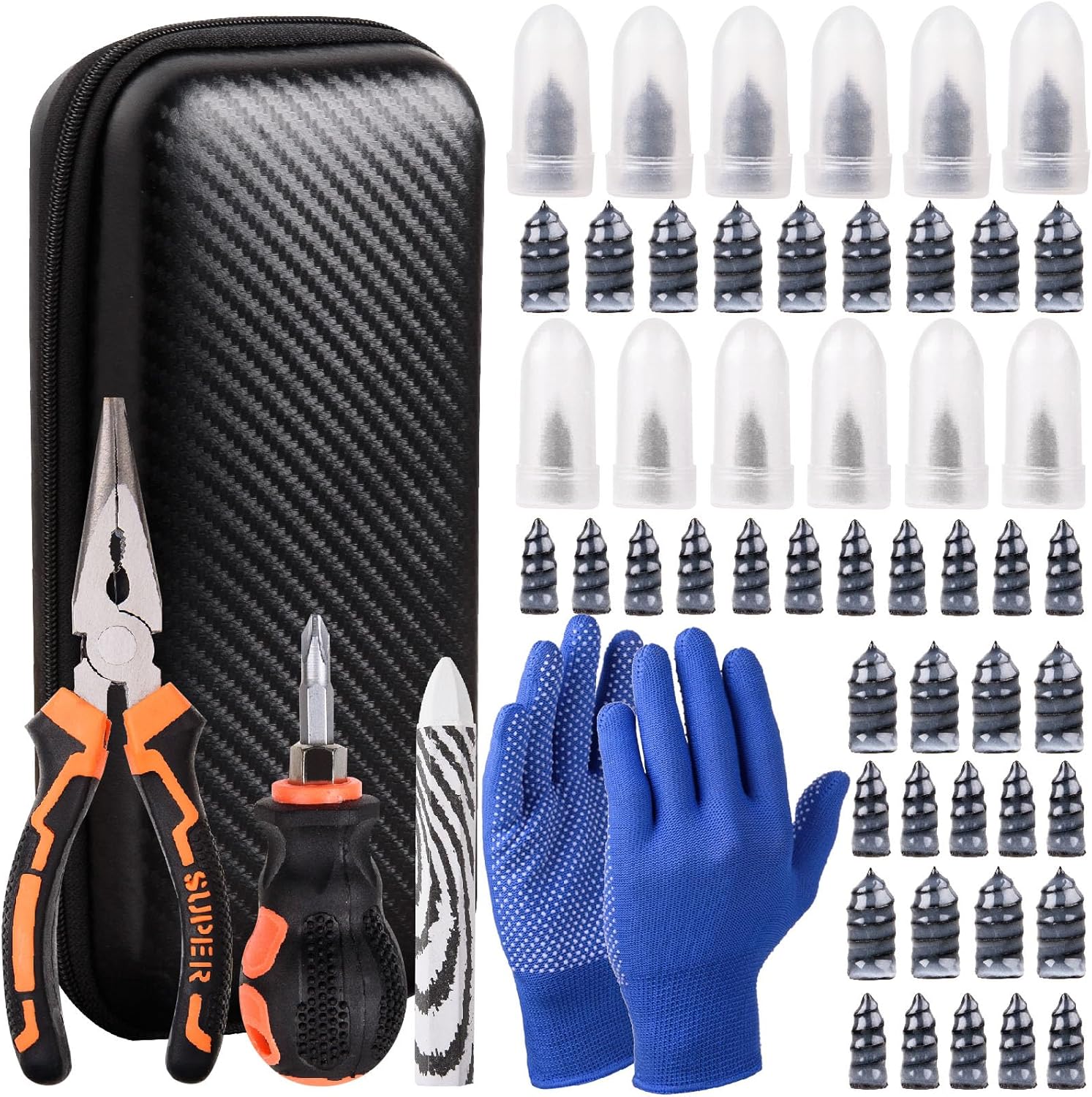
This tire sidewall puncture repair kit fixes flats fast without removing the tire, helping you get back on the road in minutes. It includes self-tapping repair nails, essential tools, gloves, and a portable storage bag for convenient roadside use. Designed for tubeless tires, it helps create a tight, leak-resistant seal for cars, motorcycles, trucks, SUVs, and ATVs.
What Is the ZERINT TP-MRSV5?
The ZERINT TP-MRSV5 is a bulk assortment of repair patches designed to seal the inner liner during a chemical-vulcanizing repair. The box contains round, square, and rectangular patches, with dimensions ranging from 41 mm round to 38 × 61 mm rectangular. That variety helps you match the repair unit to different injury locations and prepared areas without buying several separate boxes.
The patches use black vulcanizing gum with a removable blue poly backing. ZERINT lists them for radial and bias-ply tires and says they can also be used on inner tubes. The product is best understood as repair material for an equipped work area, not as a complete kit that lets you fix a mounted tire at the roadside.
Before You Buy: These patches must be applied from inside the tire. For passenger and light-truck tires, industry guidance calls for removing the tire from the wheel, inspecting it internally, filling the puncture channel with a suitable stem or vulcanizing material, and sealing the inner liner with a patch. A patch by itself is not a complete repair.
Who Should Buy It?
Best For
- Tire shops that need several internal patch sizes in one box
- Fleet maintenance teams that perform repeated, documented tire repairs
- Experienced DIY users with tire-demounting, inspection, buffing, cementing, and stitching tools
Skip If
- You need a simple roadside plug kit for a mounted tire
- The damage is in the sidewall, shoulder, bead area, or larger than the repair limits for your tire
- You do not have the training or equipment to demount and inspect the tire safely
Patch Sizes and Selection
The strongest feature is the size mix. You receive 24 small round patches at 41 mm, 12 larger round patches at 57 mm, 24 square patches at 45 × 45 mm, 12 larger square patches at 57 × 57 mm, and 24 rectangular patches at 38 × 61 mm. The higher counts are concentrated in the smaller and rectangular formats, which may suit shops that encounter common small tread injuries more often than large repair areas.
A larger patch is not automatically better. The repair unit must match the injury, tire construction, prepared inner-liner area, and repair-material instructions. Use the size chart and procedure supplied with your repair system rather than selecting a patch only by visual coverage.
Materials and Build Quality
ZERINT describes the patches as black vulcanizing gum with blue poly backing. The backing helps protect the bonding surface before installation, but the gum still depends on clean preparation and the correct chemical-vulcanizing process. Dirt, moisture, silicone-based products, or skin oils on the bonding face can reduce adhesion.
The listing calls the patches heavy duty, but durability depends as much on the repair procedure as on the patch. A properly prepared inner liner, correct cement, full contact, and careful stitching matter. The patch also cannot correct hidden structural damage, broken cords, belt separation, or damage caused by driving while severely underinflated.
Compatibility and Required Equipment
The listing states that the assortment works with radial tires, bias-ply tires, and inner tubes. That broad compatibility is useful, but it does not mean every puncture in those products is repairable. Tire type, injury angle, location, diameter, prior repairs, remaining tread, and internal damage all affect the decision.
The product page identifies the patches and their backing, but it does not list a complete set of repair tools. Depending on your repair system, you may also need tire-demounting equipment, an inner-liner cleaner, a scraper or low-speed buffing tool, chemical-vulcanizing cement, a stitcher or roller, an injury-filling stem or material, marking tools, leak-checking supplies, and proper inflation equipment.
Pro Tip: Keep the patch box closed until you are ready to choose a repair unit. After removing the blue backing, avoid touching the black bonding surface, and follow the cement maker’s drying and installation instructions rather than guessing by feel.
How It Performs in Real Use
For a Tire Shop
The 96-piece count can reduce the need to open several small packages during routine work. Five formats give a technician more flexibility than a single-size box, while the labeled dimensions make inventory checks easier. The value is strongest when the shop already stocks compatible cement, injury-filling materials, and the required tools.
For Fleet Maintenance
A fleet operation may benefit from the low per-patch cost and consistent assortment. The box can support repeated repairs across passenger vehicles, motorcycles, or light trucks, provided each tire is inspected and repaired according to the tire maker and repair-material procedures. Repair records should identify the injury location, size, and work completed.
For an Experienced Home Garage
The patches can be useful when you already own a tire changer or have another safe way to remove the tire from the wheel. The actual patch application is only one part of the job. You still need to inspect for run-flat damage, prepare the inner liner without exposing or damaging tire cords, fill the injury channel, reinstall the tire, seat the beads, inflate safely, and verify that the repair does not leak.
For a Roadside Emergency
This is not the most practical roadside choice. Because the patch goes on the inside, you cannot correctly install it through the tread of a mounted tire. A spare tire, roadside assistance, or an approved temporary mobility solution is usually more realistic until the tire can be inspected and repaired by a qualified technician.
How to Use These Patches Correctly
Start by identifying the puncture and checking whether its location and size fall within the repair limits for that tire. For passenger and light-truck tires, common industry guidance limits repairs to the tread area and punctures no larger than 1/4 inch, or 6 mm. Shoulder and sidewall injuries should not be repaired with this patch set.
The tire must be removed from the wheel for a complete internal inspection. A trained repairer then marks the injury, removes the object, checks the injury angle and internal condition, prepares the puncture channel, cleans and buffs the inner liner to the repair-material specification, applies the correct cement, installs the injury-filling material, places and stitches the patch, seals any exposed buffed area when required, and checks the finished repair for leaks.
Do not improvise the procedure from a short online summary. Follow the instructions supplied by the tire manufacturer, patch maker, cement maker, and your repair-equipment provider. When any step or damage condition is uncertain, take the tire to a qualified tire service professional.
[Products Worth Considering]

This VEVOR tire bead breaker uses a slide-hammer impact and wedge tip to separate tire beads from rims quickly and efficiently without damaging hub surfaces. The long handle and sturdy steel construction help reduce user strain while providing reliable, portable tire changing for cars, trucks, and more. Ideal for home mechanics and repair shops handling multiple vehicle tire sizes.

Camco Trailer Aid Plus tandem tire ramp lifts your trailer for quick, safe tire changes with ample clearance from its 5 1/2-inch lift. It helps you change a flat tire without unloading cargo, making roadside and routine maintenance more efficient. The heavy-duty, waterproof and rustproof polymer design supports up to 15,000 lb and is built for easy portability and storage.
Compatibility and Safety
A repair should never be based only on the visible nail hole. Damage may exist inside the tire after underinflated driving, impact, heat buildup, or previous improper repair. Tires with sidewall or shoulder damage, exposed or broken cords, bead damage, separation, large injuries, overlapping repairs, or evidence of being driven flat may need replacement rather than patching.
For a proper passenger or light-truck puncture repair, the inner liner must be sealed and the injury channel must be filled. This helps prevent air loss and reduces the chance that water reaches the belts or plies. A patch-only repair leaves the channel unfilled, while a plug-only repair does not seal the inner liner or allow a complete internal inspection.
Inflation also requires care. Use a restrained inflation procedure and appropriate equipment when seating beads, follow the vehicle placard or tire-service specification, and never exceed equipment or tire limits. If you lack tire-service training, the safer choice is professional installation.
What Buyers Say
The customer-feedback summary in the source article is broadly positive. Buyers commonly mention good adhesion, easy handling, useful size variety, and strong value from the 96-piece count. The Amazon listing also displayed a 4.4-star average when this article was reviewed, although ratings and review totals can change.
The most important limitation is not a complaint about the patches themselves. It is the risk of treating the box as a complete emergency kit. Buyers should plan for the additional repair materials, equipment, and inspection steps before relying on it.
Overall Sentiment: Positive, with proper installation required

Pros and Cons
Pros
- Large 96-piece count suits repeated repairs and shop inventory
- Five size-and-shape combinations cover a useful range of prepared repair areas
- Listed for radial tires, bias-ply tires, and inner tubes
- Black vulcanizing gum is protected by removable blue poly backing
- Low per-patch cost can offer strong value for equipped users
Cons
- Not a complete kit, because cement, tools, and injury-filling materials are not listed as included
- Requires tire removal and internal inspection, so it is poorly suited to quick roadside use
- Cannot make sidewall, shoulder, large, or structurally damaged tires repairable
Is It Worth the Price?
The article and Amazon listing showed a price of $16.99 during verification, which places this assortment in the budget range for bulk repair materials. At that price, the cost per patch is low, and a shop or fleet operation can recover the purchase cost quickly through repeated use. Amazon prices can change, so check the current listing before buying.
The value is less compelling for a driver who only wants one emergency repair. You would still need compatible cement, injury-filling material, inspection tools, tire-removal equipment, and the skill to complete the repair. For most drivers, paying a tire professional is a better value than buying all of the supporting equipment for occasional use.
How It Compares to Alternatives
A combination patch-plug unit joins the inner-liner patch and injury-filling stem in one repair component, which can simplify matching both functions for a suitable straight puncture. Separate stem-and-patch systems, including this ZERINT assortment, provide more flexibility but require you to select compatible components and follow the full repair process.
Rope-plug kits are easier to use on a mounted tire and are often marketed for roadside emergencies, but they do not replace internal inspection or a complete industry-recommended repair. A professional shop repair costs more per puncture, yet it includes the equipment and inspection most drivers do not have. The ZERINT box makes the most sense when you already have that setup and need affordable replacement patches.
Why Choose ZERINT?
ZERINT gives you a larger and more varied patch assortment than a small single-size package. The 96-piece count is divided among round, square, and rectangular formats, so you can stock several common repair-unit dimensions in one compact box. That is the main reason to choose it over a smaller pack.
You should choose it for inventory value, not because it makes tire repair effortless. Its benefit appears only when the patch is paired with the correct inspection, preparation, cement, injury-filling material, and finishing steps.

Frequently Asked Questions
Is the ZERINT TP-MRSV5 a complete roadside tire repair kit?
No. The listing identifies 96 internal patches, but it does not list cement, tire-removal equipment, buffing tools, an installation roller, or injury-filling stems as included. Because the tire must be removed from the wheel for internal inspection and patching, this set is better for an equipped shop or garage.
What patch sizes are included?
You receive 24 round 41 mm patches, 12 round 57 mm patches, 24 square 45 × 45 mm patches, 12 square 57 × 57 mm patches, and 24 rectangular 38 × 61 mm patches. Those quantities total 96 pieces.
Will these patches work on radial and bias-ply tires?
The product listing identifies them for puncture repairs in both radial and bias-ply tires. Compatibility does not make every injury repairable, so inspect the tire, follow its manufacturer’s limits, and use the correct repair procedure for the tire construction.
Can the patches be used on inner tubes?
ZERINT states that the patches can also be used on inner tubes. Use a repair process and cement intended for the tube material, inspect for pinching or valve damage, and replace the tube when the damage is outside the repair-material limits.
Do I need vulcanizing cement?
The listing says the patches are for chemical vulcanization and does not identify cement as part of the box. Confirm the compatible cement and preparation procedure before starting. Do not assume that the phrase “self-vulcanizing” means the patches can be applied to an unprepared surface without the specified chemicals.
Can I repair a sidewall or shoulder puncture with this kit?
No. Passenger and light-truck puncture repairs are generally limited to the repairable tread area. Sidewall, shoulder, bead, or belt-edge damage requires professional evaluation and normally means the tire should be removed from service rather than patched.
What is the largest puncture I should repair?
For passenger and light-truck tires, common industry guidance limits a repairable tread puncture to 1/4 inch, or 6 mm, in diameter. The tire manufacturer and repair-material maker may set additional limits, and the injury angle or hidden damage can still make a smaller hole unsuitable for repair.
Is an internal patch enough by itself?
Not for a complete passenger or light-truck puncture repair. The inner liner must be sealed with a patch, and the injury channel must be filled with a suitable stem or vulcanizing material. This ZERINT assortment supplies the patch portion of that system.
The Bottom Line
The ZERINT TP-MRSV5 is a strong-value 96-piece patch assortment for shops, fleets, and trained DIY users who already have the equipment and compatible materials for internal tire repairs. Buy it for the useful mix of five patch sizes and the low per-piece cost, but skip it if you need a complete roadside kit or plan to use a patch alone on a mounted tire.
Its main strength is bulk versatility. Its main limitation is that safe tire repair requires much more than pressing a patch over a puncture.
Ready to Buy?
Check the latest price, package details, and seller information before you decide.

Related Articles

Why These 10 Wheel Locks Are Perfect for Your RAV4
Protecting your RAV4 starts before you lock the doors. Wheel theft is an avoidable cost and a hassle that interrupts your routine, and choosing…
Read More
10 Long Warranty Tires That Will Transform Your RAV4 Experience
You spend a lot of time behind the wheel of your RAV4, and the right tires change everything from ride comfort to fuel economy…
Read More
10 Best 80000 Mile Tires for Rav4
You want tires that last, keep you safe, and save you money over the long run. Choosing 80,000 mile tires for your RAV4 matters…
Read More