
History of Pneumatic Tires: From 1888 to Modern Tech
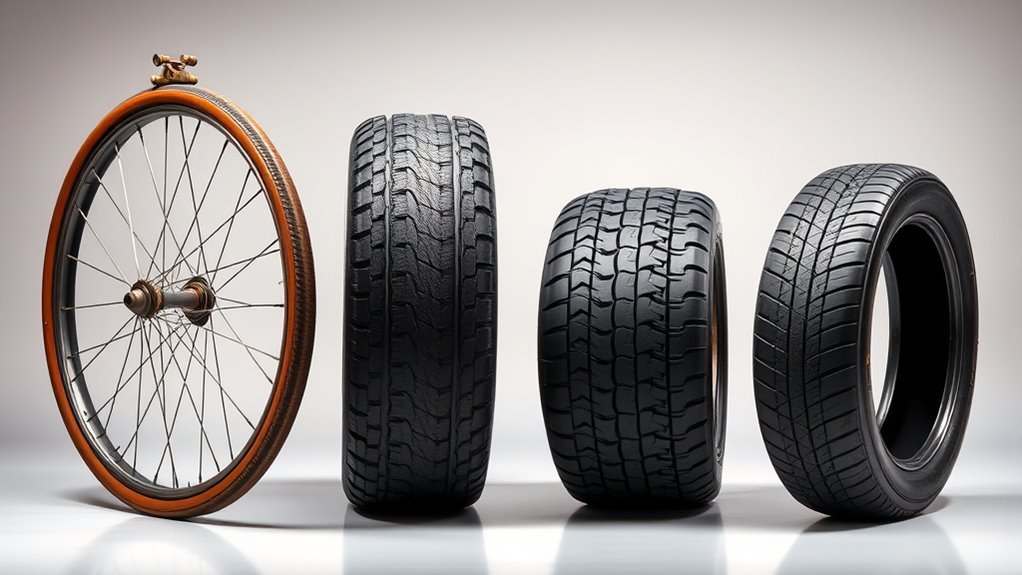
You trace how John Boyd Dunlop’s 1888 pneumatic tire first tamed rough roads for cyclists, then Michelin and others adapted the idea for early car races, proving air-filled tires sped and smoothed travel. Vulcanization, carbon black, and fabric cords built durable treads before WWII. Michelin’s 1948 radial design and later tubeless, steel-belt, and mass‑production advances improved safety and economy. Recent low‑rolling, run‑flat, sensor, and bio‑rubber work points toward smarter, greener wheels—keep going to learn the specifics.
Why 1888 Mattered: Dunlop’s Pneumatic Breakthrough
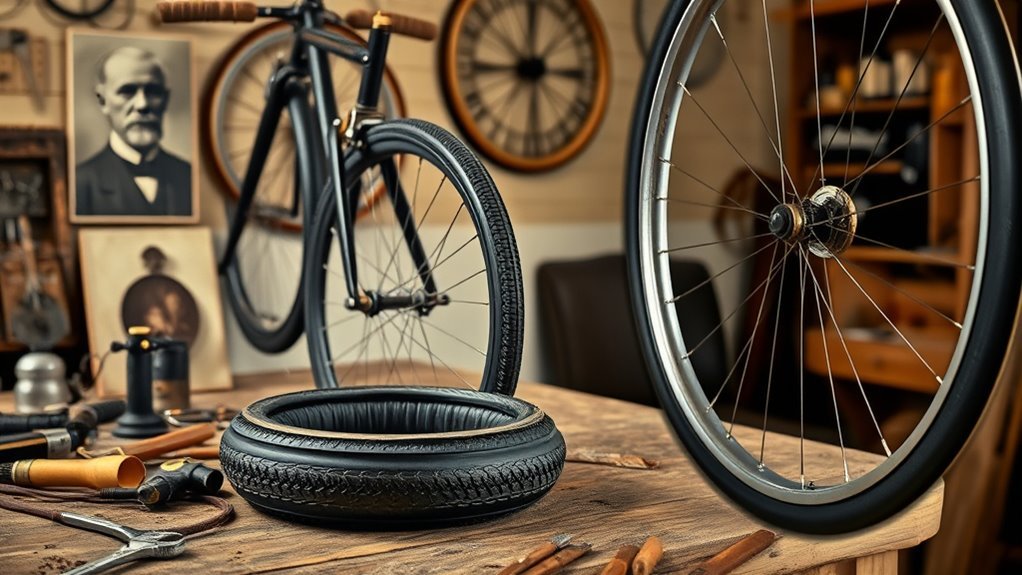
When John Boyd Dunlop patented his practical pneumatic tire in 1888, he wasn’t just solving his son’s bumpy tricycle rides—he was kicking off a chain of changes that reshaped personal transport. You trace Dunlop’s innovation step by step: he wrapped a rubberized, air-filled tube around a wheel to cut vibrations and boost traction, and that simple fix made cycling tolerable on rough roads. As riders felt comfort and control, demand climbed; Dunlop founded the Dunlop Rubber Company and scaled production to meet a hungry public. Chronologically, the pneumatic tire moved from a domestic remedy to a commercial product that rewired expectations about travel—longer distances, faster trips, freer movement. Contextually, you see how improved comfort encouraged mobility and commerce, nudging other makers to iterate. This tire evolution established core principles—air cushioning, tread for grip, manufacturable design—that later firms refined, setting the stage for broader automotive transformation without which personal liberation through mobility would’ve been delayed.
From Bikes to Cars: Michelin and Early Auto Adoption
You’ll see how bicycle racing set performance expectations that the Michelin brothers translated to early cars, moving pneumatic tires from tracks to public roads. In 1895 they fitted pneumatic tires to automobiles for trials like the Paris–Bordeaux race, proving improved comfort, traction, and endurance under higher speeds and long distances. That success spurred manufacturers and racers to push tire design further, accelerating adoption by 1900 and shaping the early automotive era.
Bicycle Racing Influence
A surge in competitive cycling in the late 19th century drove practical innovations in wheel technology, and John Boyd Dunlop’s 1888 pneumatic tire—designed to cut vibration and boost traction—quickly proved its worth on the race circuit. You follow a clear timeline: racers adopt Dunlop’s design for comfort and speed, which accelerates cycling advancements and demonstrates tangible performance gains. As success mounts, patents and trials formalize tire innovation, prompting manufacturers to invest and iterate. Michelin notices this momentum and applies lessons to motor competition, while others like Goodyear ramp up production methods learned from bicycle racing demands. You see how liberated riders’ expectations for smoother, faster travel reshaped design priorities and set the stage for broader vehicular adoption.
Early Automobile Trials
Racers’ success with Dunlop’s pneumatic tire didn’t stay confined to bicycles; by the mid-1890s engineers and entrepreneurs were testing the same principles on horseless carriages. You follow a clear, chronological arc: Dunlop’s 1888 breakthrough proved reduced vibration and better traction, inspiring early experiments on motor vehicles. In 1895 Michelin fitted pneumatic tires in the Paris–Bordeaux race, showing you how tire innovations made speed and comfort possible on rough roads. Those demonstrations encouraged drivers to embrace motor travel, accelerating demand. By the 1900s the pattern hardened: successes in competition and practical trials led to major firms like Goodyear and Firestone, institutionalizing production and refinement. You see a liberating shift from constrained cycling routes to open, motorized mobility.
Materials Before WWII: Vulcanization, Carbon Black, Cords
You’ll start with Goodyear’s 1844 vulcanization, which transformed soft natural rubber into a resilient, weather-resistant material that made sustained tire use possible. By 1904 manufacturers began adding carbon black to rubber compounds to reinforce tread strength and dramatically reduce wear. Around the same time fabric cords—initially cotton—were layered into carcasses to give tires the structural support and flexibility early autos required.
Vulcanization And Durability
Although vulcanization began as a laboratory breakthrough in 1839, its real impact came as manufacturers adopted Charles Goodyear’s process to turn sticky natural rubber into a tough, elastic material that could survive the stresses of road use. You trace vulcanization benefits chronologically: cured rubber resisted heat and abrasion, letting you push speeds and loads higher while demanding less frequent replacement, improving tire longevity. Next, cords were layered—overlapping fabric plies added structural support and flexibility during the early 1900s, letting designers refine tread and carcass shapes. You see how these steps set durable standards before WWII and freed users from constant upkeep, empowering mobility. The table below summarizes key materials and effects.
| Material | Effect |
|---|---|
| Vulcanized rubber | Elasticity, wear resistance |
| Fabric cords | Structural support, flexibility |
| Outcome | Improved durability, safety |
Carbon Black Reinforcement
After vulcanization and layered cords had given tires a tougher, more flexible carcass by the early 1900s, manufacturers sought a filler that would further stiffen rubber and slow wear; carbon black answered that need when it began appearing in tire compounds around 1904. You trace the adoption chronologically: engineers tested soot-derived pigments, measured tensile gains, and optimized dispersion to reveal carbon black properties that reinforced rubber at the molecular level. As you learn, this additive raised abrasion resistance, improved heat dissipation, and elevated tire performance under load. That technical progress let pneumatic tires survive longer, bear heavier vehicles, and free drivers from constant repairs. By integrating carbon black with vulcanized rubber and cords, makers set a durable material standard that shaped mid-century tire design.
Fabric Cord Constructions
Structure mattered as much as material in early tiremaking: builders layered woven fabric cords into overlapping plies, bonded with vulcanized natural rubber and filled with carbon black, to turn soft gum into a load-bearing carcass. You trace fabric cord history by following invention, reinforcement, and form: Goodyear’s vulcanization toughened rubber, carbon black added strength in 1904, and craftsmen stacked cords to make bias ply carcasses that carried loads and hopes for mobility. You’ll see construction techniques evolve chronologically: cords provided stability, plies resisted flex, and vulcanized rubber locked the system together. These choices freed riders from fragile casings and set the stage for postwar change toward radials and tubeless designs that promised greater resilience and control.
- Layered plies for support
- Carbon black for wear
- Vulcanization to unite components
1948: The Radial Tire Revolution and Performance Gains
When Michelin revealed the first radial tire in Europe in 1948, it set in motion a gradual but profound change in tire engineering that you’d see develop over the next decades: you begin by noting the core tire innovation—steel belts and radial cord placement—that replaced bias-ply fabric cords and immediately improved durability and handling. Throughout the 1950s and 1960s manufacturers refined belt geometry and compounds, delivering steady performance enhancement in traction and rolling resistance. Though initial production costs were higher, consumers embraced radials for longer tread life and better fuel economy, pressuring automakers to adapt. By the early 1980s the U.S. market accelerated adoption, and by 1983 nearly all new American cars came with radial designs. That alteration transformed driving: vehicles became safer, more comfortable, and more efficient. You can see this revolution as liberation from older compromises—radials freed drivers to expect consistent performance and longevity as standard.
1970s Shocks: Oil, Recalls, and the US Switch to Radials
Though oil shortages and safety scares seemed unrelated, the 1970s fused them into a turning point that pushed American drivers and makers toward radials. You felt the shock of the 1973 oil embargo firsthand as consumer demand shifted toward fuel efficiency, and radial technology offered the obvious gains in rolling resistance and tread life. Chronologically, manufacturers and buyers responded fast.
- 1973 oil embargo: you sought better mileage, spurring interest in radials and forcing automakers to reconsider tire specs.
- 1977 tire recalls: Firestone’s recall of 9 million Firestone 500s shattered trust, accelerating buyers’ insistence on safer, modern designs while Goodyear introduced competing radial models.
- 1983 industry shift: by then all new American cars wore radials, a liberation from older bias-ply limits, despite higher production costs.
You witnessed a market reforge itself—consumer demand, safety crises, and competitive innovation combined to make radial technology the new standard.
Tubeless, Steel Belts, and Mass Production Methods
Radial tires may have become the norm by the early 1980s, but the next leaps came from materials and manufacturing that changed what tires could do and how quickly they could be made. You trace tire evolution from the 1903 tubeless breakthrough—removing inner tubes cut puncture risk and let you push performance—through mid‑20th‑century steel belts, which added strength, handling precision, and wear resistance. As demand grew, manufacturers chased manufacturing efficiency: automation and process refinement now turn out a tire every 28 seconds, freeing you to expect consistent quality at scale. These steps paved the way for specialized designs without sacrificing volume.
| Innovation | Impact |
|---|---|
| Tubeless (1903) | Fewer punctures, better performance |
| Steel belts (mid‑1900s) | Strength, handling, wear |
| Automation | High throughput, consistency |
| Materials | Tailored properties |
| Scale | Wider access, choice |
You’ll see this chronology as a liberation: more durable, safer tires produced faster, expanding mobility and options.
Recent Tech Trends: Low Rolling Resistance, Run‑Flats, Sensors
As manufacturers shifted focus from sheer durability to efficiency and intelligence, tire design in the 21st century has moved through distinct, trackable phases:
- You first see low rolling resistance tires using specialized rubber compounds and optimized tread patterns to cut energy loss and boost tire efficiency, a clear step toward liberation from wasted fuel and emissions.
- Next come run-flat systems: engineered sidewalls and internal supports let you keep driving after a puncture for a limited distance, prioritizing safety innovations that free you from immediate roadside vulnerability.
- Finally smart tires embed sensors that stream pressure, temperature, and tread-wear data so you can act proactively; this intelligence pairs with experiments in airless designs and sustainable materials like dandelion rubber and recycled inputs to reduce maintenance and environmental bondage.
Taken chronologically, these trends shift control to you — more efficient, safer, and more autonomous travel, grounded in measurable performance gains.
What Drivers Need Now: Choosing Tires and Maintenance
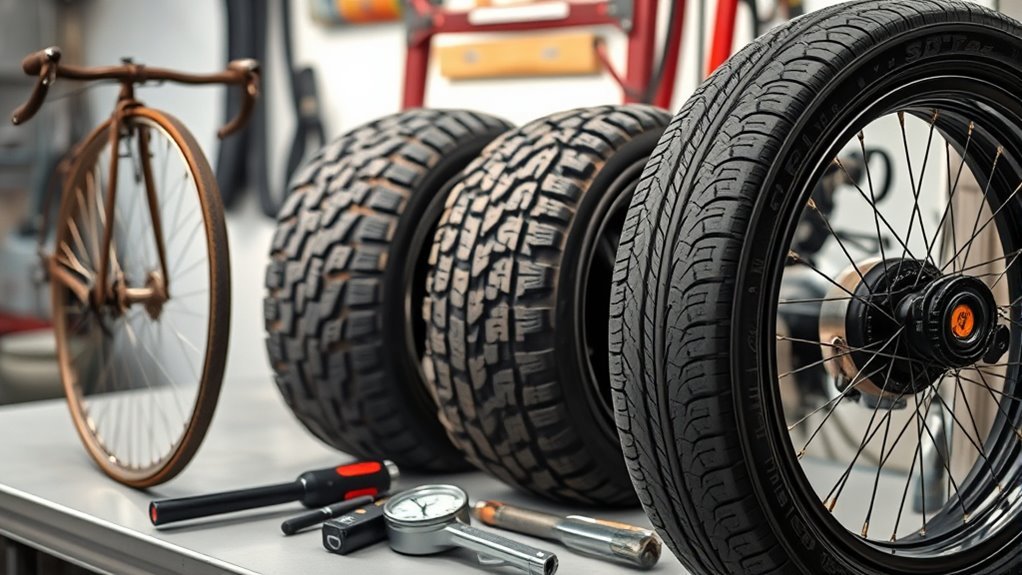
The move toward low rolling resistance, run-flats, and sensor-rich tires has shifted responsibility from manufacturers to drivers: you now get more options and data, and that makes choosing and caring for tires a more active part of ownership. Start by defining your needs: assess climate, driving style, and load to guide tire selection—choose winter tires for snow, performance for spirited driving, or all-season for mixed conditions. Next, schedule routine checks: verify tire pressure monthly using sensors or a gauge, inspect tread depth (replace at or before 2/32″), and note uneven wear that signals alignment or balance needs. Rotate tires every 5,000–8,000 miles to equalize wear and extend life. Prioritize low-rolling-resistance models if you want better fuel economy without sacrificing safety. Finally, use alignment and balancing services when handling feels off; they restore handling and prevent premature wear. These maintenance tips empower you to control safety, efficiency, and freedom on the road.
Sustainability and the Future: Bio‑Rubber and Airless Concepts
Because tire makers and researchers have started to confront rubber supply limits and lifecycle impacts, you’re seeing a rapid shift toward bio‑rubber and airless designs that promise cleaner, longer‑lasting wheels. You trace progress from early bio rubber innovation—dandelion and other feedstocks replacing plantation latex—to scaled trials where recycled fillers and bio‑based oils enter compound recipes, cutting embodied emissions and supporting circular economies. Parallel advances in airless technology move from prototypes to commercial applications, removing puncture risk and boosting service life.
- Material shift: initial biosource trials → pilot production → integration of recycled content and low‑rolling‑resistance formulations.
- Structural change: solid or cellular airless designs evolve, improving durability and ride while reducing maintenance.
- Smart integration: sensor systems that monitor tread and pressure trends extend life and inform reuse or recycling.
You’ll find these converging paths give you freer mobility with smaller environmental footprints, aligning technical progress with liberation-focused values.
Frequently Asked Questions
How Did Dunlop’s Invention Impact Bicycle Racing Rules and Competitions?
Dunlop’s invention transformed racing regulations quickly: you’ll see Dunlop legacy codified into rules prioritizing tire performance, reshaping competition dynamics chronologically, empowering riders’ freedom to pursue speed while organizers adapted safety and fairness standards.
Were There Any Patent Disputes Between Dunlop, Michelin, or Goodyear Early On?
Bold beginnings: you’ll see Dunlop patent disputes sparked, then Michelin rivalry emerged, Goodyear claims followed; you’ll trace chronologically detailed court contests, contextualizing tire innovations, revealing shifting rights, remedies, and liberating lessons for innovators.
How Did Tire Manufacturing Influence Urban Planning and Road Surfaces?
You’ll reshape urban mobility: pneumatic tires drove infrastructure development, prompting smoother pavements, wider boulevards, drainage systems, and transit corridors; cities sequentially adapted roads, zoning, and public transport to liberate movement and expand economic access.
What Were Early Safety Testing Standards for Pneumatic Tires?
Better safe than sorry: you’ll first see rudimentary burst and wear tests in the 1890s, then systematic tire durability trials, serial inspections, and emerging safety regulations in the 1920s–30s, freeing drivers through clearer standards.
How Did Tire Innovations Affect Military Vehicle Design and Tactics?
You’ll see military mobility expand as tire innovations chronologically enhanced speed, range, and off‑road resilience, giving tactical advantages like rapid maneuver, stealthier patrols, supply flexibility, and liberated forces adapting doctrine to new vehicle capabilities.
Conclusion
You’ve traced tires from Dunlop’s 1888 breakthrough through Michelin’s auto leap, wartime materials, the 1948 radial turn, 1970s recalls and the radial shift, tubeless and steel-belt mass methods, then low‑rolling resistance, run‑flats and sensors, and today’s bio‑rubber and airless ideas. Like “don’t throw the baby out with the bathwater,” you’ll balance proven tech with new materials; keep maintenance, correct choice, and context-aware adoption front and center as the industry evolves.
Related Articles
10 Tires That Will Transform Your 2017 Toyota RAV4
You rely on your RAV4 for commuting, errands, and weekend adventures, so the right tires change more than grip — they improve safety, fuel…
Read More
10 Tires That Will Transform Your 2016 Toyota RAV4
You rely on your RAV4 for daily driving, trips and errands, so the right tires make a dramatic difference in safety, comfort and fuel…
Read More
10 Tires to Boost Your 2015 Toyota RAV4’s Performance This Year
You rely on your 2015 Toyota RAV4 for daily driving, road trips and unpredictable weather, so the tires you choose will change how it…
Read More